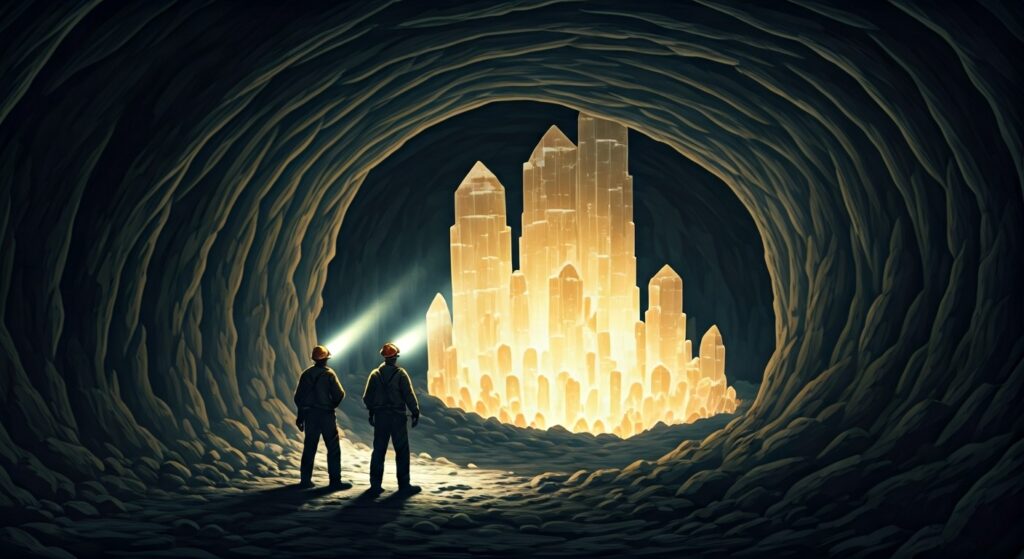
Deep underground, enveloped in suffocating darkness and the deafening roar of heavy machinery, brothers Juan and Pedro Sanchez were just trying to survive another grueling shift. The year was 2000. As miners for the Industrias Peñoles company, their task was to excavate a new tunnel 300 meters (980 feet) beneath the surface of Chihuahua, Mexico, in the Naica Mine.
Suddenly, their drill broke through the solid limestone wall into an open void.
When they shined their headlamps into the newly formed breach, the beams of light didn’t just hit rock. They bounced, refracted, and scattered across a subterranean cathedral of impossible, gleaming pillars. The brothers had just accidentally discovered what would soon be known as the Cueva de los Cristales—the Cave of the Crystals.
A Subterranean Fortress of Solitude
What the Sanchez brothers stumbled upon looked like a hallucination ripped straight from a science fiction novel. Piercing the cavern from every conceivable angle were some of the largest natural crystals ever found on Earth.
These massive, pale-gold beams are made of selenite, a crystalline form of the mineral gypsum. The largest documented crystal in the cavern measures a staggering 11.4 meters (37.4 feet) in length. To put that in perspective, imagine a solid, translucent gemstone the size of a yellow school bus, weighing in at an earth-crushing 55 tons.
But as breathtaking as this glittering underworld is, it hides a terrifying secret: it actively wants you dead.
Ten Minutes to Midnight
At first glance, the pale, icy-looking crystals might give the illusion of a freezing environment. The reality is a suffocating nightmare.
The cavern sits directly above a colossal underground magma chamber. Because of this bubbling cauldron deep in the earth, temperatures inside the cavern routinely reach 58 degrees Celsius (136 degrees Fahrenheit). Worse yet, the humidity violently fluctuates between 90 and 99 percent.
In this hyper-humid, boiling environment, human sweat simply cannot evaporate. The body loses its only natural mechanism to cool itself down. Without specialized cooling suits padded with ice packs and respirators pumping refrigerated air, a human can only survive inside the Cave of the Crystals for about ten minutes. Any longer, and the body rapidly succumbs to severe heatstroke and total organ failure.
A Half-Million-Year Recipe
How did these deadly, beautiful leviathans grow to such monstrous proportions? It turns out, nature is an incredibly patient architect.
Roughly 26 million years ago, a surge of magma pushed upward, creating a mountain of limestone and filling its deep caverns with scalding, mineral-rich water. For the last 500,000 years, the water temperature in the cave remained remarkably stable at exactly 58 degrees Celsius.
This wasn’t just a random number; it was a geological magic trick. Fifty-eight degrees Celsius is the precise threshold where the mineral anhydrite dissolves into water, while gypsum simultaneously crystallizes out of it. Because the cave was completely submerged and the temperature never wavered, the selenite crystals were able to feed and grow continuously at a microscopic, agonizingly slow pace for half a million years.
Awakening the Ancients
The sheer scale of the crystals wasn’t the only thing that shocked the scientific community. The cave also turned out to be a goldmine for astrobiologists hunting for alien life.
In 2017, a NASA team led by Dr. Penelope Boston extracted dormant microbes trapped within fluid inclusions deep inside the giant crystals. These extremophiles had been sealed inside tiny pockets of water for an estimated 10,000 to 50,000 years.
Against all odds, Dr. Boston’s team successfully revived these ancient organisms in a laboratory. The fact that life could endure for millennia in such an extreme, toxic environment has radically shifted how scientists believe life might survive on other harsh, unforgiving planets across the universe.
Swallowed by the Earth Once More
If you are hoping to add the Cave of the Crystals to your travel bucket list, the window of opportunity has permanently closed.
For years, the only reason humans could access the cavern was because the mining company ran massive industrial pumps, draining millions of gallons of water away daily to reach nearby silver, zinc, and lead deposits. But around 2015, the mining operations ceased. The great pumps were finally silenced.
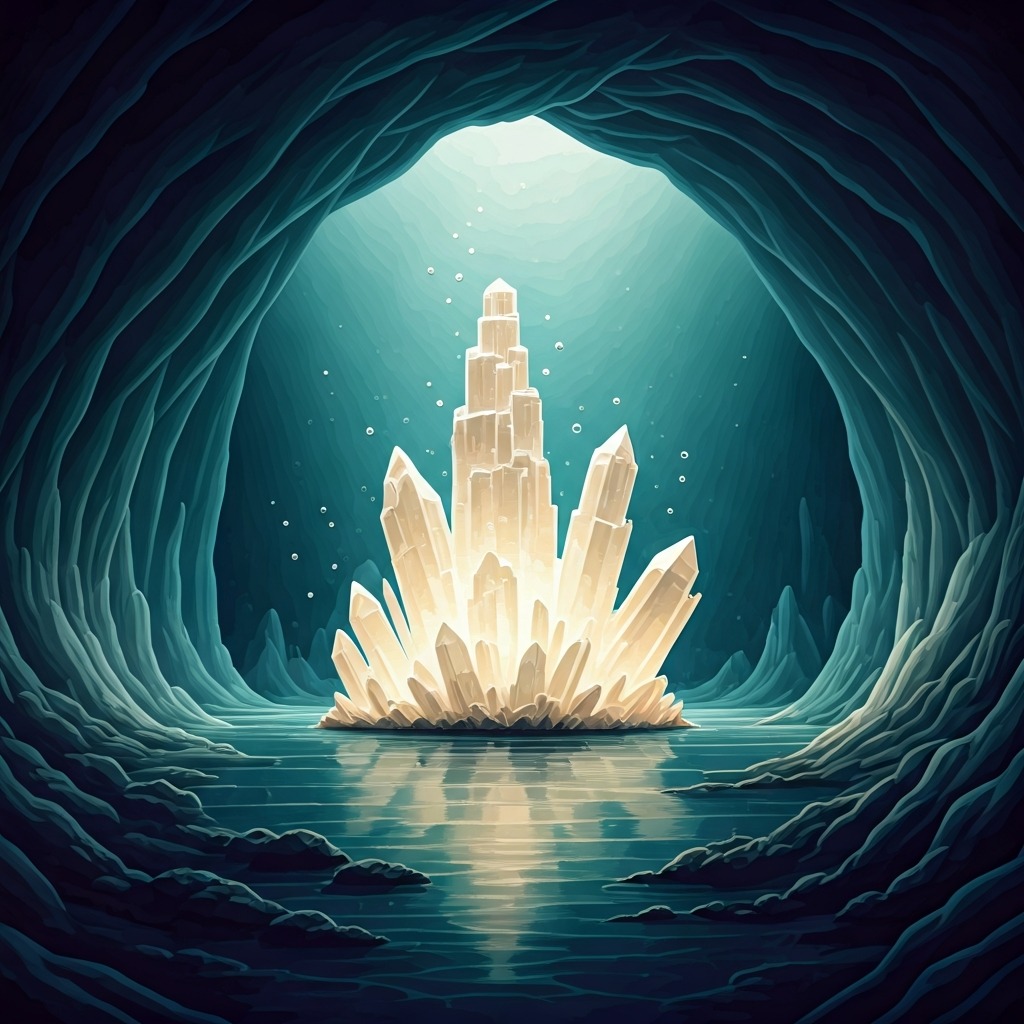
Slowly but surely, the mineral-rich waters rose back up from the depths. Today, the Cave of the Crystals is completely reflooded, swallowed once again by the earth. While it means we can no longer walk among these glittering giants, it is the ultimate happy ending for the cavern. Protected from human interference and atmospheric degradation, the crystals are back in their natural element, quietly resuming their impossibly slow growth in the boiling dark.