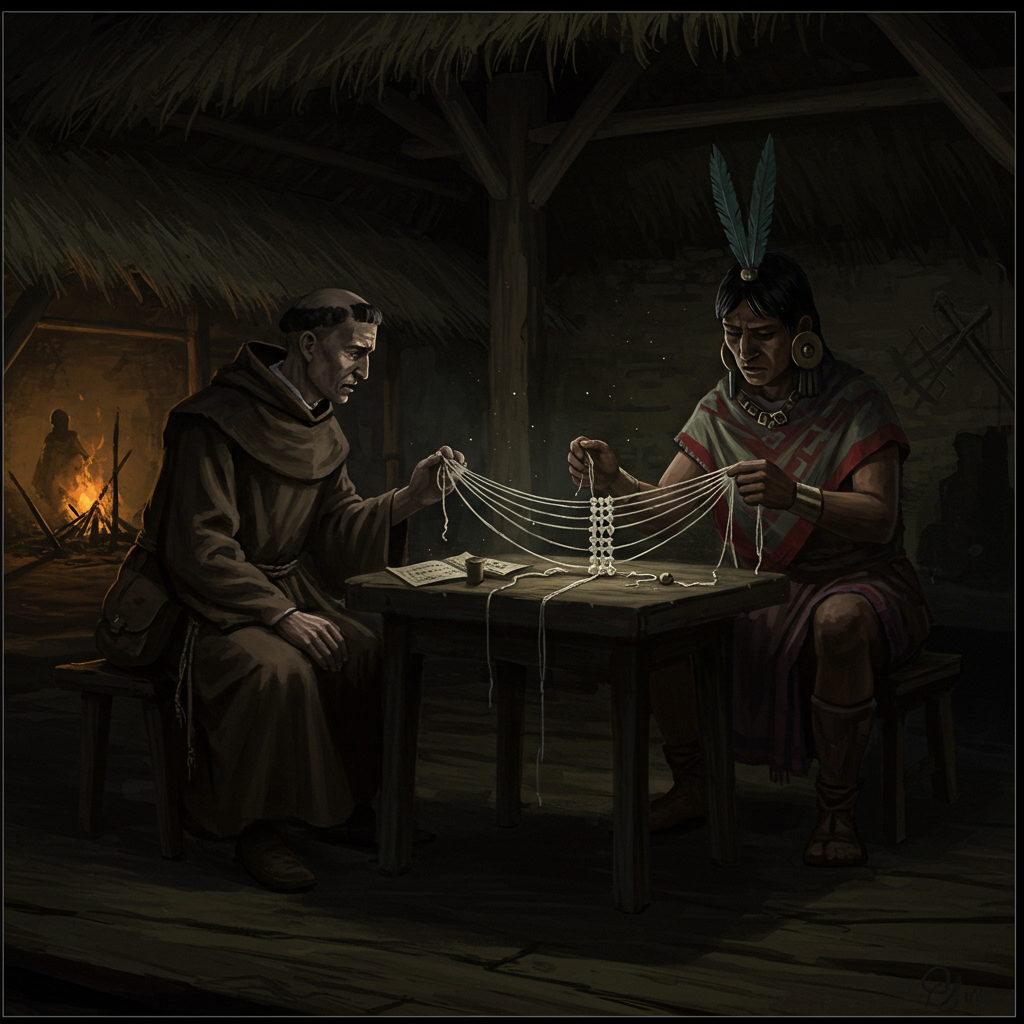
An empire of 10 million souls, stretching 2,500 miles across the jagged spine of the Andes. A civilization that engineered cities in the clouds, managed continent-spanning agriculture, and ran a complex bureaucracy. The Inca did all of this. And they did it without writing a single word.
For centuries, this paradox has haunted historians. How could a society of such staggering complexity function without a written language? How do you record laws, track tribute, or pass down royal histories without ink and paper? The answer, it turns out, was hiding in plain sight, in a tangle of knotted cords the Spanish conquistadors dismissed as mere decoration. They called it the quipu. But as we are now discovering, this was no simple accounting tool. It was a three-dimensional language, a tactile code that may have been one of history’s first computers.
The Code Everyone Thought They Cracked
At first glance, a quipu looks like a colorful, fibrous mop. A primary cord serves as a backbone, with dozens, sometimes hundreds, of pendant strings dangling from it. For decades, scholars believed they understood its purpose. In 1923, historian L. Leland Locke deciphered its mathematical genius: the knots were a base-10 positional system, an ancient spreadsheet woven from cotton and alpaca hair. A figure-eight knot meant “one,” a long knot with four turns meant “four,” and the absence of a knot meant “zero.” With this system, Inca accountants could track census data and tax records for an entire province on a device they could roll up and carry in a satchel.
The case seemed closed. But a stubborn mystery remained. In museum archives across the world, roughly 20 percent of the surviving quipus refused to conform. The knots made no mathematical sense. The colors and spacing seemed random. These were the outliers, the anomalies, and for nearly a century, they held their silence, guarding a far deeper secret.
A Secret Language Woven in 3D
The breakthrough came from a radical idea proposed by anthropologist Gary Urton. What if we were reading the quipus all wrong? He argued that the “anomalous” cords weren’t accounting tools at all—they were narrative devices, used to record histories, myths, and genealogies. But how do you write a story with knots?
Urton’s theory was mind-bending: the quipu was a 7-bit binary code. He realized that at every step of its creation, the Inca knot-maker, the quipucamayoc, made a series of binary choices. Was the fiber cotton or wool? Was the string spun clockwise (S-twist) or counter-clockwise (Z-twist)? Was it attached to the main cord from the front or the back? Combined with a palette of 24 distinct colors, these choices created 1,536 unique character possibilities—almost the exact number of symbols in Sumerian cuneiform and Egyptian hieroglyphs. The Inca weren’t just counting. They were programming information in three dimensions, using a system eerily similar to the ASCII code that powers the device you’re reading this on right now.
The Whispers of a Rebellion
Urton’s theory was brilliant, but it was still a theory. The key—a potential Rosetta Stone for this knotted language—was found not in an imperial archive, but in the remote Andean village of San Juan de Collata. In 2015, anthropologist Sabine Hyland was shown two 18th-century quipus that had been carefully preserved by the community. They weren’t imperial records. They were letters—secret messages exchanged between local leaders planning a revolt against their Spanish oppressors.
Hyland’s analysis was electrifying. These quipus used a phonetic system. The type of animal fiber—alpaca, llama, deer, vicuña—mattered. The color and ply direction of the string corresponded to different syllables. She identified 95 distinct symbols, a number consistent with a logosyllabic writing system. The Incas had literally woven their spoken language into the cords. The whispers of rebellion were encoded in the very texture of the strings.
An Empire Erased by Fire
The quipucamayocs who created these masterpieces were the elite intellectuals of the Inca world. Their memories were vast, their skills revered, but their jobs were perilous. A single mistake in a tribute record could mean death. Once complete, their knotted messages were handed to the chasquis, elite relay runners who sprinted across the empire’s high-altitude road network, covering up to 150 miles a day.
When the Spanish conquistadors arrived, they were initially baffled but intrigued by the quipus, even relying on them to calculate the tribute they could extract. But fascination curdled into fear. As they began to understand that these cords held not just numbers, but the histories, genealogies, and religious beliefs of the Inca people, they saw the quipus for what they were: a symbol of cultural identity and a threat to colonial rule.
In 1583, the Third Council of Lima declared the quipus to be idolatrous works of the devil. The order was given for their destruction. Across the Andes, bonfires were lit, and centuries of Inca literature, poetry, and history turned to ash.
The Unread Voices
Today, only about 1,000 quipus are known to survive, scattered in museums and collections around the globe. The cryptographic puzzle is immense, the loss incalculable. Some scholars still cling to the idea that they were merely memory aids, their meaning lost forever with the minds that made them.
But a new generation of researchers, armed with digital databases and a willingness to challenge the definition of “writing,” believes otherwise. They see the quipu not as a primitive tool, but as a brilliant, alternative path to literacy, one that valued texture and color as much as shape. The surviving quipus hang silently in the dark, the lost library of an empire. Their knotted voices are waiting, patiently, for us to finally learn how to read them.