Deep in the rugged central plateau of Mali, a mystery was born that would pit ancient alien theorists against world-renowned astrophysicists. It involved an isolated West African tribe, a completely invisible star, and a cosmic secret that defied all logical explanation.
A Secret Hidden in the Dark
For centuries, the Dogon people have been celebrated for their complex art, rich culture, and dynamic oral traditions. But in the mid-20th century, they became the center of an astronomical paradox: they seemingly possessed impossible knowledge of the cosmos.
The mystery centers on the brightest star in our night sky, Sirius. Modern astronomy tells us that Sirius isn’t just one solitary star; it is a binary system. It is accompanied by a tiny, incredibly dense white dwarf known as Sirius B. The catch? Sirius B is completely invisible to the naked eye. It wasn’t visually confirmed by modern astronomers until 1862, using a massive telescope.
Yet, the Dogon allegedly knew all about it long before the lens was ever ground.
The Blind Priest and the Heavy Metal Star
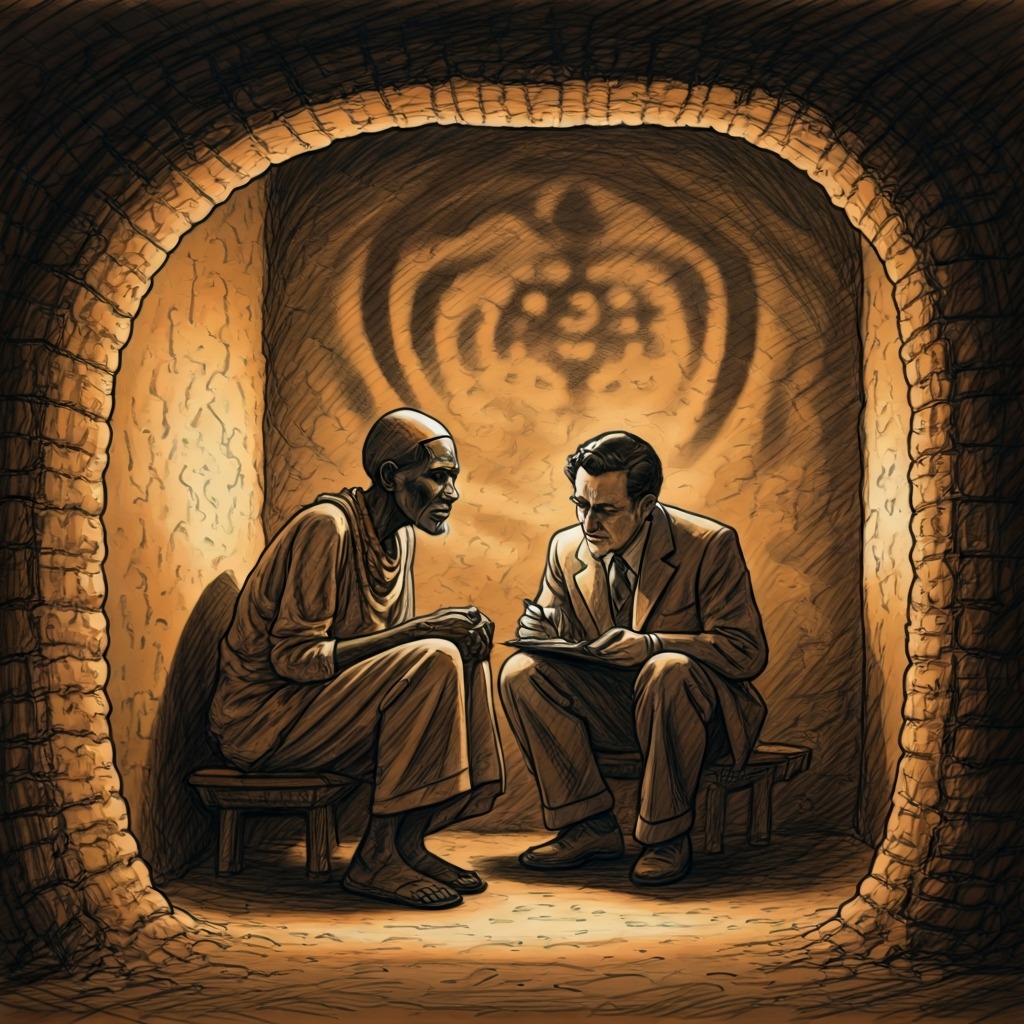
The world learned of this impossible knowledge through French anthropologists Marcel Griaule and Germaine Dieterlen. In 1946, after years of living among the Dogon, Griaule sat down for a series of intense interviews with a blind elder and priest named Ogotemmêli.
What the priest revealed was a jaw-dropping cosmology. The Dogon didn’t just revere the main star, Sirius A; they supposedly worshipped its hidden companion, which they called po tolo.
The details were chillingly accurate. Ogotemmêli reportedly described po tolo as the smallest and heaviest of all celestial bodies, forged from a super-dense metal called sagala. He claimed it completed a perfect elliptical orbit around Sirius A every fifty years. They even described a third star in the system.
How could a society without telescopes know the exact orbital period and mass of an invisible white dwarf?
Enter the Ancient Astronauts
For decades, this mind-bending anomaly collected dust in academic journals. Then, in 1976, author Robert Temple ignited a pop-culture frenzy with his wildly popular book, The Sirius Mystery.
Temple looked at the Dogon’s inexplicable astrophysics and concluded there was only one logical explanation: extraterrestrial intervention. He linked Dogon mythological figures—the “Nommo,” described as amphibious beings who descended from the sky in a great ark—to ancient astronauts. According to Temple, these interstellar travelers journeyed from the Sirius system thousands of years ago, landed in West Africa, and gifted advanced cosmic knowledge to the ancestors of the Dogon.
A Cosmic Case of Broken Telephone
While the public devoured the alien theory, the scientific community pushed back. In 1979, legendary astrophysicist Carl Sagan entered the fray. In his book Broca’s Brain, Sagan pointed out a glaring flaw in the timeline.
While Sirius B was discovered in 1862, its mind-boggling density as a white dwarf wasn’t established until the 1920s. Griaule didn’t record the Dogon’s “ancient” knowledge until 1946.
Sagan proposed a far more grounded theory: cultural contamination. Between the 1920s and 1946, the Dogon were not entirely isolated. They had interacted with French colonial soldiers, missionaries, and European schools. Sagan argued it was highly probable that a Western traveler, looking up at the brightest star in the sky, shared the newly discovered scientific facts about Sirius with the locals. The Dogon, possessing a highly fluid and assimilative oral tradition, simply wove this fascinating new information into their existing mythology. No aliens required.
The Anthropological Mic Drop
The final, devastating plot twist didn’t come from the stars, but from the dirt of Mali itself.
In 1991, Dutch anthropologist Walter van Beek, who had spent over a decade studying the Dogon, published a comprehensive critique. He traveled through the region, interviewing the general population and their religious leaders, searching for the ancient myth of po tolo.
He found absolutely nothing.
Nobody had any idea what he was talking about. The Dogon had no knowledge of a hidden companion to Sirius, nor did they recognize a 50-year orbit.
Van Beek concluded that the entire “Sirius mystery” was an academic illusion, born from Marcel Griaule’s highly leading, interrogative interview style. Griaule was a passionate astronomy enthusiast. During his intense, isolated conversations with the blind elder, he likely introduced the concepts himself. The complex mythology wasn’t an ancient Dogon tradition; it was a co-created story, a tragic miscommunication between a French academic projecting his own fascinations and a local priest trying to oblige him.
Today, the Dogon Sirius mystery stands not as proof of ancient aliens, but as a profound cautionary tale. It reminds us that history is not just about what is observed, but who is looking through the lens—and how easily the storyteller can accidentally write themselves into the script.