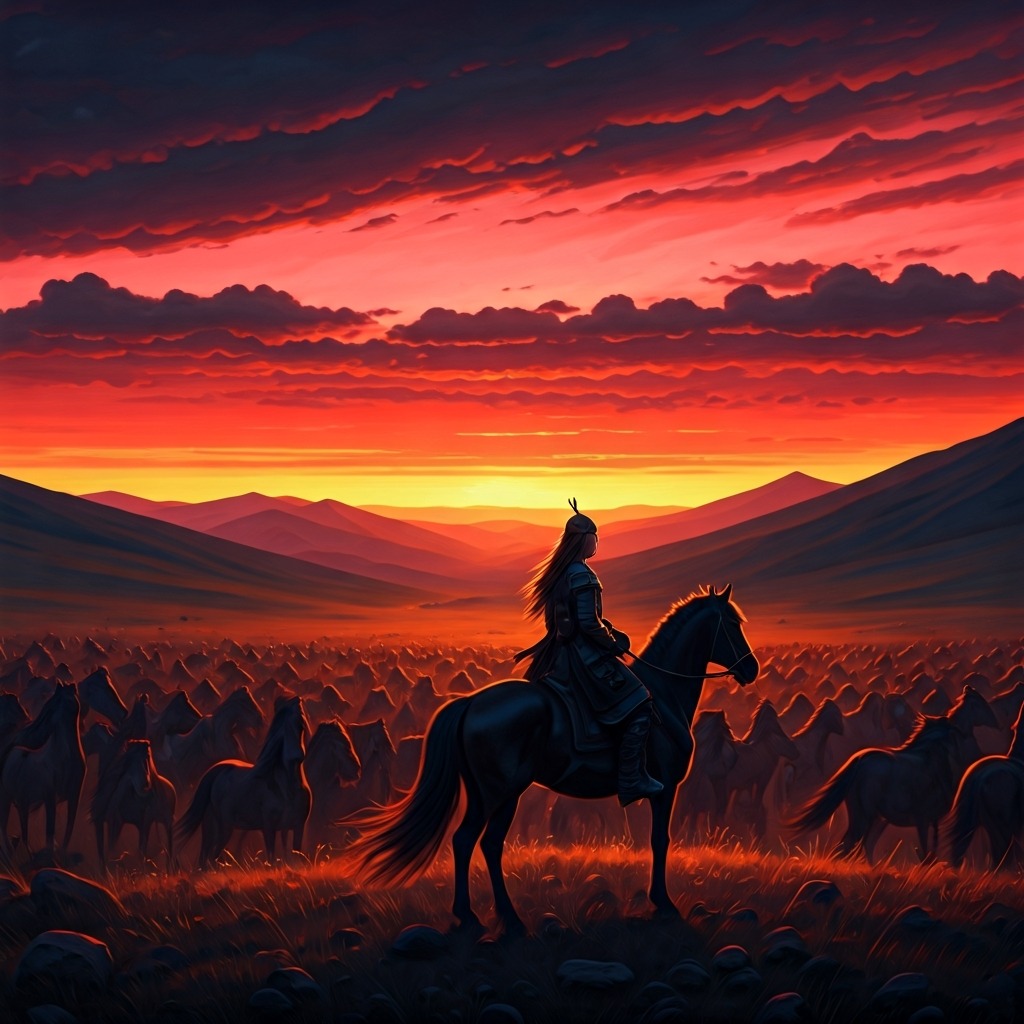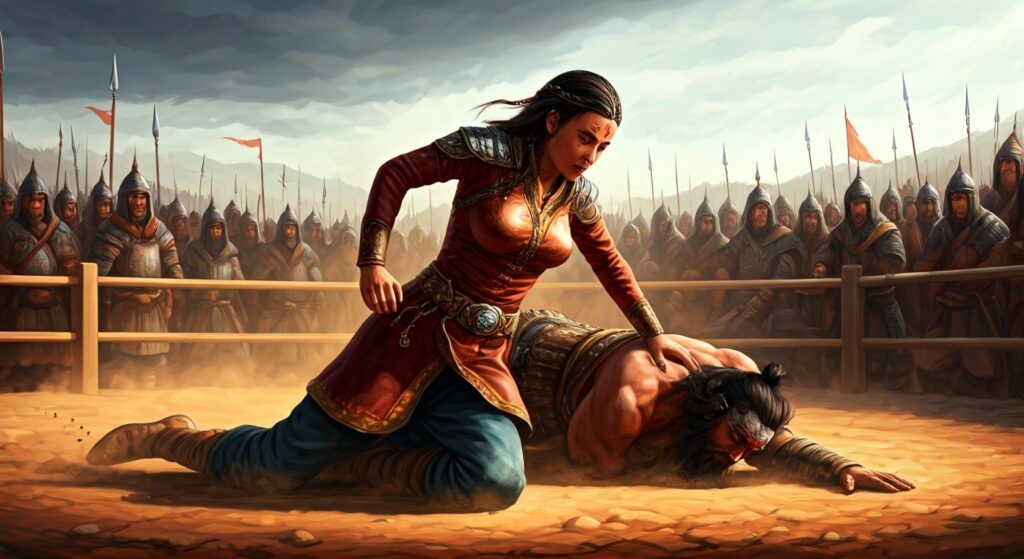
Imagine standing in the center of a dusty ring on the Asian steppe, the deafening roar of a Mongol horde in your ears. You are a warlord, a champion of your people. Across from you stands a woman. If you pin her, you win a royal bride and an alliance with the most dangerous faction in the Mongol Empire. If you lose, you forfeit your pride and a herd of your finest horses.
You charge. Seconds later, you are eating dirt.
You have just become another footnote in the legend of Khutulun, the 13th-century Mongol princess who literally body-slammed her way into history.
Blood of the Conqueror
Born around 1260, Khutulun was not a woman to be traded in the quiet corners of diplomatic tents. She was the great-great-granddaughter of Genghis Khan. Her father, Kaidu, was the fiercely independent ruler of the Chagatai Khanate, a man locked in a bitter, high-stakes rebellion against his own cousin, Kublai Khan.
Growing up in the nomadic heart of the Mongol Empire, Khutulun was raised alongside fourteen brothers. She didn’t just keep up with them; she eclipsed them. She mastered the essential Mongol arts: elite horsemanship, pinpoint archery, and most importantly, Bökh—traditional Mongolian wrestling. In a culture that valued physical dominance and tactical brilliance above all else, Khutulun quickly became her father’s ultimate weapon.
The 10,000-Horse Wager
As Khutulun came of age, political pressure to marry mounted. But she refused to be a pawn. Instead, she laid down a decree that sent shockwaves across the steppes: she would only marry a man who could defeat her in a wrestling match. The catch? Any suitor who stepped into the ring and lost had to forfeit a wager of horses.
Princes, warlords, and elite fighters traveled from across the known world, confident they could best the khan’s daughter. One by one, they stepped up. One by one, she drove them into the dirt. According to historical accounts, Khutulun remained completely undefeated. By the time the dust settled on her wrestling career, she had amassed a personal herd of 10,000 horses from thousands of humiliated suitors—a literal cavalry’s worth of wealth acquired simply by being an untouchable champion.
The Hawk and the Chicken
Khutulun’s dominance was not confined to the wrestling ring. When she rode into actual combat, she was a terrifying phantom.
Contemporary accounts by the Persian historian Rashid al-Din and the Venetian traveler Marco Polo paint a picture of a warrior who shattered enemy morale. Marco Polo famously wrote that Khutulun was so physically powerful and skilled that she would ride deep into enemy lines, snatch a captive out of the chaos, and drag them back to her father’s camp as effortlessly as a hawk swooping down on a chicken.
She wasn’t just a vanguard shock troop. Khutulun possessed a brilliant tactical mind and became Kaidu’s most trusted military advisor. When the war councils convened, it was the undefeated princess who had the khan’s ear.
Whispers and a Shadowy Exit
When you are that powerful and that close to the throne, enemies—both foreign and domestic—start sharpening their knives. When Khutulun remained unmarried for years, malicious rumors began to spread through the camps, suggesting an incestuous relationship with her father.
To protect Kaidu’s political standing and silence the whispers, Khutulun finally made a sacrifice. She chose to marry a loyal warrior named Abtakul. But she did it on her own terms: she married him without forcing him to wrestle her, ensuring her undefeated record remained permanently intact.
By 1301, Kaidu was dying. Recognizing that his daughter was the sharpest strategic mind and the fiercest warrior in his camp, he attempted the unthinkable: he named Khutulun as his successor to rule the khanate.
But her fourteen brothers, who had spent their lives being overshadowed by their sister, fiercely opposed a female ruler. The resulting political fracture forced a compromise, stripping Khutulun of the absolute power her father intended for her.
Then, the trail goes cold in a highly suspicious way. In 1306, just a few years after her father’s death, Khutulun died under mysterious circumstances. Was she assassinated by political rivals? Poisoned by her own brothers? The steppes kept her final secret, leaving historians to piece together the shadows of her downfall.
The Ghost in the Ring
Though her life was cut short, Khutulun’s ghost still haunts Mongolian culture.
If you watch traditional Mongolian wrestling today, you’ll notice the athletes wear a very specific jacket called a zodog. It features an entirely open chest. According to widespread legend, this unique design was introduced for one specific reason: to ensure that no woman could ever secretly enter a tournament and dominate the men of the steppe the way Khutulun once did.
Even Western culture couldn’t escape her shadow. Her legend traveled along the Silk Road, eventually inspiring the character of Turandot in Francois de la Croix’s 1710 fable collection, which later evolved into Giacomo Puccini’s world-famous opera Turandot. Yet, the European writers swapped her physical wrestling dominance for a deadly battle of riddles.
They changed the game, likely because they couldn’t fathom a princess who didn’t need a riddle to break a man. She just needed her bare hands.