
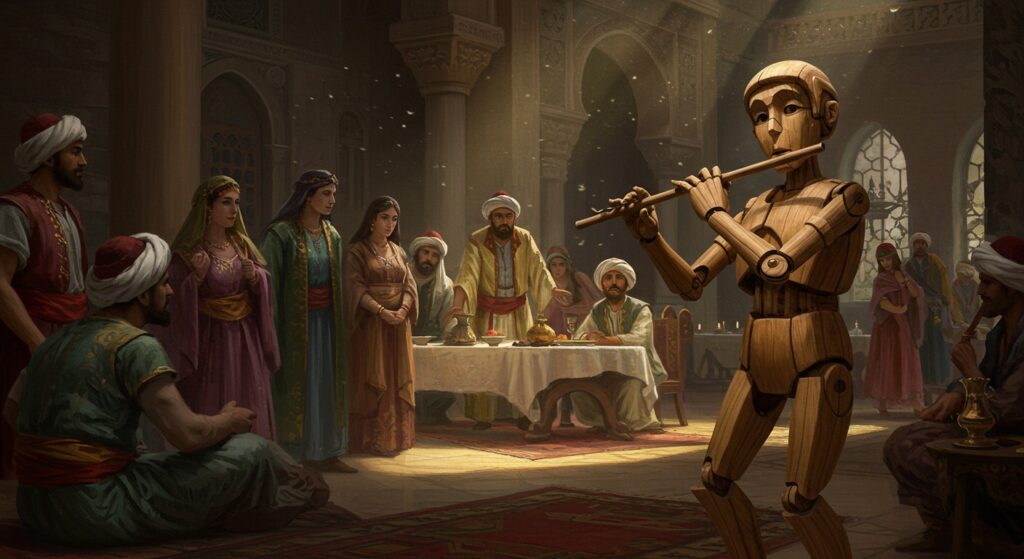
The year is 850 CE. A hush descends upon the gilded banquet hall of the Caliph in Baghdad, the dazzling heart of the Islamic Golden Age. In the center of the room, a life-sized wooden figure sits motionless, a flute pressed to its lips. No human hand guides it. No breath escapes its carved mouth. Then, it begins to play.
A perfect, haunting melody fills the opulent space. Courtiers gasp, their whispers turning to fearful murmurs of dark magic, of a captured djinn trapped within the wood. But this is no illusion. What they are witnessing is not sorcery, but the birth of an idea that would change the world. They are listening to the first programmable machine in history.
The Highwayman’s Heirs
The minds behind this marvel were not sorcerers, but three orphaned brothers with a past as incredible as their creation. Known as the Banu Musa—the Sons of Musa—their father was a reformed highwayman who had traded a life of crime for the study of the stars, eventually becoming a companion to the Caliph himself. When he died, the Caliph took the three young boys, Muhammad, Ahmad, and Al-Hasan, under his protection.
They were given an unparalleled education at Baghdad’s legendary House of Wisdom, where their talents ignited. The brothers formed a perfect intellectual triad: Muhammad was a master of geometry, Al-Hasan possessed an intuitive genius for the same, and Ahmad was the visionary engineer who could transform their abstract mathematics into breathtaking physical reality.
The Secret of the Breathless Melody
In their groundbreaking Book of Ingenious Devices, the brothers detailed the blueprints for nearly one hundred mechanical wonders. But the automatic flute player was their masterpiece. For centuries, historians assumed it must have been powered by steam, a technology the ancient Greeks had toyed with. The truth was far more elegant.
The automaton’s lifeblood was water. A hidden tank fed a steady flow into a chamber, displacing air and creating a constant, pressurized stream—a mechanical ‘breath’—that was forced through the flute. This same flow of water turned a concealed wheel, powering the machine’s intricate movements. But a steady stream of air creates only a single, droning note. How did this wooden musician command a full symphony of sound? The answer lay hidden deep within its core, a secret that would echo for a thousand years.
A Code Written in Wood and Brass
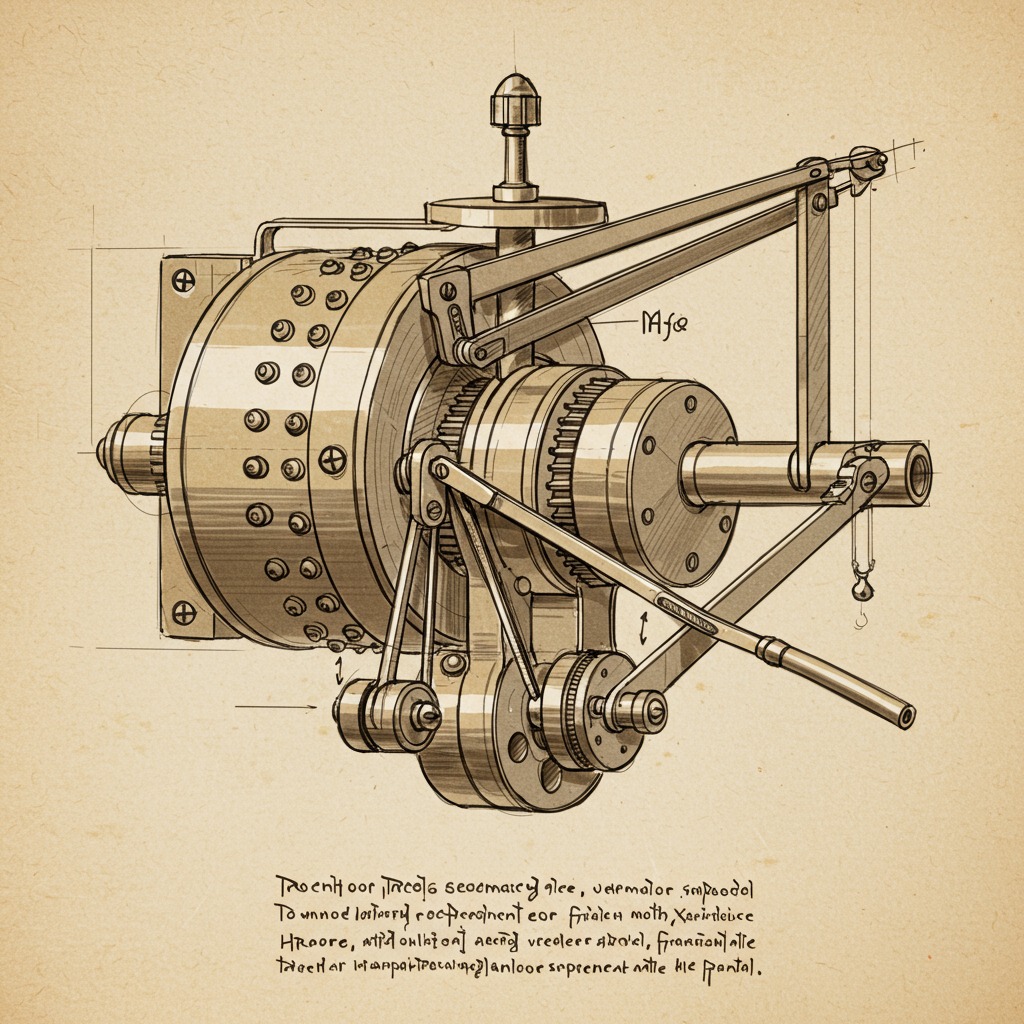
This is where the Banu Musa’s device makes the leap from a clever toy to a paradigm-shifting invention. The waterwheel didn’t just provide power; it slowly rotated a large metal cylinder covered in a pattern of small pegs. As this drum turned, the pegs engaged a series of levers connected to the flute’s finger holes. Peg strikes lever, lever lifts finger, hole is uncovered. A different peg, a different note.
This cylinder was the world’s first hard drive. The arrangement of pegs was its software.
If the Caliph desired a new song, Ahmad didn’t need to build a new machine. He simply had to swap out the cylinder for one with a different pattern of pegs. He was, in the most literal sense, reprogramming the automaton. The brothers had not just built a machine; they had invented a way to give a machine memory and instructions.
The Ghost in Your Machine
It’s easy to dismiss this as an opulent curiosity, but the core concept—a rotating drum storing instructions—was a seed of pure genius. It was passed down through generations of Islamic engineers, refined and perfected. Eventually, the idea crossed into Europe, inspiring the creation of programmable music boxes and barrel organs.
By the 19th century, the concept had evolved into the punched cards of the Jacquard Loom, which in turn directly inspired Charles Babbage and Ada Lovelace as they designed the Analytical Engine, the theoretical ancestor of all modern computers. Decades later, the first IBM mainframes would process data using that very same punch-card logic.
The digital world wasn’t born in a Silicon Valley garage. Its first notes were played over a millennium ago in a Baghdad palace—a ghostly melody from a water-powered flute that taught the world, for the very first time, how to write a code.
Dig Deeper
If the story of the first programmable machine sparked your curiosity, these resources will take you further down the fascinating rabbit hole of history and technology.
- Who were the Banu Musa brothers?
Learn more about the lives and diverse scientific contributions of Muhammad, Ahmad, and al-Hasan, from geometry to astronomy, in their detailed biography at the MacTutor History of Mathematics Archive. - What other inventions are in the Book of Ingenious Devices?
The automatic flute player was just one of nearly a hundred mechanisms described in their famous treatise. Explore more of their creations, including trick vessels, fountains, and a self-regulating lamp, at Muslim Heritage. - What was Baghdad’s House of Wisdom?
Discover the history of the legendary academy where the Banu Musa were educated. This Wikipedia article details its role as a major intellectual center during the Islamic Golden Age, where scholars from across the world gathered to translate and build upon global knowledge.