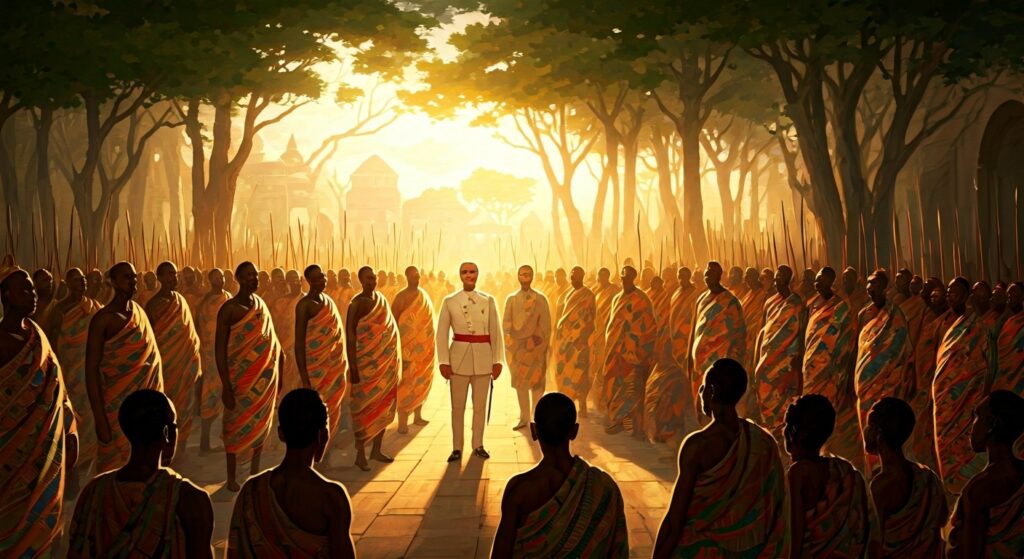
Imagine a foreign conqueror walking into your holiest sanctuary, demanding your most sacred, priceless relic, and casually asking to use it as a footstool. In the spring of 1900, that is exactly what happened in West Africa. The tension that followed didn’t just break diplomatic ties—it ignited a ferocious, bloody rebellion.
This is the story of the War of the Golden Stool.
The Soul from the Sky
By the late 19th century, the British Empire was relentlessly swallowing the mighty Ashanti Empire in present-day Ghana. Desperate to control the region’s lucrative trade routes, the British made a ruthless power play in 1896: they arrested the Asantehene (King) Prempeh I and banished him to the Seychelles.
With the king gone, the British assumed the Ashanti would crumble. They were dead wrong. They fundamentally misunderstood what held the empire together. It wasn’t a man on a throne. It was the throne itself.
Enter the Golden Stool, or Sika Dwa Kofi.
According to Ashanti cosmology, this was no mere piece of furniture. In the 17th century, the legendary priest Okomfo Anokye conjured the solid gold stool straight from the heavens, landing it gently on the knees of the first Asantehene. The Stool housed the sunsum—the literal soul, spirit, and essence of the Ashanti nation.
It was so profoundly sacred that it was never allowed to touch the bare earth; it was always placed on its own blanket. And crucially: no one, not even the king himself, was ever permitted to sit on it.
The Governor’s Fatal Arrogance
Fast forward to March 1900. Sir Frederick Hodgson, the British Governor of the Gold Coast, arrived in Kumasi and summoned a grand assembly of the remaining Ashanti leaders.
Dripping with colonial hubris, Hodgson looked at the gathered crowd and demanded the surrender of the Golden Stool. To him, it was merely a symbol of political power that now rightfully belonged to Queen Victoria. But he didn’t stop there. He demanded the Golden Stool be brought out so he could sit on it.
To the Ashanti, this was the ultimate sacrilege—a threat to erase their very soul. The crowd sat in stunned, horrified silence. They didn’t strike him down right then and there, but the moment the assembly ended, the whispers of rebellion began.
The Queen Mother’s Midnight Ultimatum
That night, the Ashanti chiefs convened a secret council. The atmosphere was suffocatingly grim. Their king was a prisoner across the ocean, the British possessed devastating firepower, and a full-scale rebellion felt like a suicide mission. The male chiefs hesitated. They debated surrendering.
And that is when Yaa Asantewaa, the Queen Mother of Ejisu, had heard enough.
Disgusted by the paralyzing fear in the room, she rose to her feet. In a society where military leadership was strictly male, she commanded the shadows and delivered one of the most legendary speeches in African history.
She looked the chiefs in the eye and challenged their courage. If the men of Ashanti would not step forward, she declared, then the women would.
“I shall call upon my fellow women,” she fiercely proclaimed. “We will fight the white men. We will fight till the last of us falls in the battlefields.”
Her fierce defiance shattered the cowardice in the room. In an unprecedented move, the chiefs chose Yaa Asantewaa to lead the Ashanti forces. The war was on.
The Phantom Relic and a Cultural Victory
Under Yaa Asantewaa’s brilliant, relentless command, the Ashanti forces didn’t just fight—they cornered the British Empire. They laid a brutal, suffocating siege to the British fort at Kumasi. Sir Frederick Hodgson and his officials were trapped, nearly starving to death before Hodgson barely managed a desperate escape through the dense jungle.
Eventually, the British were forced to pull heavily armed reinforcements from across their African colonies to break the siege. The war was bloody, and British military might ultimately overwhelmed the Ashanti. Yaa Asantewaa was captured and, like her king, exiled to the Seychelles, where she died in 1921.
But the story does not end in defeat.
While the British won the military conflict, the Ashanti secured the ultimate cultural victory. As the war raged, they took the Golden Stool and vanished it into the deep, impenetrable forest. The British scoured the land, turning over every rock, but they never found it.
Years later, when the Stool was accidentally uncovered by road laborers, the British—having learned a very hard, very bloody lesson about Ashanti resilience—agreed to leave it completely alone.
Today, Yaa Asantewaa remains an immortal icon of anti-colonial defiance. And the Golden Stool? It remains exactly where it belongs: the revered, untouchable soul of the Ashanti people.