Imagine an empire pushed to the brink of annihilation, its survival hinging not on a new weapon of iron or bronze, but on flesh, bone, and blood. Specifically, the blood-sweating horses of a distant, mythical kingdom.
When an ancient Chinese emperor was denied a trade for the most legendary mounts of the ancient world, he didn’t just accept the diplomatic slight. He launched a massive, apocalyptic desert war. It was a conflict where a golden statue sparked a massacre, a river was stolen to break a siege, and a quest for elite cavalry accidentally changed global economics forever.
Welcome to the War of the Heavenly Horses.
A Deadly Mismatch on the Steppe
To understand why a catastrophic war was fought over horses between 104 BC and 101 BC, you have to look at the grim reality of the Han Dynasty’s borders. Emperor Wu of Han was facing an existential crisis. His northern territories were being relentlessly ravaged by the Xiongnu confederation, a fierce, unstoppable alliance of nomadic warriors.
The Han Dynasty was fighting a slow, heavy war of attrition, while the Xiongnu were executing a relentless, lightning-fast offense. The secret to the nomads’ success? They rode incredibly durable, swift steppe ponies. The Han cavalry, by contrast, were mounted on shorter, slower, farm-bred horses that simply couldn’t keep pace. Emperor Wu was being outmaneuvered and out-slaughtered. He desperately needed a game-changer to save his empire.
Rumors of the Blood-Sweating Beasts
The turning point arrived via the scouting reports of an intrepid explorer named Zhang Qian. Deep in the Fergana Valley of modern-day Central Asia, Zhang discovered the Dayuan—an isolated Greco-Bactrian kingdom. And the Dayuan possessed a secret weapon: the Tianma, or “Heavenly Horses.”
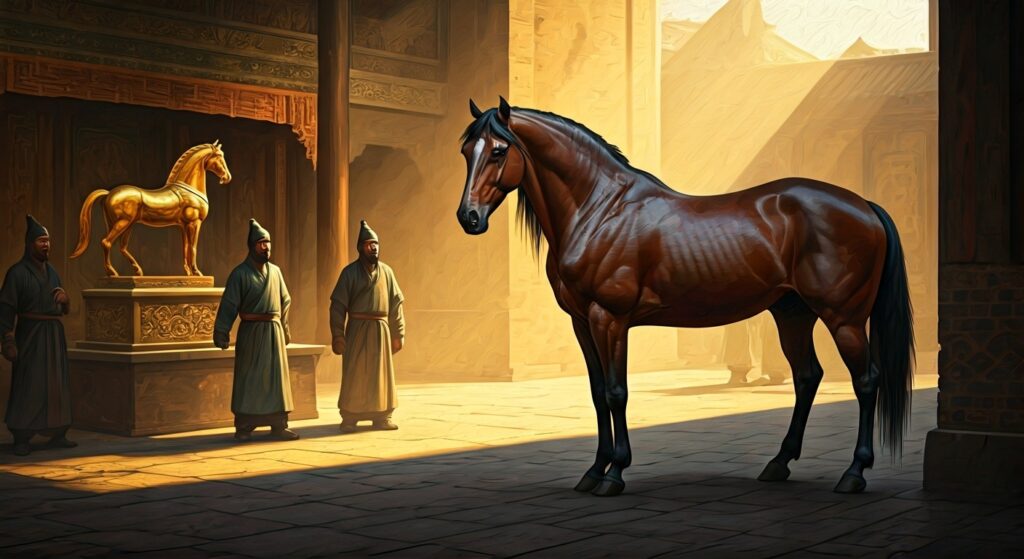
These beasts were the stuff of legends. They were taller, more muscular, and wildly faster than anything bred in China. But the most terrifying and mysterious detail? These horses were rumored to sweat actual blood. Modern historians and scientists suspect this gruesome phenomenon was either a poetic exaggeration of their reddish sweat under extreme stress, or the result of a subcutaneous parasite like Parafilaria multipapillosa, which causes bleeding skin nodules when the horse exerts itself.
Blood parasites or not, Emperor Wu needed them. He required these top-tier mounts for breeding to build a cavalry that could finally crush the Xiongnu. He dispatched a diplomatic mission loaded with a fortune in gold—including a spectacular, life-sized golden horse statue—to purchase the breeding stock.
The Dayuan king, feeling untouchable behind thousands of miles of brutal, unforgiving desert, laughed off the offer. He insulted the Han envoys, refused the trade, and—in a spectacularly arrogant blunder—had the ambassadors slaughtered on their journey home, seizing the golden treasure for himself.
A March of Skeletons
Emperor Wu was incandescent with rage. In 104 BC, he appointed his brother-in-law, General Li Guangli, to march an army to the Fergana Valley and take the horses by force.
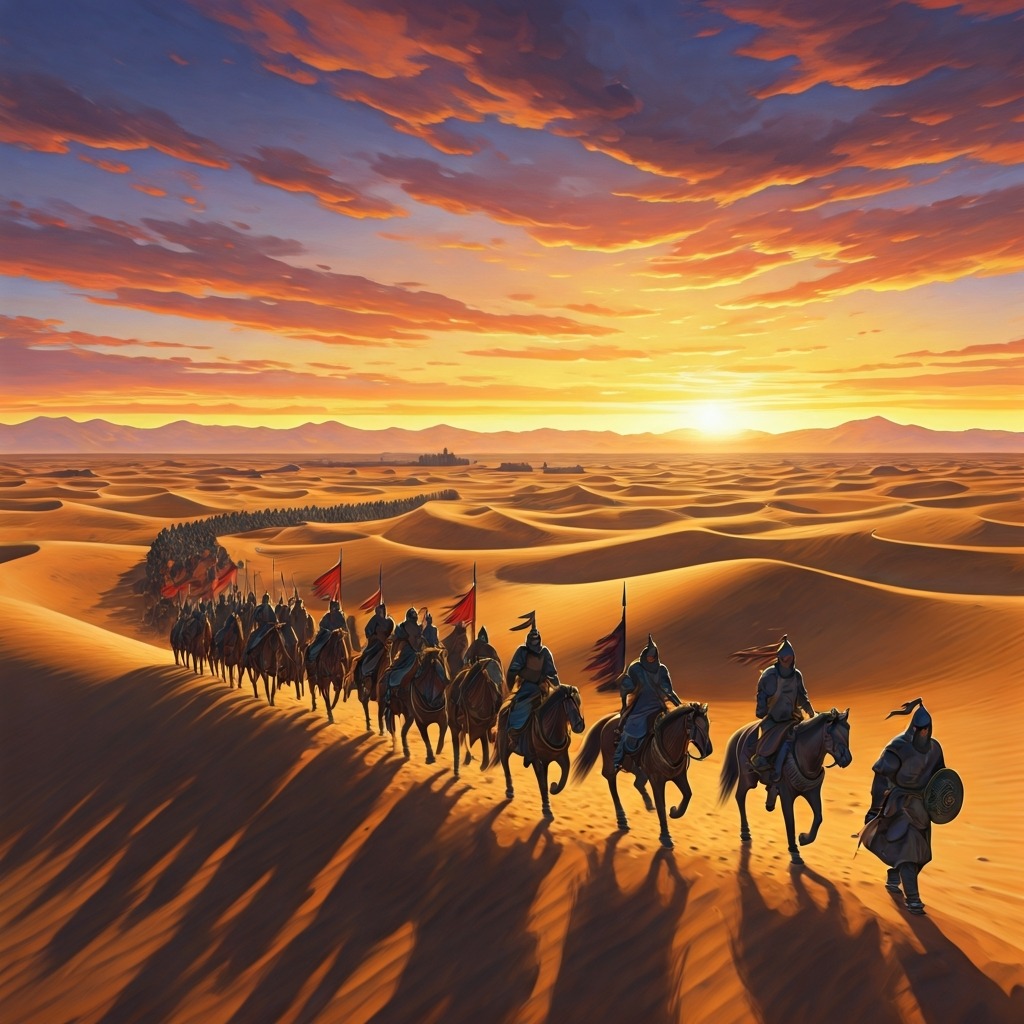
But the first campaign was a logistical nightmare of epic proportions. The army, largely composed of pardoned criminals, was sent into the unforgiving Taklamakan Desert with woefully inadequate supplies. It was a death sentence. Hostile oasis states locked their gates, refusing to sell the marching army food or water. Starvation, disease, and the brutal elements ravaged the ranks.
By the time Li Guangli reached the Dayuan borders, his army was a skeletal fraction of its former self. They were easily swatted away by the Dayuan defenders, forcing Li to make a humiliating, devastating retreat to Dunhuang.
The Dayuan king thought he had won. He believed the desert was an impenetrable shield. He was dead wrong.
The Juggernaut Awakens
Emperor Wu refused to accept defeat. If a small expedition couldn’t get the job done, he would marshal the entire economic and military might of the Han empire.
In 102 BC, Wu launched a second campaign, and this time, the logistics were flawless and terrifying. He gave Li Guangli over 60,000 troops, 30,000 horses, and a massive, rolling supply train of cattle and sheep that stretched across the horizon. This was a juggernaut designed to consume everything in its path.
The Han army marched into the Tarim Basin like an unstoppable force of nature. Any oasis state that refused to provide supplies was instantly crushed, its leaders executed, and its cities laid to waste. The Han forces took no prisoners and accepted no excuses, carving a bloody, highly organized path straight to the Dayuan capital of Ershi.
A Stolen River and a Severed Head
When the Han forces finally arrived, they didn’t just throw bodies at the heavily fortified walls of Ershi. General Li Guangli executed a brilliant, ruthless tactical masterstroke: his engineers diverted the river that supplied the city’s water.
Inside the walls, panic set in. The Dayuan were entirely cut off from the outside world, staring down a massive, well-fed army, and they were dying of thirst. Realizing their absolute destruction was imminent, the Dayuan nobles staged a desperate rebellion. They assassinated their arrogant king, severed his head, and sent it out to General Li Guangli along with a plea for peace.
The terms were simple: take the king’s head, spare our lives, and take your pick of the Heavenly Horses.
Li Guangli walked through the royal stables and drafted his ultimate cavalry. He selected several dozen of the absolute finest, top-tier breeding horses, and over 3,000 horses of middle and lower quality to march back to China.
The Unintended Empire
The Han-Dayuan War was an absolute triumph. By securing the Heavenly Horses, the Han Dynasty finally bred the elite cavalry they needed to turn the tide and vanquish the Xiongnu.
But the ripple effects of this war changed the world in ways Emperor Wu could never have imagined. By projecting such terrifying military might so deep into Central Asia, Wu forced the surrounding kingdoms into submission. He secured the Tarim Basin, pacified the treacherous desert routes, and accidentally laid the foundation for a safe, lucrative, transcontinental trade network.
Because of a stolen golden statue and a ruthless quest for blood-sweating horses, the Silk Road was born. Sometimes, the most transformative chapters of human history all come down to who has the best ride.