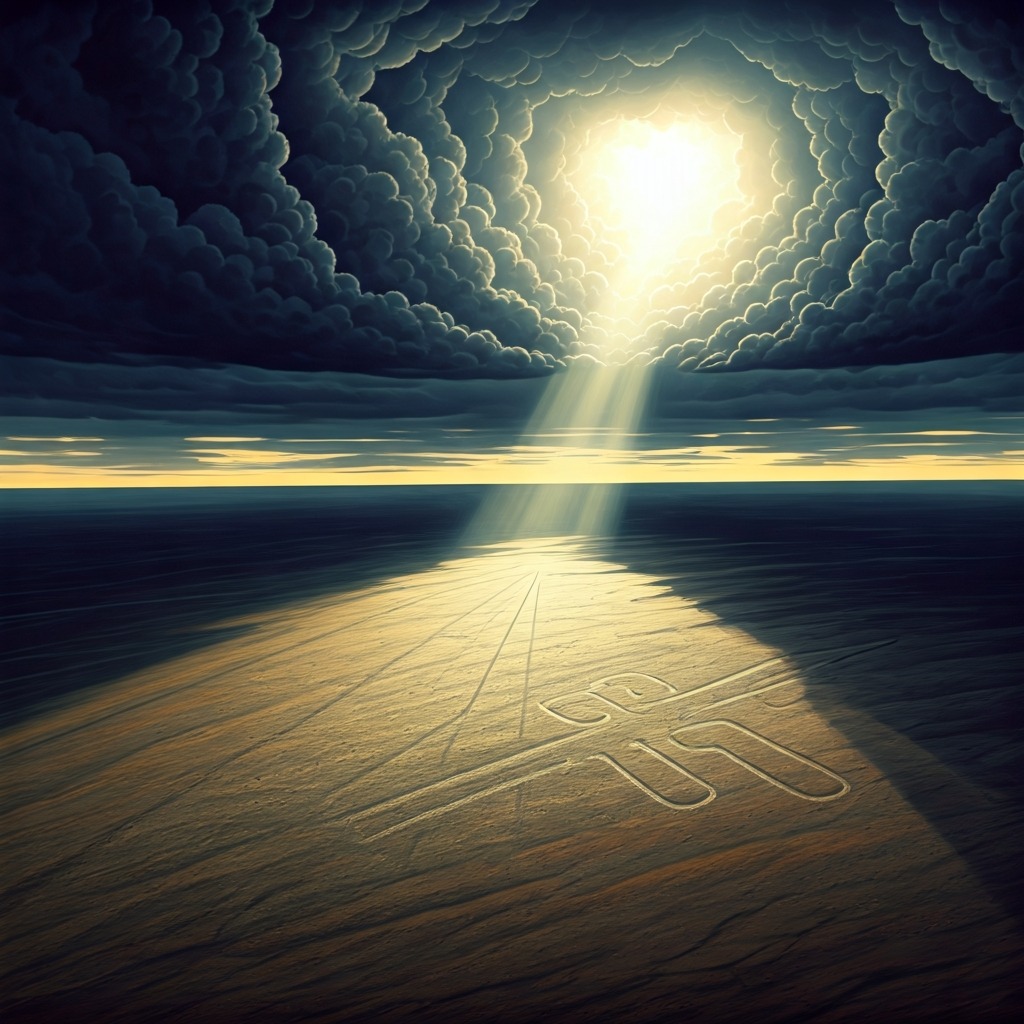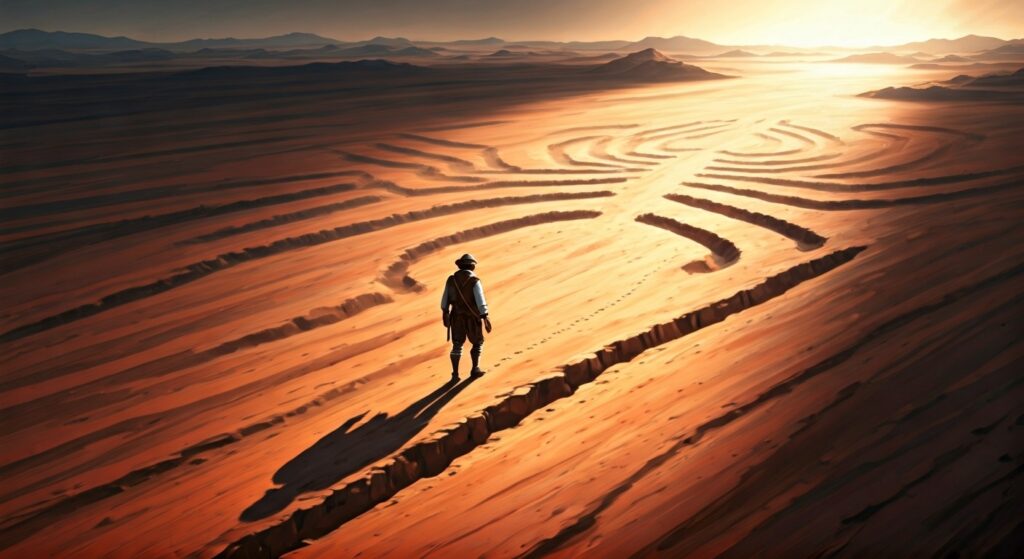
Imagine walking across a barren, sun-baked expanse of reddish-brown rock. You kick at the dirt, perhaps noticing a shallow, dusty trench, but you keep walking. You have absolutely no idea that you are standing on the abdomen of a spider the size of a skyscraper.
For centuries, travelers, conquerors, and locals walked right over one of the greatest mysteries of the ancient world without ever realizing it. Perspective, it turns out, is everything. If you are too close to a masterpiece, you completely miss the big picture. Nowhere in human history is this more mind-bendingly true than in the hyper-arid plains of southern Peru.
A Secret Hidden in Plain Sight
In 1553, Spanish conquistador Pedro Cieza de Leon trekked through the unforgiving Nazca Desert. He noted peculiar markings etched into the earth but dismissed them as simple trail markers. And who could blame him? From the ground, these shallow trenches—often a mere four to six inches deep—look like nothing more than random, meandering pathways to nowhere.
Humanity remained blind to the desert’s secret until the 1930s. With the advent of commercial aviation, pilots flying high above the Peruvian plains looked down and realized the earth below wasn’t just dirt. It was a colossal canvas.
Etched into the ground were over 800 perfectly straight lines, 300 massive geometric figures, and 70 astonishing biomorphs—gigantic depictions of animals, plants, and imaginary beings. There was a monkey with a spiraling tail, a massive condor, and a hummingbird. Some of these figures spanned up to 1,200 feet in length, sprawling across an area of nearly 1,000 square kilometers.
The discovery sent shockwaves through the archaeological world. Who drew these colossal figures? And more importantly, why draw something that you yourself could never see from above?
Alien Landing Strips or Human Genius?
Because the full scope of the Nazca Lines can only be recognized from the sky, the 20th century saw a surge of wild speculation. Fringe theorists eagerly claimed the lines were alien landing strips, arguing that ancient humans couldn’t possibly have engineered such massive, precise figures without aerial guidance.
But crediting extraterrestrials robs the Nazca people of their brilliant, earth-bound ingenuity.
Created between 500 BCE and 500 CE, the lines were forged using a method that was ingeniously simple yet required staggering communal coordination. The Nazca people systematically removed the top layer of reddish-brown, iron oxide-coated desert pebbles. By scraping away this dark crust, they revealed the starkly contrasting light-colored clay and lime earth underneath.
How did they keep the lines so perfectly straight over miles of uneven terrain? Archaeologists found the answer buried right there in the dirt: wooden stakes used for surveying, alongside scattered pottery shards. It was human sweat, mathematics, and raw determination—not spaceships.
They survive today only by a miracle of geography. The Nazca Desert is one of the driest places on Earth. With virtually no wind and zero temperature fluctuation, the climate acted as a perfect time capsule, preserving these shallow scratches in the earth for over two millennia.
A Desperate Plea to the Sky
For decades, the purpose of the lines remained a tantalizing mystery. Early researchers, including American historian Paul Kosok and the legendary German mathematician Maria Reiche, believed the desert was a giant astronomical calendar, hypothesizing that the lines aligned with celestial events to dictate agricultural cycles.
But as modern anthropologists dug deeper, a darker, more desperate narrative emerged.
The Nazca people lived in a hyper-arid, unforgiving environment where water was the ultimate currency of survival. Modern ecological theories suggest the lines weren’t just a calendar; they were a massive, interactive temple. The lines were sacred paths. Priests and citizens would walk these immense geometric shapes during intense religious rituals dedicated to deities of water and fertility.
Those massive geometric trapezoids? They weren’t landing strips. They were sprawling ceremonial gathering spaces. Here, beneath the blazing sun, the Nazca people made offerings of precious crops and performed animal sacrifices, sending a desperate, bloody plea into the sky, begging the gods for rain.
The Fragility of Forever
Today, the Nazca Lines are a heavily protected UNESCO World Heritage site. Yet, despite surviving for 2,000 years, they have never been more vulnerable.
The very modern world that finally allowed us to see the lines from the sky is now threatening to erase them. Climate change is bringing uncharacteristic weather to the once-static desert. Illegal mining operations and unauthorized land occupations are encroaching on the ancient canvas, threatening to churn up the delicate clay that holds the memories of the Nazca people.
It is a chilling reminder that history isn’t just something that happened in the past; it is something we must actively choose to protect right now. The Nazca lines survived empires, conquests, and millennia of isolation. It is up to us to ensure that the giant spider in the desert doesn’t finally wash away.