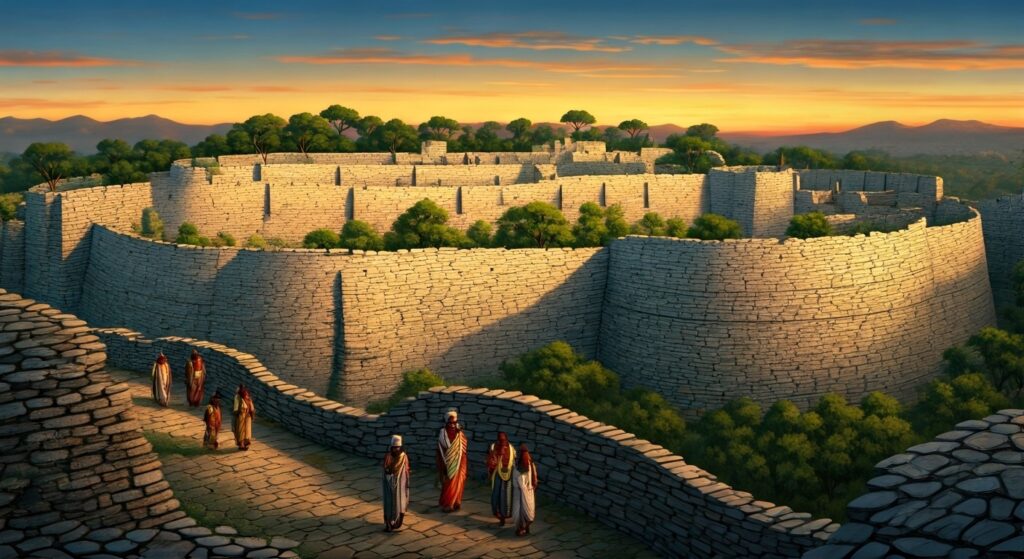
Deep in the southeastern hills of the African continent lies a sprawling architectural marvel that defied everything 19th-century European explorers thought they knew about the world. It was a metropolis of towering granite, built with such staggering precision that it stood for centuries without a single drop of mortar. But instead of marveling at the indigenous genius before them, colonizers orchestrated one of the most audacious historical cover-ups in human history—a desperate, century-long campaign to rewrite the past.
This is the scandalous, riveting saga of Great Zimbabwe.
A Masterpiece Defying Gravity
Imagine walking through the lush landscapes of modern-day Zimbabwe between the 11th and 15th centuries. You wouldn’t stumble upon a quiet, sleepy village. You would find yourself standing in the shadow of a booming, cosmopolitan metropolis.
At its peak, this capital city housed an estimated 18,000 inhabitants and sprawled across nearly 1,800 acres. Built by the ancestors of the Shona people, the city was a triumph of urban planning, divided into three distinct zones: the Hill Complex, the Valley Ruins, and the breathtaking Great Enclosure.
The Great Enclosure remains the undisputed showstopper. Its massive, curving outer walls reach up to 36 feet high and 16 feet thick. The true marvel? They were built entirely without mortar. This technique, known as dry stone walling, relied on millions of perfectly shaped granite blocks held together by nothing but gravity, friction, and sheer engineering brilliance. Inside these impenetrable walls sits a massive, solid stone Conical Tower, a silent sentinel whose exact purpose remains shrouded in mystery to this day.
The Queen of Sheba Delusion
Fast forward to the 19th century. European explorers stumbled upon this majestic stone complex, but their reaction was not one of awe for the local inhabitants. Driven by the deeply ingrained racism and colonial ideologies of the era, these men suffered from a profound case of cognitive dissonance. They simply refused to believe that indigenous Africans were capable of engineering such a sophisticated metropolis.
Enter German explorer Karl Mauch. In 1871, Mauch “discovered” the ruins and immediately began spinning a wild, fantastical narrative. He popularized the theory that Great Zimbabwe was actually the biblical city of Ophir—the legendary source of King Solomon’s wealth and the vacation home of the Queen of Sheba. Mauch even found wooden lintels in the ruins and confidently declared they were made of Lebanese cedar brought by ancient Phoenicians.
In reality, they were local African hardwoods. But Mauch and his contemporaries weren’t about to let pesky things like facts ruin a narrative that suited their ambitions.
The Architect of Erasure
This denial birthed centuries of wild conspiracy theories, and it wasn’t born of innocent ignorance. It was a deliberate, calculated political weapon.
European colonizers, including the infamous Cecil Rhodes, eagerly funded expeditions to prove that Great Zimbabwe was built by Phoenicians, Arabs, Egyptians, or literally any lost tribe of wandering white builders. The motive was sinister: if an ancient, non-African race had built the city, the British could justify their brutal colonization by claiming they were merely “reclaiming” the land rather than violently conquering it.
The desperation to prove this lie led to absolute tragedy. In 1902, the British South Africa Company hired Richard Hall, a journalist with zero archaeological training, to “preserve” the site. In his frantic zeal to find evidence of mythical white builders, Hall stripped away several feet of vital archaeological deposits. He literally threw away priceless artifacts and centuries of stratigraphic evidence, dismissing it all as mere “Kaffir [African] debris.”
He destroyed the very history he was pretending to study.
The Truth Buried in the Soil
But the truth is stubborn, and it always leaves a trace.
In 1905, an Egyptologist named David Randall-MacIver visited the site and became the first European researcher to look at the evidence and conclude that the ruins were undeniably of medieval African origin. Naturally, the colonial establishment fiercely rejected his findings.
It wasn’t until 1929 that a pioneering British archaeologist named Gertrude Caton-Thompson finally drove a stake through the heart of the Ophir myth. Bypassing the areas Hall had ruined, she conducted meticulous excavations in untouched parts of the complex. Her findings definitively proved that Great Zimbabwe was built by the Bantu-speaking ancestors of the Shona.
But Caton-Thompson unearthed something else, too—something that proved Great Zimbabwe wasn’t just an isolated kingdom, but a cosmopolitan hub of a vast, global Indian Ocean trade network. Buried in the African soil, she found Persian glass beads, Arabian coins, and gorgeous Ming dynasty porcelain. The Kingdom of Zimbabwe had been trading its abundant gold and ivory for luxury goods from across the globe.
A Legacy Carved in Stone
You would think the science would settle it. You would be wrong.
Even after archaeology proved the African origins of the city, the political suppression continued. During the 1960s and 1970s, the white minority government of Rhodesia (named after Cecil Rhodes) actively censored publications. They threatened museum curators with losing their jobs—or worse—if they dared to state publicly that Great Zimbabwe was built by Africans. The regime was terrified that acknowledging a glorious African past would fuel black nationalist movements.
But you cannot bury the truth forever, especially when it is built out of 36-foot-high granite walls.
When the country finally won its hard-fought independence in 1980, the people threw off the colonial name of Rhodesia. They proudly renamed their nation Zimbabwe, which translates to “houses of stone” in the Shona language, directly honoring the ancient city. Today, the iconic soapstone Zimbabwe Birds—ancient sculptures found within the ruins by those early explorers—are proudly featured on the nation’s flag and currency.
It is the ultimate vindication. A powerful, enduring symbol of reclaimed history, indigenous genius, and a towering reminder that no matter how hard an empire tries to rewrite your story, the truth will always stand strong.