We take the passage of time for granted. A quick glance at a glowing screen, a digital chime, and we move on. But eight centuries ago, tracking time wasn’t just a practical necessity—it was a theatrical masterpiece.
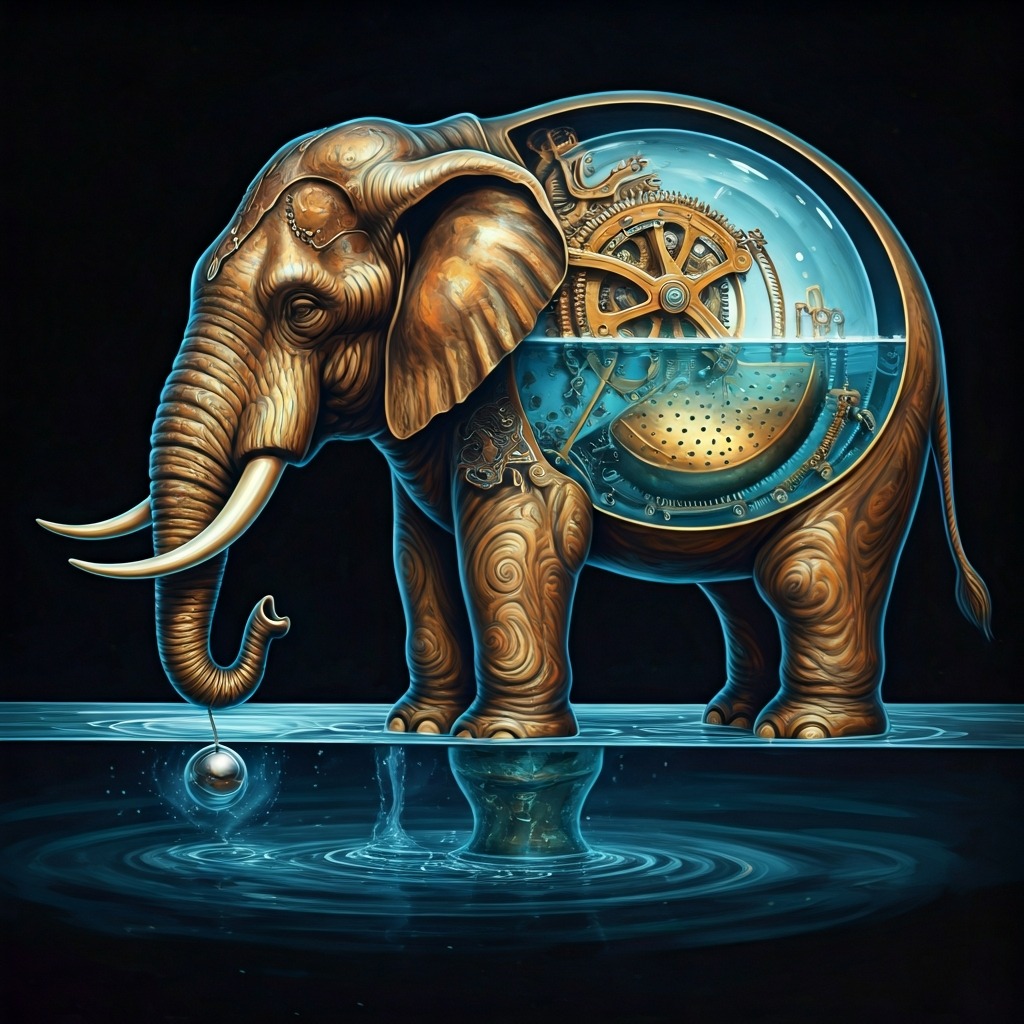
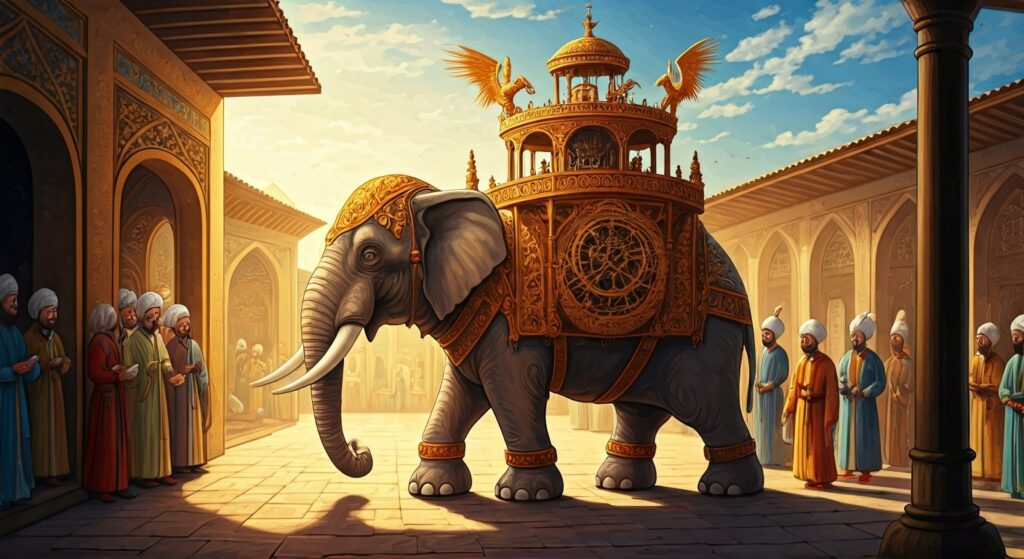
Imagine standing before a massive, hollow wooden Indian elephant. On its back rests an ornate tower swarming with dragons, falcons, and robotic humans. For twenty-nine minutes, the magnificent beast sits in perfect, eerie silence. But deep inside its belly, a hidden mechanism is building toward a spectacular climax.
This isn’t a modern theme park attraction. The year is 1206, and you are about to witness the genius of a man who didn’t just want to tell time—he wanted to put on a show.
The Secret in the Wooden Beast
In the early 13th century, a brilliant engineer named Ismail al-Jazari published a manuscript titled The Book of Knowledge of Ingenious Mechanical Devices. The text would cement his legacy as a pioneer of the Islamic Golden Age, but its crowning jewel was a blueprint for a machine that sounds like a fever dream: the Elephant Clock.
The true mystery of this masterpiece wasn’t its lavish exterior, but the dark, hollow space hidden deep within the beast’s belly.
At its core, the invention was a weight-powered water clock. Inside the elephant sat a large water tank. Floating on the surface was a precisely calibrated, perforated bowl. This was a mathematical marvel, engineered with such exactitude that it took exactly half an hour to slowly fill with water and sink.
For twenty-nine minutes, the water rises. The tension builds. The audience waits.
A Dance of Dragons and Falcons
When the bowl finally succumbs to the water and plunges to the bottom of the tank, it triggers a violent, beautiful chain reaction that puts modern Rube Goldberg machines to shame.
As the bowl sinks, it violently tugs a hidden string connected to a complex seesaw mechanism housed inside the howdah—the ornate tower resting on the elephant’s back. This sudden pull releases a solid metal ball, and the clock springs to life.
The metal sphere rolls out of the beak of a mechanical falcon, dropping straight into the gaping mouth of a mechanical Chinese dragon. The sudden weight causes the dragon to pivot sharply downward, depositing the ball into a waiting vase.
CRASH.
The sound of the ball striking the vase is the cue. Instantly, a robotic mahout (the elephant driver) strikes a cymbal, ringing out the half-hour. At the exact same moment, an Egyptian phoenix perched at the very top of the clock begins to spin wildly.
The Ghost in the Machine
It is a spectacular display of kinetic energy, but the true genius of al-Jazari’s Elephant Clock lies in what happens next.
If the bowl sank to the bottom of the tank, how did the clock continue to tell time? Did an attendant have to reach inside the elephant’s belly every thirty minutes to fish it out?
Not at all. Al-Jazari was centuries ahead of his time. When the heavy metal ball forced the Chinese dragon to pivot downward, that very motion pulled a secondary chain attached to the sunken bowl. As the dragon lowered its head, it physically hauled the bowl back to the surface of the water, emptying it and flawlessly resetting the thirty-minute cycle.
It was an incredibly elegant, early example of a closed-loop automated system. The machine was entirely self-regulating, breathing life into itself over and over again without a single human touch.
A World United in Bronze and Wood
As mind-bending as the medieval water pressure and automated robotics are, the most beautiful aspect of the Elephant Clock is its soul.
Al-Jazari explicitly designed this clock to be a celebration of global diversity. He wanted the machine to reflect the vast, interconnected world of the 13th century. Every element was a deliberate homage: the elephant represented the royalty and majesty of India; the dragons symbolized the ancient power of China; the spinning phoenix was a nod to Egyptian mythology; the hidden water mechanics paid deep respect to ancient Greek engineering; and the turbaned robotic figures reflected the artistry of the Islamic world.
It wasn’t just a clock. It was a philosophical statement rendered in wood, water, and bronze. Al-Jazari was telling anyone who looked at his invention that humanity is bound together by the universal language of science.
The next time you glance at your phone to check the time, take a second to imagine a dragon, a falcon, and an elephant, working in perfect, automated harmony to give you that exact same half-hour.