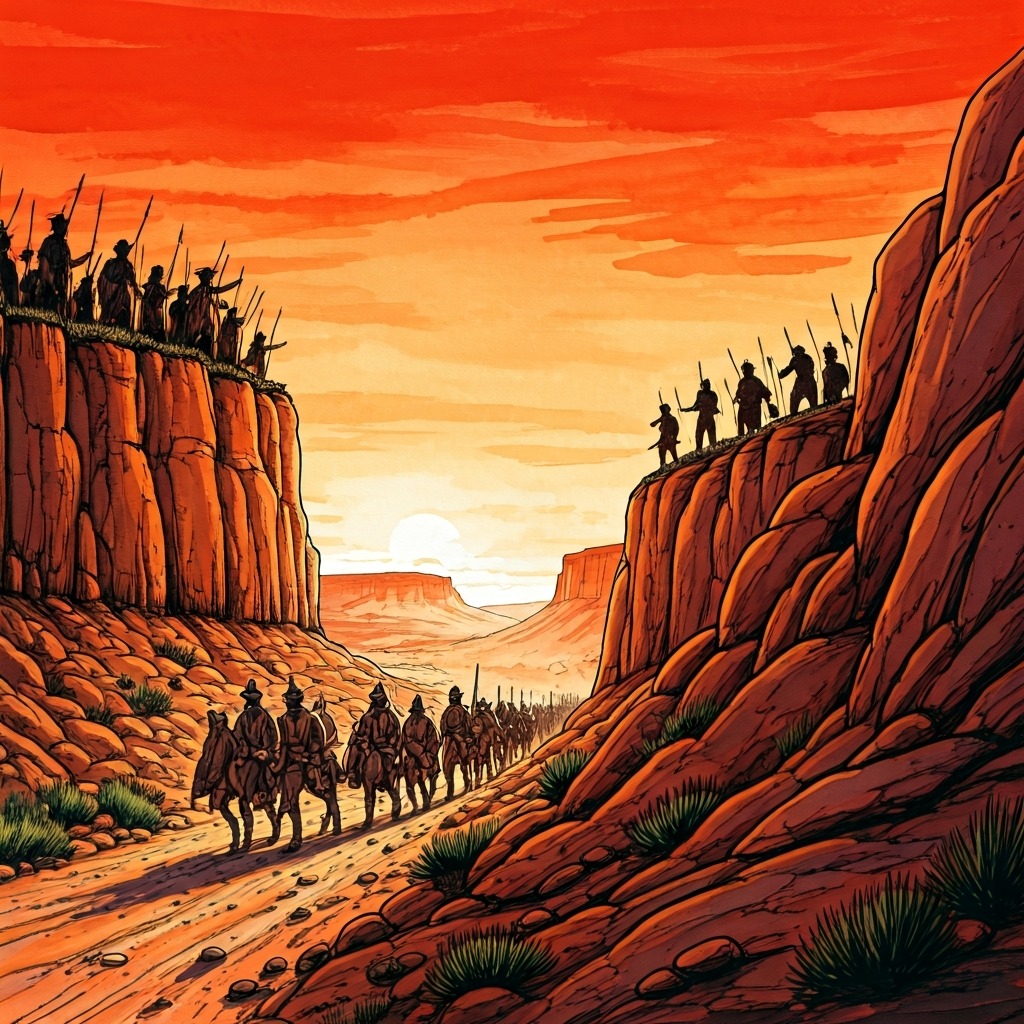
Imagine trying to coordinate a massive, synchronized military strike across hundreds of miles of unforgiving desert. Your forces are scattered across dozens of fiercely autonomous villages. They don’t even speak the same language. You are constantly watched by a heavily armed, ruthless occupying empire. Oh, and you must do it all without a single written message.
It sounds like an impossible tactical nightmare. Yet, in 1680, an indigenous leader named Popé orchestrated exactly that, executing one of the most astonishingly successful uprisings in North American history: the Pueblo Revolt.
A Powder Keg in the Desert
To understand the sheer magnitude of this rebellion, you have to rewind to the 17th century in present-day New Mexico. For over eight decades, the indigenous Pueblo peoples had lived under the crushing weight of Spanish colonial rule.
The Spanish didn’t just want land; they demanded total subjugation. They imposed the encomienda system, a brutal regime that forced the Pueblo people into heavy labor and demanded crippling tributes of food and goods. Worse still, Franciscan missionaries violently suppressed traditional Pueblo religious practices, specifically targeting the sacred Kachina religion. Sacred objects were burned, and ancient ceremonies were outlawed.
The tension simmered for decades, but the breaking point finally arrived in blood and fire.
The Witchcraft Trials of 1675
By 1675, paranoia was brewing among the Spanish authorities. In a devastating crackdown, Spanish Governor Juan Francisco Treviño ordered the arrest of 47 Pueblo medicine men, charging them with witchcraft and sorcery.
The punishment was swift and brutal. Four of the men were hanged. The rest were publicly whipped, humiliated, and thrown into a dark prison. But Treviño made a fatal miscalculation: he eventually released the survivors.
Among those battered, scarred men walking out of the Spanish prison was a religious leader from the San Juan Pueblo named Popé. He didn’t return home to quietly lick his wounds. Instead, he retreated north to the remote Taos Pueblo. There, operating in the shadows for five long years, Popé began to mastermind an unprecedented pan-Pueblo coalition.
A Countdown Hidden in Plain Sight
Here is where Popé’s genius truly shines. How do you plan a synchronized, secret attack under the watchful eyes of Spanish oppressors across a vast landscape with multiple language barriers?
You use a countdown hiding in plain sight.
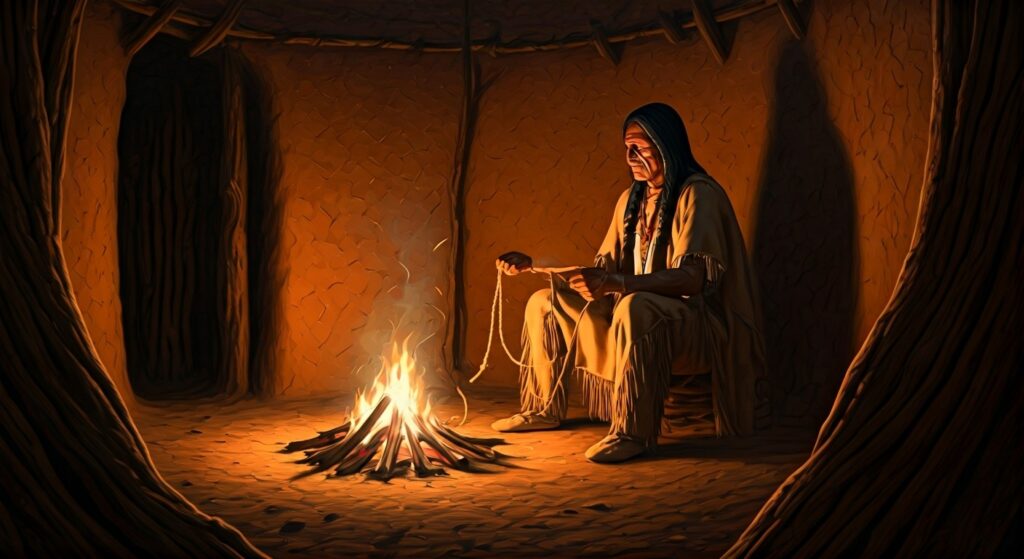
Popé dispatched runners across the region. They didn’t carry letters or obvious weapons. They carried simple cords made from the virtually indestructible fibers of the yucca plant. Tied into each cord was a specific number of knots.
The instructions were whispered to the leader of each pueblo: Untie one knot every morning. When the last knot is untied, we strike as one.
The date was set. On August 11, 1680, the last knot would be undone, and the Spanish would be driven out forever.
The Betrayal and the Pivot
No grand conspiracy is without its leaks. On August 9, just two days before the planned strike, Spanish authorities intercepted and captured two of Popé’s runners. The secret was out. The Spanish governor knew the attack was coming on the 11th.
Most leaders would have panicked. The element of surprise—their greatest weapon—was gone. But Popé didn’t freeze. Realizing the timeline was compromised, he immediately sent out a new, frantic wave of runners with an updated, lethal command: Move the attack up. We strike tomorrow.
On August 10, the Pueblo warriors unleashed a devastatingly effective, highly coordinated assault. They targeted isolated Franciscan missions and Spanish haciendas with ruthless precision. Over 400 Spaniards were killed in the initial wave, including 21 priests.
The surviving colonists, numbering around 1,000, fled in terror to the capital of Santa Fe. They barricaded themselves inside, praying for reinforcements. But Popé’s forces were already closing in. The Pueblo warriors surrounded the city and executed a masterful siege tactic: they cut off the city’s water supply.
Parched, desperate, and completely outmaneuvered, Spanish Governor Antonio de Otermin had no choice. The Pueblo forces intentionally left a southern escape route open, allowing the defeated Spaniards to flee south to El Paso del Norte.
Against all odds, the Pueblo people had won.
An Empire Brought to Its Knees
For the next twelve years, the Pueblo people lived completely free of Spanish domination. Popé set out to violently erase every trace of their oppressors. Christian names were discarded, marriages performed by priests were annulled, churches were burned to the ground, and European crops were ripped from the soil, replaced by native plants.
History, however, is rarely a neat and tidy victory. The unified coalition eventually fractured. Internal power struggles, severe droughts, and relentless raids by neighboring Apache and Navajo tribes weakened the newly independent pueblos. In 1692, Spanish Governor Diego de Vargas led a reconquest of New Mexico.
But the Spanish who returned were not the same arrogant conquerors who had been driven out. The Pueblo Revolt had terrified them, and it left a lasting, undeniable impact. Upon regaining control, the Spanish abolished the oppressive encomienda system. They granted the Pueblos greater land rights, and, crucially, they tacitly tolerated traditional Pueblo religious practices.
It forged a unique cultural synthesis in New Mexico—a blend of traditions that endures to this very day. All because one man, armed with nothing but knotted plant fibers and an unbreakable will, managed to pull off the ultimate strategic masterstroke.