The Impossible Mirage
Deep in the parched, sun-scorched canyons of southern Jordan lies a city that defies every law of nature. Imagine a sprawling metropolis of 30,000 people dropped into a brutal desert wasteland that receives a mere four to six inches of rain a year. By all logic, this place should be a graveyard of bleached bones. Instead, it became an empire.
When we picture Petra, we envision the breathtaking, rose-red facade of the Treasury. But the city’s true masterpiece isn’t carved from stone—it is completely invisible to the casual observer.
The Desert’s Deadliest Paradox
To understand the sheer genius of Petra, you must understand the terrifying environmental paradox its founders faced. The Nabataeans, a nomadic Arab tribe who settled the region around the 4th century BC, chose a fortress-like location that was highly defensible but cursed by the elements.
For 350 days a year, the land was bone dry, threatening the population with chronic dehydration. But when the rare rains finally broke, they arrived with apocalyptic fury. The steep, rocky terrain couldn’t absorb the deluge, triggering catastrophic flash floods.
The only entrance to the city was the Siq, a narrow, winding gorge. During a storm, this gorge acted like the barrel of a gun, funneling a towering, deadly wall of water directly into the heart of the capital. The Nabataeans didn’t just have to find water in a wasteland; they had to stop the water from annihilating them.
Taming the Torrent
Their solution was a feat of unparalleled hydraulic engineering that still leaves modern hydrologists in awe.
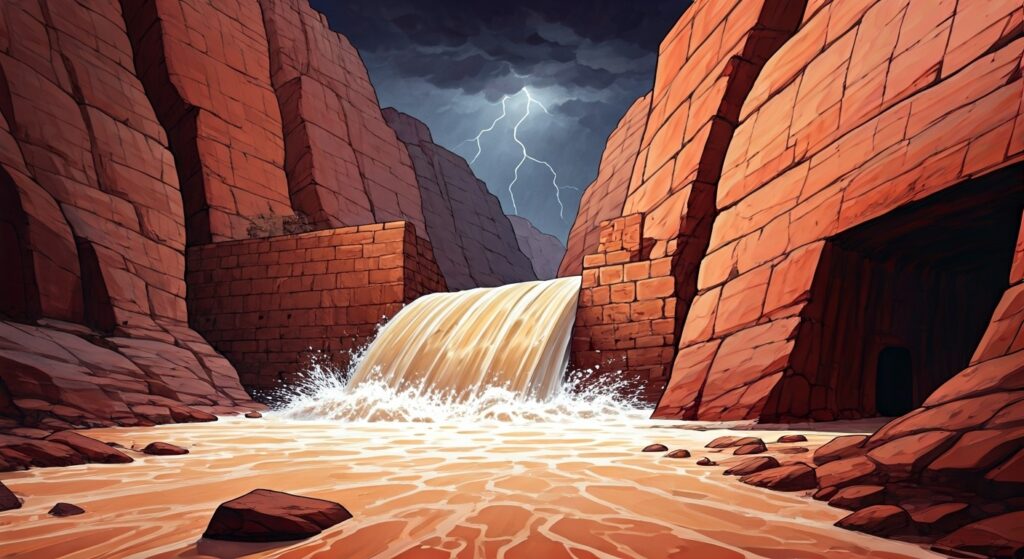
To protect their vulnerable capital, the Nabataeans constructed a massive dam at the entrance of the Siq. When torrential rains struck, this barrier caught the lethal floodwaters and forcefully diverted them into a dark, hand-carved tunnel known as the Wadi Mudhlim.
In one brilliant stroke, they neutralized a lethal natural hazard and transformed it into a controlled municipal water supply. But capturing the raging torrent was only the first piece of the puzzle. They still had to move it.
The Invisible Veins of a Metropolis
Beneath the dusty, sun-baked streets of Petra lay an intricate, hidden network of carved channels, aqueducts, and terracotta pipes.
These ceramic arteries were absolute marvels of ancient fluid dynamics. Engineered with bell-and-spigot joints and sealed with specialized waterproof cement, they were designed to handle immense water pressure while perfectly tracing the natural gradient of the harsh landscape.
Because the floodwaters carried choking silt and debris, the Nabataeans incorporated ingenious particle-settling chambers into the pipeline. These chambers allowed dirt to sink to the bottom while clean water flowed over the top, effectively filtering the supply and preventing clogs. It was a level of sophistication that easily rivaled—and in some cases, predated—the legendary aqueducts of Rome.
To store this harvested water for the brutal dry months, they carved massive subterranean cisterns directly into the solid rock. Lined with a unique hydraulic plaster that prevented seepage, these underground vaults kept the water cool, dark, and perfectly protected from evaporation.
A Weapon of Mass Intimidation
But the Nabataeans didn’t just survive the desert. They conquered it, and then they flaunted it.
In the ancient world, water was life—but it was also absolute power. At the height of its glory, the arid center of Petra featured lush terraced gardens, bubbling public fountains, and a massive monumental pool complex complete with an island pavilion.
This conspicuous consumption wasn’t just for aesthetics; it was a highly calculated psychological weapon. Imagine being a weary trader, exhausted and parched after weeks of navigating the brutal, dust-choked incense routes. You step out of the claustrophobic gorge and into Petra, only to be greeted by an oasis of unimaginable, watery luxury.
It was a masterclass in intimidation. Without firing a single arrow, the Nabataeans used their fountains and pools to cement their status as an invincible economic powerhouse. The most powerful forces in history aren’t always the ones carved into towering facades. Sometimes, they are the quiet, invisible currents running right beneath our feet.