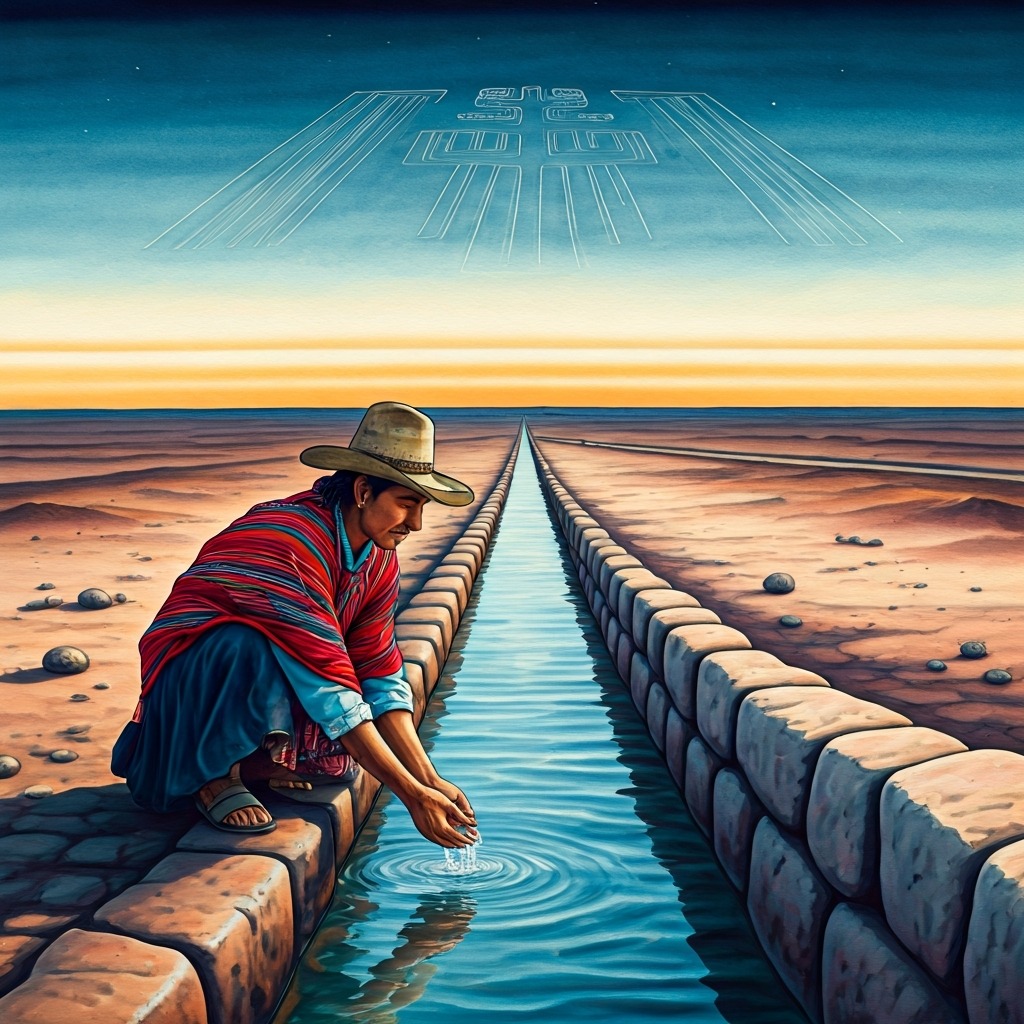
The Nazca Desert in southern Peru is one of the most unforgiving, hyper-arid environments on the planet. It is a landscape so bone-dry and desolate that simply surviving here seems like a mathematical impossibility. Yet, an ancient civilization didn’t just survive in this wasteland—they transformed it into a thriving agricultural empire.
We all know the Nazca people for their massive, enigmatic geoglyphs—the famous Nazca Lines etched into the desert floor. But the real mystery of the Nazca isn’t what they drew on top of the earth. It’s the mind-bending engineering they hid beneath it.
The Staring Eyes of the Desert
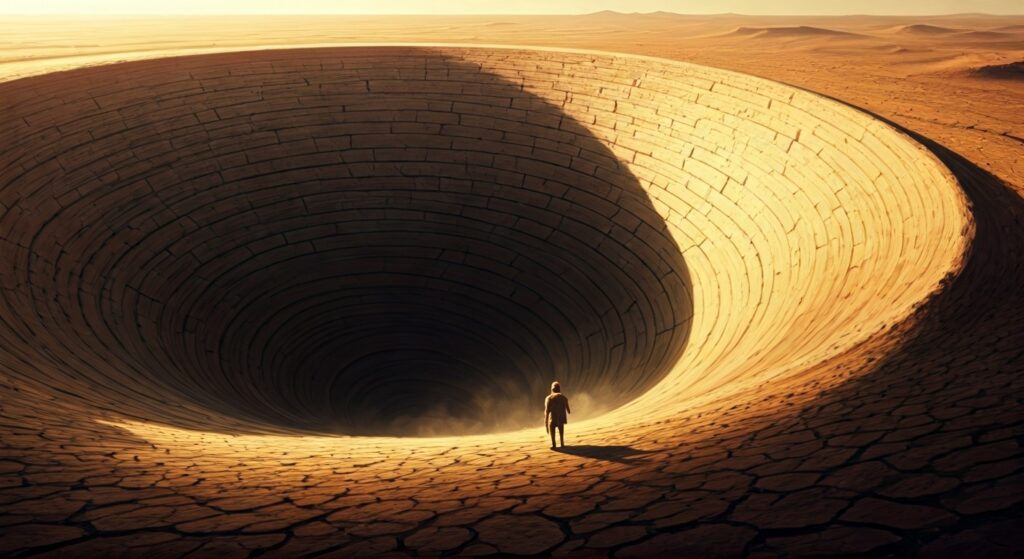
Walk across this sun-baked terrain, and you might suddenly find yourself standing at the edge of a massive, spiraling hole plunging deep into the earth. These funnel-like depressions are lined with smooth, carefully stacked river stones, swirling downward in a perfect spiral until they vanish into the pitch black.
The locals call them ojos, or “eyes.”
For a long time, these staring eyes were a profound mystery. Were they ritualistic portals to the underworld? Bizarre tombs? The truth, it turns out, is a feat of ancient ingenuity that makes modern engineering look lazy. Built somewhere between 1000 BCE and 750 CE, these spirals are the visible markers of the puquios—a highly sophisticated, subterranean aqueduct system.
The Nazca people had figured out how to tap into naturally occurring underground aquifers. But finding the water was only half the battle. They had to move it across miles of desert to their crops and cities without it evaporating in the blistering sun. Their solution was to build underground canals. But how do you keep water flowing through subterranean tunnels without modern pumps?
Harnessing the Breath of the Earth
This is where the ojos come into play, and where the Nazca’s genius truly shines.
The spiral funnels weren’t just decorative, and they weren’t merely access points for workers to clear out silt and debris—though they did serve that purpose. Their primary function was aerodynamic.
The funnels were precisely shaped to catch the fierce desert winds. As the wind whipped across the barren plains, the spiral design grabbed the air and forced it down the shaft. This injected a continuous blast of wind into the underground canals, increasing the atmospheric pressure and literally pushing the subterranean water through the system. The Nazca didn’t just mine water; they weaponized the wind to move it.
The Eye in Space Solves an Ancient Map
For centuries, the true scale of the puquios remained shrouded in mystery. Because they are underground, traditional archaeology could only piece together fragments of the network. It took an eye in space to finally see the big picture.
Through recent satellite imaging research, Rosa Lasaponara and her team at the Institute of Methodologies for Environmental Analysis in Italy peered beneath the desert surface. The satellite data revealed that the puquio system was vastly more extensive and complex than anyone had ever imagined. It required a profound, almost modern understanding of the region’s complex geology and the annual variations in underground water supply.
But Lasaponara’s research threw another thrilling puzzle piece onto the board. The spatial distribution of the puquios perfectly aligns with the Nazca Lines. This suggests a deep, undeniable connection between the two. Those massive geoglyphs—the hummingbirds, the spiders, the geometric shapes—weren’t just random art. They may have served as a colossal, landscape-sized map, or a grand ritualistic homage to the very water sources that kept their civilization alive.
An Engineering Marvel That Refuses to Die
The Nazca people played the ultimate game of survival against nature, and their strategy was so flawless that they permanently conquered the desert.
The most staggering part of this story isn’t that the Nazca built this system over two thousand years ago. It’s that it still works. Today, dozens of these ancient, wind-powered aqueducts are still functioning. Local Peruvian farmers continue to rely on the puquios to irrigate their crops, drinking from the exact same subterranean rivers, pushed by the exact same desert winds, that sustained their ancestors millennia ago.
Empires rise and fall, and lines in the sand eventually fade. But true genius? That flows forever.