For centuries, the Amazon rainforest has been mythologized as the ultimate pristine wilderness—a sprawling, hostile “green hell” where human footprints are instantly swallowed by the relentless crawl of nature. For generations, historians and anthropologists insisted the jungle’s soil was simply too poor to support anything more than small, nomadic bands of hunter-gatherers.
They were dead wrong.
Beneath the dense, emerald canopy lies a graveyard of massive, mathematically precise monuments. The Amazon is not an untouched wilderness at all; it is one of the largest, oldest abandoned gardens on Earth. And the story of the Acre Earthworks is completely rewriting the history of the Americas.
The Scars Beneath the Canopy
The mystery began in the 1970s, high above the dense canopy of southwestern Amazonia. Brazilian paleontologist Alceu Ranzi was on a routine commercial flight over the state of Acre when he looked out the window and spotted something impossible. Carved into the deforested patches of the earth below were massive, perfect geometric shapes.
At the time, it was dismissed as an isolated anomaly. But fast forward to the 21st century. The tragic, rapid acceleration of modern deforestation, combined with the unblinking eye of satellite imagery, peeled back the canopy to reveal a staggering secret.
There wasn’t just one shape. There were hundreds.
To date, over 450 geometric geoglyphs have been identified, sprawling across a mind-bending 13,000 square kilometers. The rainforest had been hiding an ancient secret of monumental proportions, waiting for centuries to be found.
An Impossible Geometry
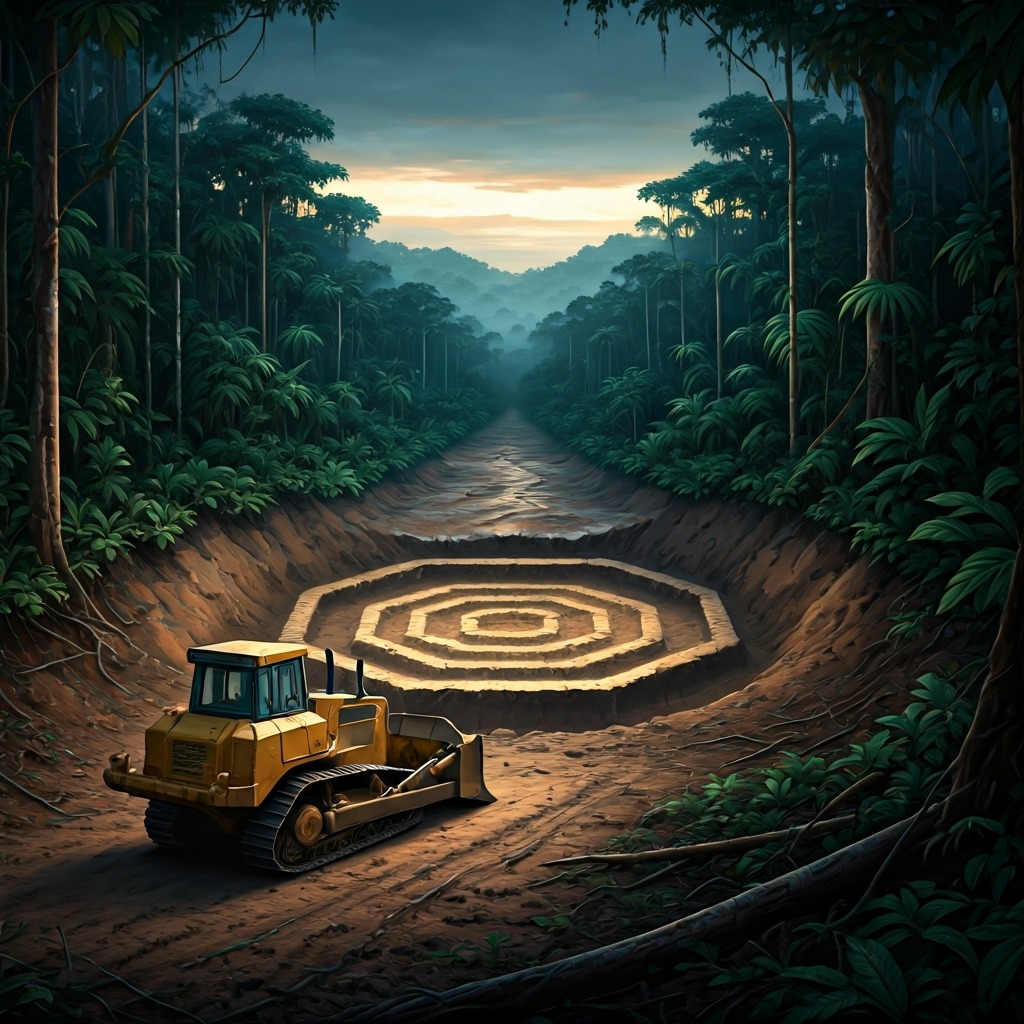
These aren’t crude scratches in the dirt. The Acre Earthworks are characterized by enormous, perfectly geometric shapes: interlocking circles, squares, ellipses, octagons, and U-shapes.
The unknown indigenous builders excavated massive ditches, some measuring up to 11 meters wide and 4 meters deep, flanked by towering earthen banks. The enclosures themselves span anywhere from 100 to 300 meters in diameter.
The sheer perfection of these shapes suggests something profound: the builders possessed a deep, complex understanding of geometry and utilized advanced surveying techniques. You don’t just accidentally dig a perfect 300-meter octagon in the middle of the jungle. It requires immense planning, mathematical precision, and a highly organized workforce.
Ghost Temples of the Rainforest
So, who built them?
Radiocarbon dating reveals that these structures were constructed between 0 and 1250 CE. While the specific identity of the civilization remains a tantalizing mystery, the scale of the earthworks tells us one undeniable fact: moving this much dirt required a densely populated, highly structured society.
This revelation shatters the 20th-century consensus. The Amazon wasn’t an empty wilderness; it was a thriving, bustling hub of human engineering. Estimates now suggest that millions of people may have lived in the Amazon before European contact introduced devastating diseases that wiped them out.
But here is where the mystery deepens. When archaeologists excavated the sites, they expected to find the remnants of fortified villages. They looked for cooking pottery, habitation debris, and the trash of everyday life.
They found almost nothing.
The enclosures were virtually empty. This led researchers to a haunting conclusion: these massive geometric earthworks were not defensive forts or bustling cities. They were sacred spaces. Likely used for sporadic public gatherings, religious ceremonies, or astronomical observations, these sites were monumental temples carved directly into the earth itself.
The Tragic Irony of Discovery
Perhaps the most mind-blowing part of this story isn’t the geometry or the scale, but how these ancient people interacted with the rainforest.
Botanical and soil analyses have revealed that the builders did not clear-cut the forest using widespread, destructive fire. Instead, they practiced sophisticated, sustainable agroforestry. They acted as master gardeners, selectively managing the forest to encourage the growth of economically useful trees like palms, Brazil nuts, and bamboo. They even altered the soil composition, contributing to the creation of terra preta, the hyper-fertile “Amazonian dark earth” that still baffles modern agronomists today.
They didn’t conquer the jungle; they collaborated with it. When their civilization declined, the resilient rainforest simply swallowed their monuments whole, protecting them for centuries.
And here we arrive at the tragic irony of the Acre Earthworks. The only reason we know about these ancient, harmonious land-management practices is because of the destructive, unsustainable clearing of the rainforest happening today. The modern bulldozers tearing down the Amazon are the very tools that revealed how ancient humans successfully lived alongside it.
It leaves us with a haunting question: as we look at the scars we are leaving on the earth today, what will the people of the future think of us? Will our legacy be as perfectly measured, and as deeply respectful of the earth, as the geometric ghosts hiding beneath the canopy of Acre?