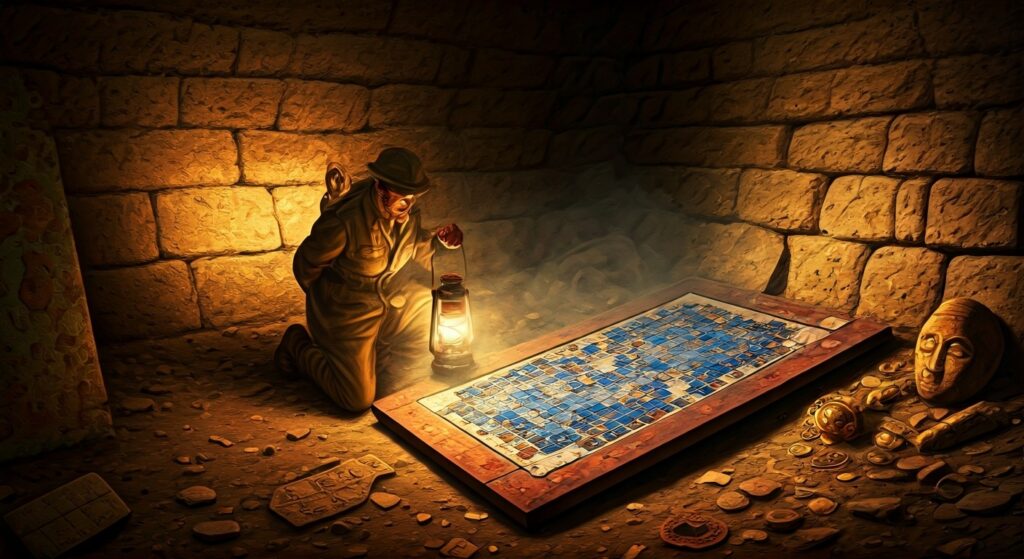
Deep within the Royal Cemetery at Ur, amidst staggering treasures untouched for four millennia, lay a silent enigma. It was breathtakingly beautiful, crafted from lapis lazuli and shell. But for decades, it harbored a frustrating secret: it was the ultimate ancient board game, and the rulebook was completely lost.
We tend to think of our ancient ancestors as distant, unknowable figures who spent all their time building monuments or surviving plagues. But human beings have always been human beings. And what do humans do when they have a little downtime? They invent highly addictive games to utterly crush their friends in competition.
A Tomb of Silent Treasures
In the 1920s, British archaeologist Sir Leonard Woolley was excavating the Royal Cemetery at Ur in modern-day Iraq. Amidst the gold and artifacts dating back to approximately 2600 BC, Woolley unearthed something wholly unexpected: a series of exquisite game boards.
Crafted with staggering detail from lapis lazuli, shell, and red limestone, they were a testament to the wealth and artistry of the early Bronze Age. Yet, they were also entirely mute. Woolley had discovered what would become known as the Royal Game of Ur, but for decades, it remained a tantalizing mystery. The boards sat behind museum glass, stunning but completely unplayable. No one on earth knew the rules. The game was dead.
Or so the world thought.
The Astronomer’s Cipher
The board remained a silent relic until the early 1990s, when Dr. Irving Finkel, a brilliant Assyriologist at the British Museum, decided to play detective.
Finkel turned his attention to a cuneiform tablet that had been quietly gathering dust in the museum’s archives since the 1880s. Inscribed in 177 BC by a Babylonian astronomer named Itti-Marduk-balatu, the wedge-shaped script held a revelation. As Finkel translated the ancient clay, a realization washed over him: he wasn’t just reading an astronomical text. He had stumbled upon the oldest known rulebook for a board game in human history.
Across the span of millennia, an ancient astronomer was reaching out to teach the modern world how to play.
Blood, Rosettes, and Tetrahedral Dice
Thanks to Finkel’s translation, the Royal Game of Ur was resurrected from a static museum piece into a highly engaging, cutthroat race game—a distant, aggressive ancestor to modern Backgammon.
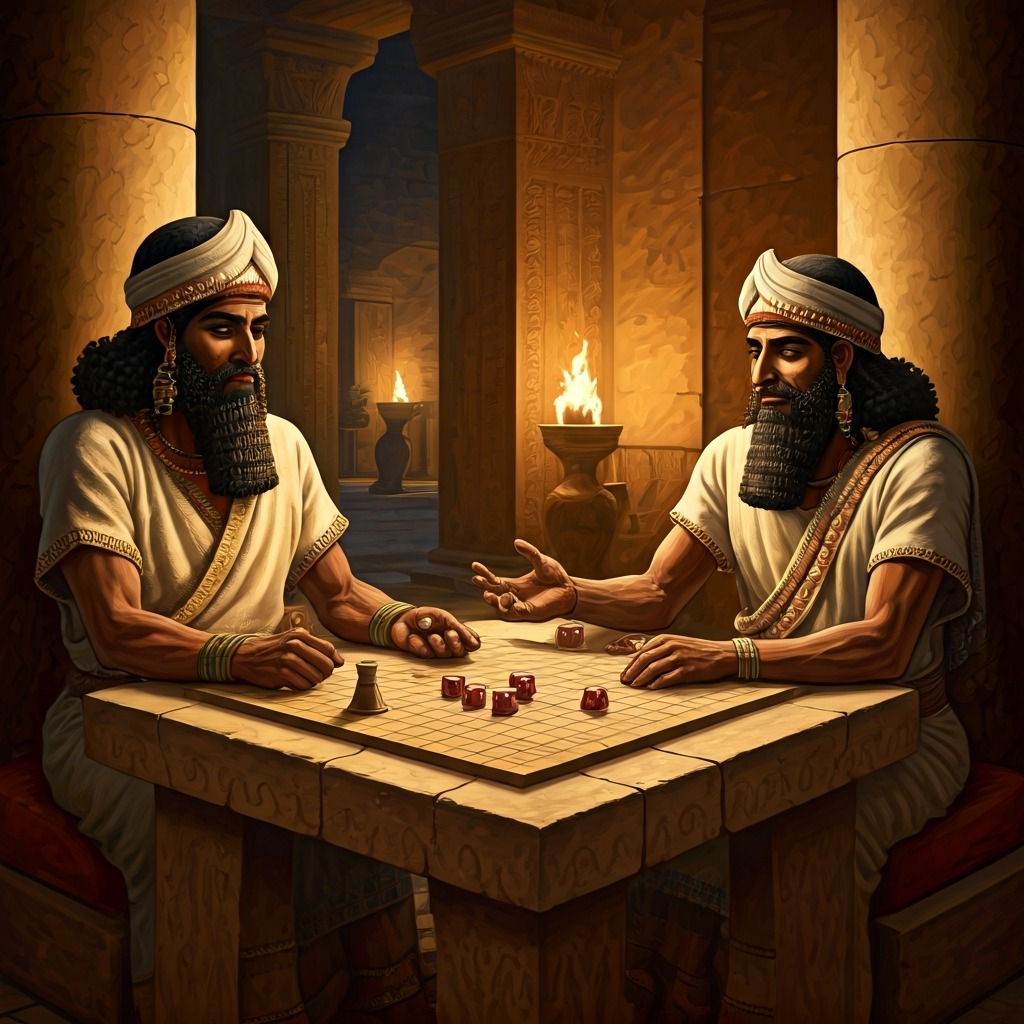
The ancients didn’t play nice. Players use four tetrahedral (pyramid-shaped) dice, each with two marked corners, yielding a score from zero to four. Each player commands seven pieces, navigating a winding, 20-square path.
But this is no peaceful stroll. The board features distinct rosette symbols. Landing on one is the ultimate stroke of luck, granting an extra roll and creating a safe haven where a piece cannot be captured.
The real suspense, however, unfolds in the middle of the board. The central bridge is a high-tension combat zone. If your piece lands on a square occupied by your opponent, you knock them entirely off the board, sending them crying back to the start. It is a game of ruthless strategy, sudden reversals of fortune, and pure, ancient road rage.
The Game That Transcended Thrones
Perhaps the most fascinating aspect of the Royal Game of Ur is how it shatters our preconceptions of a rigid, joyless ancient world. This wasn’t just a pastime for kings and queens; it was a massive pop-culture phenomenon that transcended social classes across the ancient Middle East.
While opulent lapis lazuli boards were buried in royal tombs, archaeologists have also discovered rudimentary grids scratched directly into the stone guards of palace gates. Imagine it: heavily armed palace guards, bored out of their minds on a long shift, furiously throwing pyramid dice in the dust to pass the time.
A Ghost Brought Back to Life
Over thousands of years, the game naturally evolved, eventually being overshadowed and absorbed by Backgammon. It seemed as though the Royal Game of Ur had truly vanished into the sands of time, requiring Finkel’s brilliant translation to exist again.
But history always has one last trick up its sleeve.
In a twist that defies the ages, Finkel discovered that the game hadn’t actually died out at all. A closely related version, called Aasha, was still being played in modern times by the Jewish community in Kochi, India. Without realizing it, they had preserved a living link to a 4,500-year-old everyday pastime.
The next time you gather around a table to ruthlessly conquer your friends in a board game, take a moment to appreciate the legacy you’re stepping into. We’ve been rolling the dice, cursing our luck, and knocking our opponents off the board since the dawn of civilization.