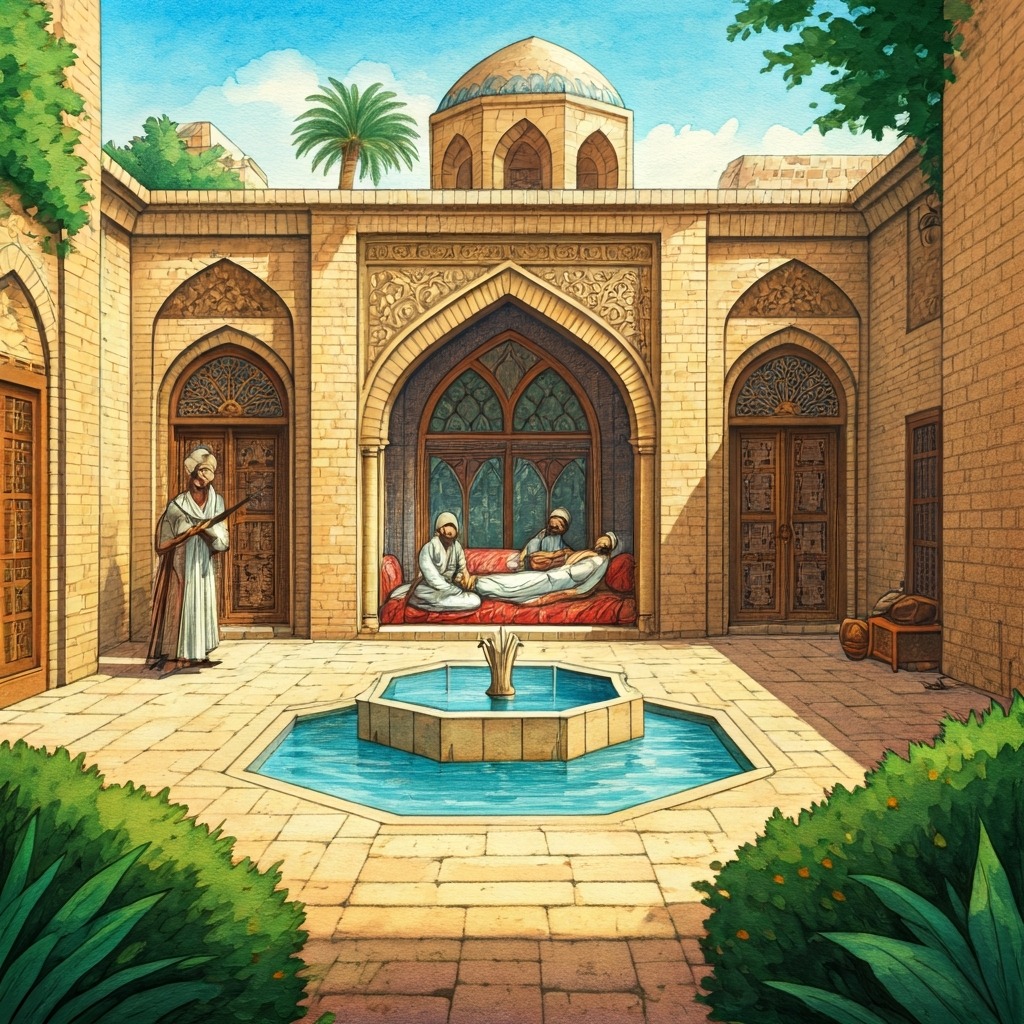
Imagine it is the 9th century. You are struck by a mysterious, burning fever. If you live in medieval Europe, your fate is sealed. You are carried to a dimly lit religious hospice where the only prescribed treatment is a whispered prayer and a quiet corner in which to wait for the end.
But if you lived in Baghdad, your salvation began with a scene that looked suspiciously like dark magic.
Welcome to the Abbasid Caliphate, where a medical revolution was about to unfold—centuries before the West would catch up.
The Macabre Experiment in the Streets of Baghdad
In the early 10th century, the sprawling metropolis of Baghdad needed a massive new hospital. To choose the perfect location, officials turned to the renowned polymath and physician Abu Bakr al-Razi.
Instead of consulting astrologers or surveying the land, al-Razi ordered a bizarre and grisly city-wide operation. He had his assistants hang slabs of fresh meat from wooden poles in various neighborhoods across the capital.
Then, the great physician simply waited.
Days later, al-Razi inspected the rotting flesh. He bypassed the heavily decayed slabs and selected the neighborhood where the meat had putrefied the slowest. Centuries before the discovery of microorganisms, al-Razi had brilliantly deduced the principles of airborne pathogens. The area with the least rot possessed the cleanest air and the most hygienic environment.
Upon this very spot rose a revolutionary institution: the Bimaristan, a Persian word translating simply to “place of the sick.”
Sanctuaries of Sound and Water
Unlike the fatalistic hospices of Europe, Bimaristans were fiercely secular, scientific arenas of healing. The physicians of the Islamic Golden Age understood a concept modern medicine is only just rediscovering: the environment is as critical to healing as the cure itself.
Bimaristans were architectural marvels designed as tranquil oases. Patients were carried into lush, meticulously tended gardens. Courtyards echoed with the soothing sounds of flowing fountains and complex running water systems, designed to cool feverish bodies and calm anxious minds.
The treatments were shockingly progressive. In an era when those suffering from mental illness were locked in dungeons or burned as heretics elsewhere in the world, the Bimaristan offered dedicated psychiatric wards. Patients were treated with profound compassion. Therapies included specialized diets, storytelling, and immersive music therapy, where live musicians played specific, soothing melodies to untangle troubled minds.
The Blueprint of Tomorrow
Walk into a major Bimaristan—like the Al-Nuri Hospital in Damascus or Cairo’s colossal Al-Mansuri, which accommodated thousands—and you would instantly recognize the layout. It was the exact blueprint of a modern hospital.
Patients were separated into specialized wards: surgery, ophthalmology, orthopedics, internal medicine, and contagious diseases. But the most staggering feature of the Bimaristan wasn’t its architecture—it was its accessibility.
Healthcare was entirely free.
Funded by the Waqf system—a robust network of charitable endowments—these massive institutions turned no one away. Care was provided regardless of religion, race, gender, or socioeconomic status. Even more astonishingly, when an impoverished patient was discharged, they were handed a financial stipend. This ensured they could recover fully at home without being forced back into grueling labor before their bodies had healed.
The First True Teaching Hospitals
These grand institutions were not merely places to treat the sick; they were the world’s first true teaching hospitals.
Behind the garden walls lay extensive medical libraries, grand lecture halls, and fully stocked pharmacies. Medical students trailed behind master physicians—legends like al-Razi and Ibn Sina (Avicenna)—on daily ward rounds. They observed patient care firsthand, meticulously took notes, and fiercely debated diagnoses in the corridors.
The structural, ethical, and educational foundations laid in these ancient wards are the very same ones we rely on today. The next time you walk through the sliding glass doors of a modern hospital, past the specialized wings and the bustling medical students, remember the hanging meat of Baghdad. The architects of the Islamic Golden Age weren’t just treating the sick—they were curing the future.