The next time you wander through a museum, admiring the deep, luminous shadows of a 19th-century masterpiece, lean in a little closer. The secret to that perfect, glowing flesh tone might be staring back at you. Because for centuries, the most sought-after color in an artist’s toolkit was made from one shocking ingredient: ground-up human mummies.
This is the horrifying, bizarre, and utterly true story of Mummy Brown.
A Ghastly Misunderstanding
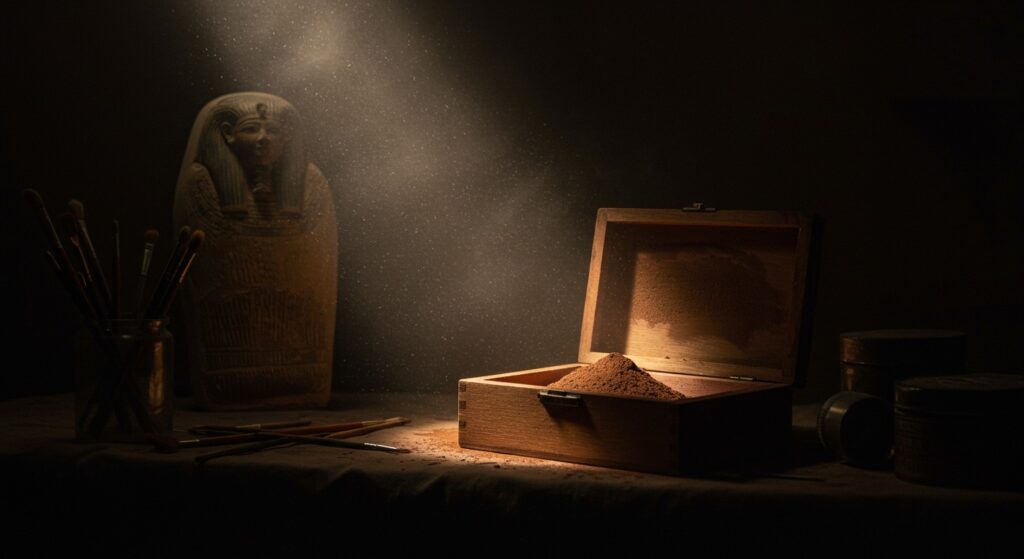
The tale begins not with art, but with medicine—and a tragic translation error. Ancient physicians prized a black, sticky asphalt called mumiya, believing it held miraculous healing properties. But as demand in Europe outstripped the supply of natural bitumen, apothecaries found a gruesome workaround. They noticed that ancient Egyptian mummies were embalmed with a similar dark, resinous substance. Their solution? Grind up the mummies.
By the Middle Ages, powdered mummia was a standard prescription across Europe, swallowed by aristocrats to cure everything from headaches to internal bleeding. And in the 16th century, when painters visited those same apothecaries for their supplies, a dark thought occurred: if you can eat it, why not paint with it? By mixing the human dust with a little pitch and myrrh, they created a pigment unlike any other.
Painting with Pharaohs
The resulting color, known as Mummy Brown, was an instant sensation. It produced a rich, warm, transparent brown that was a dream for glazing and capturing the subtleties of shadow and light. In a twisted irony, artists discovered that the ground-up remains of ancient Egyptians were the perfect medium for rendering the vibrant, living flesh of European nobles.
Eugène Delacroix, the master of French Romanticism, used it liberally. But the most macabre use belongs to Martin Drolling. During the French Revolution, the royal tombs of St. Denis were desecrated. Drolling reportedly acquired the exhumed hearts of French kings, grinding the literal monarchy into paint to cast the shadows in his masterpiece, L’Intérieur d’une cuisine—a painting that hangs in the Louvre today.
A Sinister Supply Chain
You can’t run a global industry on a finite supply of pharaohs. The insatiable European demand for mummy—both for medicine and paint—triggered a massive, unregulated grave-robbing boom in Egypt. Tombs were plundered, and the dead were packed into crates like spices. The commodification was so absolute that by the 19th century, mummies were being used as fertilizer in England and even burned as locomotive fuel in Egypt.
When the supply of ancient mummies dwindled, a counterfeit market emerged. Merchants began purchasing the fresh corpses of executed criminals, slaves, and the poor. They would stuff the bodies with bitumen, bind them, and bake them in the sun to create convincing fakes. The beautiful, romanticized shadows of the Victorian era were very likely painted with the bodies of the recently deceased.
The Secret Spilled at Lunch
The most baffling part of this saga is that many artists had no idea. They assumed “Mummy Brown” was just a fanciful marketing name, like “Burnt Sienna.” They never imagined the label was literal.
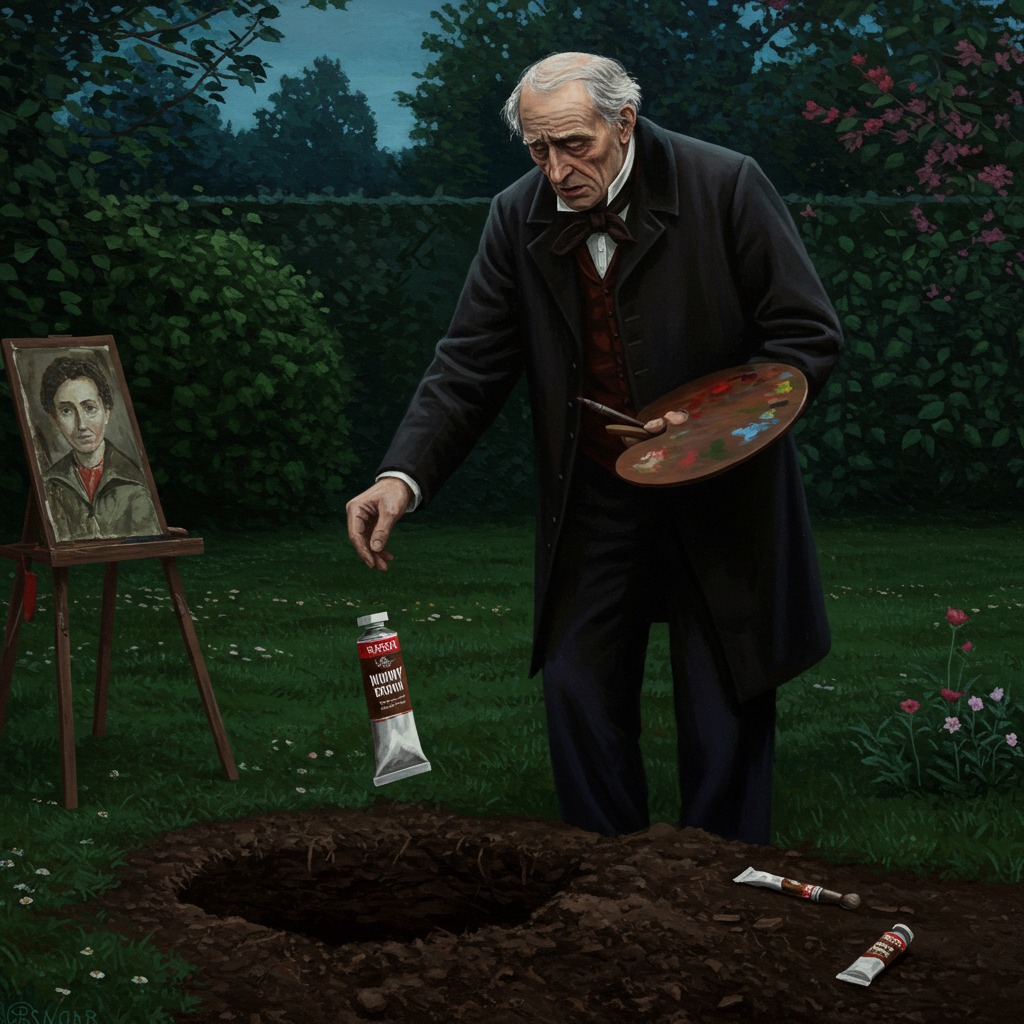
The illusion shattered in 1881. The celebrated painter Edward Burne-Jones was at lunch with his friend, Lawrence Alma-Tadema, who casually mentioned that their beloved brown paint was, in fact, made from actual pharaohs. Burne-Jones was so horrified that he immediately fled the table, sprinted back to his studio, and retrieved his last tube of Mummy Brown. He took it out to his garden and gave it a proper, solemn burial.
Fading to Black
Burne-Jones’s crisis of conscience was a sign of changing times, but the pigment had a more practical flaw: it was chemically unstable. The organic matter and asphaltum within the paint never fully dried, causing the rich shadows to crack and degrade over time, ruining the very masterpieces artists had created with it.
By the early 20th century, the Egyptian government finally cracked down on the antiquities trade, and the supply of bodies dried up. The final, chilling nail in the coffin came in 1964. When a journalist from TIME magazine asked the London-based art supplier C. Roberson & Co. if they still had any, the managing director replied, “We might have a few odd limbs lying around somewhere, but not enough to make any more paint.”
And just like that, the era of painting with the dead was over. It’s a haunting reminder that the art we see as pristine and eternal is often born from a history that is messy, dark, and all too human.