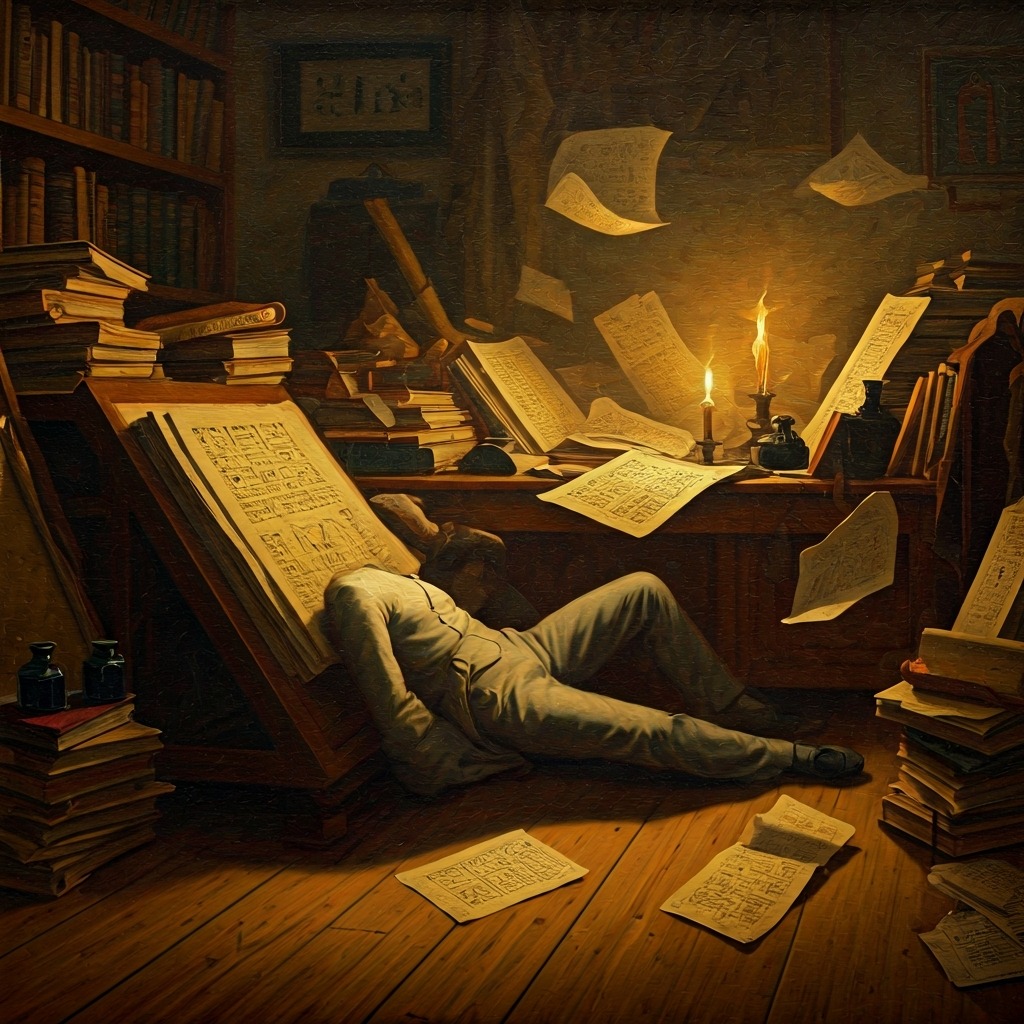
For over a thousand years, the greatest civilization of the ancient world was trapped in silence. The gods, the pharaohs, and the poetry of ancient Egypt were locked behind beautiful, impenetrable symbols. Early scholars assumed hieroglyphs were purely mystical pictograms—a magical code never meant to be read.
They were wrong. The key to unlocking three millennia of history was waiting in the dark, buried in the rubble of a crumbling fortress, waiting for the right person to stumble upon it.
A Strike in the Dust
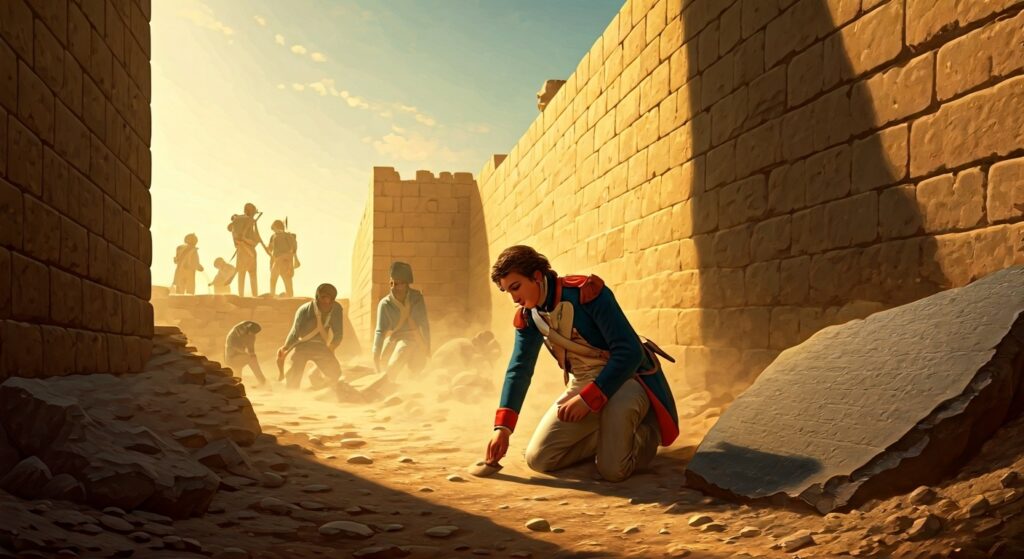
The year was 1799. Napoleon Bonaparte’s military campaign in Egypt was in full swing, a bloody expedition deeply entangled with scientific discovery. In the sweltering July heat near the town of Rosetta in the Nile Delta, French soldiers were swinging pickaxes to rebuild the walls of Fort Julien.
Suddenly, a young engineering officer named Pierre-François Bouchard noticed something anomalous. Protruding from the fortress wall was a heavy slab of dark rock, covered in tightly carved inscriptions. Bouchard knew instantly he was looking at something world-altering. He immediately halted the digging and alerted his superiors.
This heavy slab of granodiorite would soon become the ultimate prize of empires. When British forces defeated the French in 1801, the stone was seized as a spoil of war. By 1802, it was locked inside the British Museum in London, where it remains a captive marvel to this day.
The Boy King’s Desperate Bribe
If you were to guess what profound, mystical secrets were carved into this world-changing artifact, you probably wouldn’t guess “tax exemptions.” Yet, history has a wicked sense of humor.
The text on the Rosetta Stone is actually the Memphis Decree, issued in 196 BC. At the time, Egypt was ruled by the Ptolemaic dynasty—Greeks who had seized power following the conquests of Alexander the Great. The sitting king, Ptolemy V Epiphanes, was just 13 years old. With native rebellions brewing, the boy king desperately needed to secure the loyalty of the powerful Egyptian priesthood.
His solution? A massive royal bribe. Ptolemy V offered the priests tax exemptions, silver, and grain. To ensure the entire kingdom knew of this generous arrangement, the council of priests decreed the agreement be carved in stone.
Crucially, it was inscribed in three distinct scripts so that all relevant classes could read it: 1. Ancient Egyptian hieroglyphs: The “language of the gods,” used exclusively by the priests. 2. Demotic: The everyday, cursive script of the Egyptian people. 3. Ancient Greek: The administrative language of the Ptolemaic rulers.
Because 19th-century scholars could easily read Ancient Greek, a shockwave rippled through the academic world. The stone was a bilingual translation. It was the ultimate cipher.
The Codebreakers’ Duel
Having the key is one thing; knowing how to turn it is another. The race to decipher the Egyptian scripts ignited a fierce, high-stakes battle of wits between two brilliant minds: the British polymath Thomas Young and the French philologist Jean-François Champollion.
Young, a physicist whose brain was wired for intense pattern recognition, drew first blood. Focusing on the Demotic script and the hieroglyphic “cartouches”—the oval loops enclosing certain symbols—Young correctly deduced they contained the phonetic spelling of royal names, specifically “Ptolemy.” He proved hieroglyphs weren’t just pretty pictures; they had a phonetic component. But Young soon hit a wall, unable to shake the prevailing belief that the rest of the script was symbolic nonsense.
Enter Champollion. If Young was the physicist looking for patterns, Champollion was the linguist who understood the soul of the language. He possessed a profound, obsessive knowledge of Coptic, the direct linguistic descendant of ancient Egyptian.
Champollion took Young’s foundation and pushed it to the absolute limit. In 1822, he achieved a monumental breakthrough. By applying his Coptic vocabulary to the phonetic values derived from the cartouches, the symbols suddenly transformed into spoken words. Champollion realized the hieroglyphic system was a magnificent, complex hybrid—a mixture of phonetic signs representing sounds and ideographic signs representing concepts.
Realizing he had just unlocked 3,000 years of silent history, Champollion sprinted into his brother’s office, screamed “Je tiens mon affaire!” (I’ve got it!), and promptly collapsed in a dead faint.
The Stolen Voice
Champollion’s decipherment birthed the modern discipline of Egyptology. It shifted the study of ancient Egypt from romantic treasure-hunting into a rigorous historical science grounded in primary textual evidence. Suddenly, the ancient Egyptians could speak for themselves again.
But the Rosetta Stone’s legacy is not just a triumph of linguistics; it is steeped in modern geopolitical tension. The stone remains a highly contested artifact, a glaring symbol of the colonial legacy of European empires appropriating the heritage of the Middle East and Africa.
For decades, Egyptian archaeologists and government officials have campaigned fiercely for the stone’s repatriation. They argue that the Rosetta Stone is a foundational pillar of Egyptian identity, illegally looted during colonial conflicts, and that its rightful home is on the banks of the Nile, not the Thames.
The Rosetta Stone gave ancient Egypt its voice back, but the fierce debate over who gets to own that voice is far from over.