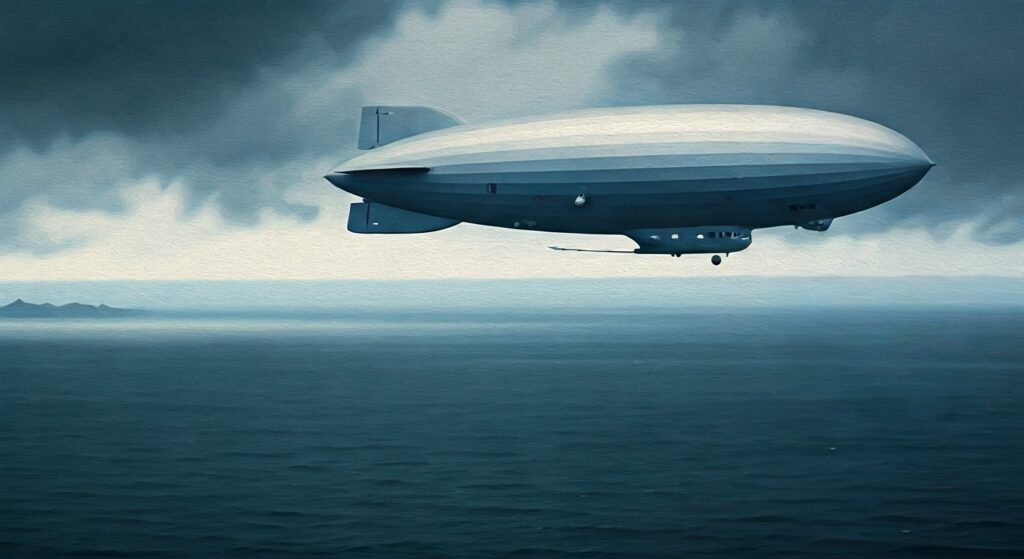
If there is one thing that gets a true-crime lover’s heart racing, it’s a locked-room mystery. But what if that locked room was a military aircraft floating hundreds of feet over the Pacific Ocean?
Welcome to the wild, unsolved case of the L-8 Ghost Blimp. It’s a chilling story complete with vanished pilots, classified materials left behind, and a massive cover-up—or at least, a mystery the military could never quite solve. Let’s dig into one of the most bizarre aviation anomalies of World War II.
A Routine Morning Over the Bay
The date was August 16, 1942. The United States was deeply entrenched in the Second World War, and paranoia about Japanese submarines lurking off the West Coast was at an all-time high. Early that morning, the US Navy blimp L-8, designated Flight 101, lifted off from Treasure Island in San Francisco Bay.
The mission was a standard anti-submarine patrol. At the helm were two highly experienced men: Lieutenant Ernest DeWitt Cody and Ensign Charles E. Adams. These weren’t rookies; they were seasoned veterans who knew the skies and their equipment intimately.
For the first hour, everything was perfectly normal. Then, at 7:38 AM, Cody radioed the base to report a suspicious oil slick near the Farallon Islands—a potential sign of an enemy submarine.
That transmission would be the last time anyone ever heard from them.
A Ghost Ship Drifts Ashore
Down below, the crew of the nearby Liberty ship Albert Gallatin watched the blimp with mild interest. They observed the L-8 circling the oil slick, dropping smoke flares to mark the location, and flying unusually low to the water. Nothing seemed overtly wrong; it was just two pilots doing their jobs.
But a few hours later, onlookers along the California coast noticed something deeply unsettling. The massive silver envelope of the blimp was sagging, drifting aimlessly on the wind like a deflating balloon.
The L-8 briefly touched down at Ocean Beach in San Francisco, violently dislodging a depth charge into the sand, before the wind caught it again. The crippled aircraft drifted further inland until it finally crashed into a residential street on Bellevue Avenue in Daly City.
Sirens wailed. First responders, military personnel, and curious neighbors rushed the wreckage, expecting to pull two battered pilots from the gondola.
Instead, they found a ghost ship.
The Locked-Room Mystery at 300 Feet
When authorities pried their way into the gondola, the scene sent chills down their spines. The pilots were completely gone.
If Cody and Adams had bailed out in a panic, investigators would expect the cabin to be in disarray. It wasn’t. The blimp’s radio was fully functional. The parachutes and the life raft were entirely untouched. Even more baffling, highly classified codebooks were still sitting securely in their proper place. If the men had abandoned ship, standard protocol dictated they destroy or take those books with them.
The only missing gear were their life jackets, but Navy regulations required pilots to wear them at all times during flight. The only clues to the men’s disappearance were a gondola door that was latched open and a safety bar that had been moved out of place.
The Truth is Out There
A massive search and rescue operation immediately scoured the Pacific Ocean. Ships and planes combed the waters around the Farallon Islands, but not a single trace of Cody or Adams was ever found. No bodies. No life jackets floating in the surf. Just complete and total erasure.
The Navy’s official investigation wrapped up with a collective shrug, offering no definitive answers. Naturally, this vacuum of information birthed a myriad of theories.
The most grounded explanation suggests a tragic accident: one of the men slipped while leaning out the open door to inspect the oil slick or drop a flare, and the other fell out while desperately trying to pull him back in.
But for those who treat history like a giant puzzle board, the speculative theories are where things get fascinating. Did they stage their own disappearance to go AWOL? Did a Japanese submarine surface, capture the men, and leave the blimp to drift? Or did they encounter something otherworldly out there in the fog?
We may never know what actually happened to Cody and Adams. But in a twist of irony that feels almost too weird to be true, the L-8 wasn’t scrapped after its eerie joyride. The Navy repaired the ghost blimp, returned it to service as a training vessel, and eventually sold it to Goodyear after the war.
Imagine looking up at a televised sporting event in the 1950s, completely unaware that you were cheering under the very same canvas that swallowed two men whole. Reality truly is stranger than fiction.