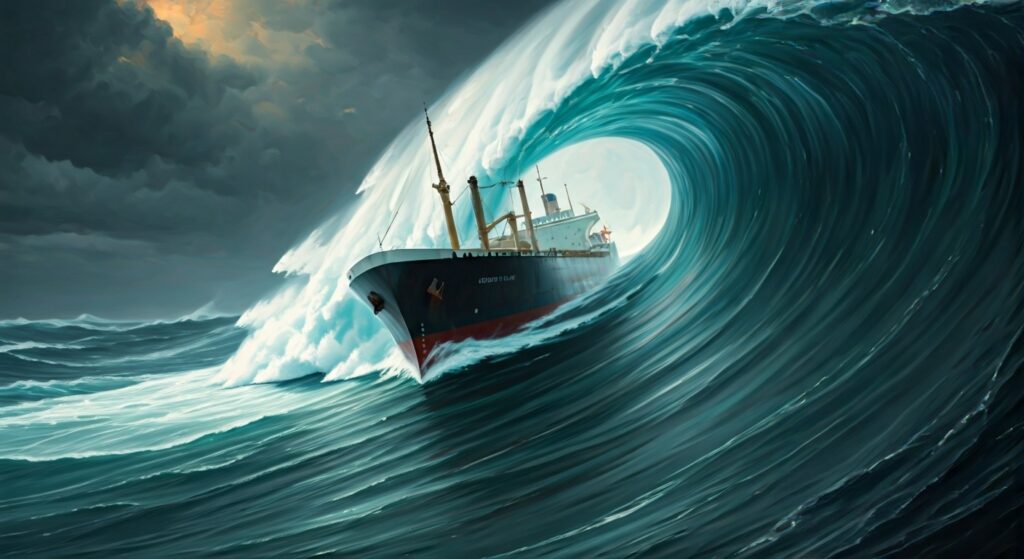
Imagine standing on the deck of a massive steel leviathan. The ocean is rough, but manageable. Suddenly, the bow of your vessel pitches forward—not into another wave, but into a terrifying, bottomless void. A literal hole in the ocean. As you stare down into that precipitous trough, you look up to see a vertical wall of water, over 100 feet tall, blotting out the sun and rushing toward you at freight-train speed.
For centuries, oceanographers and scientists dismissed these tales of “freak waves” as maritime myths, optical illusions, or the drunken exaggerations of superstitious sailors. But the ocean off the coast of South Africa held a deadly secret, and the sea dogs were telling the truth all along.
The Myth of the Ocean’s Abyss
Until the late 20th century, standard mathematical models of ocean waves relied on linear Gaussian dynamics. According to the math, a 100-foot wave was a statistical anomaly that should only occur once in 10,000 years.
But the sailors navigating the “Wild Coast” of South Africa knew better. They whispered of rogue waves that appeared out of nowhere to swallow ships whole. The scientific community demanded proof, but the problem with rogue waves is that they leave no witnesses. When a 100-foot wall of water crashes down on a ship, the empirical evidence usually sinks to the bottom of the sea.
The Graveyard of Steel Giants
The waters off South Africa eventually claimed enough massive vessels that the scientific community could no longer ignore the carnage. The grim pattern began to take shape with the infamous SS Waratah, a luxury passenger liner that vanished without a trace in 1909 with 211 souls on board. No distress call. No wreckage. Just gone.
Decades later, the evidence became structural—and undeniable. In 1968, the 344-foot oil tanker World Glory encountered a freak wave in the region that literally snapped the massive steel ship in half. Five years later, in 1973, the cargo ship Bencruachan suffered a broken back. The crew watched in horror as the ship’s bow pitched down into a massive trough before a sheer wall of water crushed its hull.
These supercarriers were being subjected to bending moments and sheer forces that far exceeded their structural design limits. The culprit wasn’t a sea monster. It was a terrifying collision of natural forces.
A Hydraulic Brake in the Roaring Forties
The breeding ground for these monsters is the Agulhas Current, a narrow, exceptionally strong western boundary current in the southwest Indian Ocean. It transports massive volumes of warm water rapidly down the east coast of Africa at speeds exceeding five knots.
But the Agulhas Current has a violent neighbor. Fierce meteorological systems from the Southern Ocean, known as the “Roaring Forties,” frequently generate massive, gale-force swells that travel northeast.
When these wind-driven behemoths run directly into the opposing, high-speed Agulhas Current, a physical phenomenon called “wave-current interaction” occurs. The current acts like a massive hydraulic brake on the waves’ forward speed. The wave energy compresses, shortening the wavelength significantly while the energy remains constant. With nowhere else to go, the water is forced violently upward.
This creates a dramatically steepened wave, characterized by that mythical “hole in the ocean” trough, immediately followed by a near-vertical wall of water exceeding 100 feet in height.
Vindicated by the Stars
The turning point for science came in 1995 when the Draupner wave in the North Sea provided the first laser-recorded proof that rogue waves were real. But it was the European Space Agency’s MaxWave project in the early 2000s that truly vindicated the sailors of the Agulhas.
Using satellite radar to scan the oceans, the project detected numerous rogue waves globally and confirmed the Agulhas Current as one of the world’s most notorious hotspots. Scientists threw out the old linear models. Today, modern non-linear physics—specifically the nonlinear Schrödinger equation—is used to model how wave energy can suddenly focus into a single, massive peak through a process called modulation instability.
Today, this deadly convergence of oceanographic and meteorological forces is recognized as a formidable natural wonder. Modern shipping lanes have been officially adjusted. When strong opposing winds from the southwest are forecast, vessels are routed closer to the coast to keep them out of the core of the current.
It’s a navigational adaptation that has saved countless lives. More importantly, it serves as a chilling reminder that when humanity tries to tame the ocean, the ocean always has the final say. And those old, superstitious sailors? They were absolutely right.