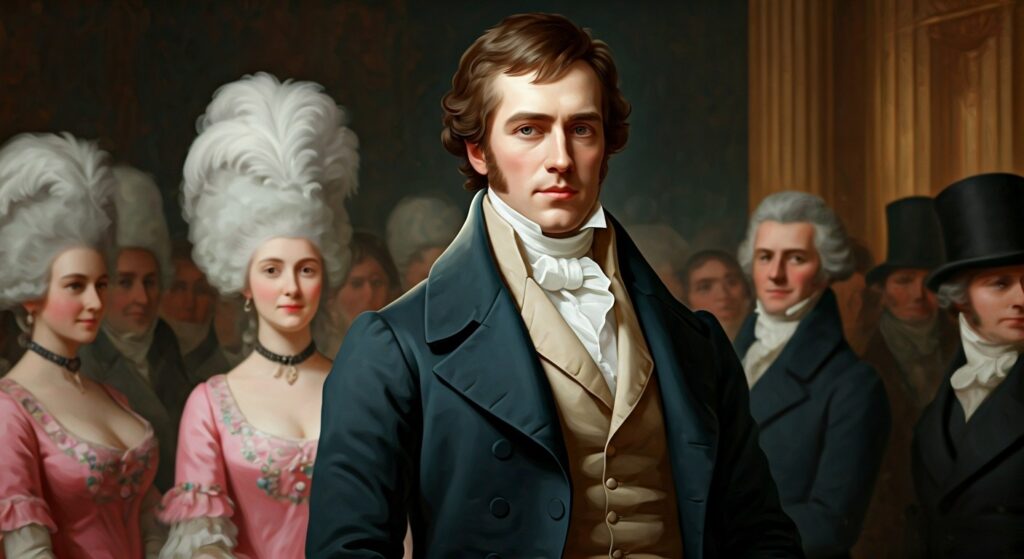
Before the dawn of the 19th century, the ultimate flex for an aristocratic man was to look like a walking wedding cake. The prevailing style was the “macaroni”—men squeezed into heavily embroidered silks, velvet knee breeches, lace ruffles, and high heels, topped with towering, heavily powdered wigs.
But beneath the glittering facade lay a sensory nightmare: the smell.
These men masked a profound lack of bathing by dousing themselves in suffocating, heavy perfumes. It was a chaotic, garish, and malodorous era. It would take a commoner with an absolute superiority complex to tear it all down and invent the uniform of the modern man.
The Man Who Stripped Away the Silk
George Bryan “Beau” Brummell was not a duke. He lacked a noble bloodline and a sprawling ancestral estate. Though he inherited a respectable fortune of £30,000, in the hyper-elite, astronomically wealthy circles of Regency London, he was practically a pauper.
So how did a man without a title become the dictatorial ruler of British fashion? Through sheer, unadulterated audacity.
Brummell looked at the powdered, perfumed aristocrats and decided to do the exact opposite. He championed a radically understated, hyper-masculine aesthetic. Out went the silks, the bright colors, and the powdered wigs. In came dark, form-fitting pantaloons tucked into sleek Hessian boots. He opted for dark blue or black coats, buff-colored waistcoats, and immaculate white linen shirts.
He also introduced something truly revolutionary to the British upper classes: daily bathing. Brummell insisted that a true gentleman shouldn’t smell of perfume, but of nothing but clean linen and fresh water.
The Weaponization of the Cravat
Brummell’s crowning glory—and his ultimate weapon of intimidation—was his cravat.
It wasn’t just a piece of fabric; it was an architectural marvel. Heavily starched and intricately knotted, achieving the perfect cravat took Brummell hours each morning. He would discard dozens of slightly wrinkled attempts onto the floor until he achieved a look of perfect, studied nonchalance.
This meticulous dedication turned him into one of the world’s first modern celebrities. From his legendary spot at the bow window of White’s Club, Brummell dictated social etiquette. He could make or break a nobleman’s reputation with a single withering glance. His supreme confidence allowed him to treat dukes as his inferiors, earning him the close friendship of the ultimate VIP: the Prince of Wales.
Brummell proved that style and wit could trump aristocratic birthright. But when you build a throne on nothing but attitude and borrowed money, the fall is bound to be devastating.
Five Fatal Words
Brummell’s reign had a ticking clock. He lacked the endless wealth of his peers, yet he lived exactly like them, developing a ruinous gambling addiction.
As his debts mounted, his arrogance curdled, and his relationship with the Prince Regent began to sour. The tension finally snapped at a legendary masquerade ball.
The Prince Regent, intending to publicly snub Brummell, greeted everyone in Brummell’s party but entirely ignored the fashion icon. As the Prince walked away, Brummell turned to his companion, Lord Alvanley, and loudly asked the most fatal question in high-society history:
“Alvanley, who’s your fat friend?”
The insult echoed across London. In a single breath, Brummell had severed his royal patronage. Without the Prince’s protection, Brummell’s creditors closed in. By 1816, his inheritance was completely consumed by debt. To avoid the horrors of a debtors’ prison, the king of fashion fled into the night, escaping across the English Channel to France.
Ghosts in a French Boarding House
The final act of Beau Brummell’s life is a masterclass in gothic tragedy.
Exiled in Calais, the man who once spent hours starching a single piece of linen began a slow, agonizing descent into squalor. His once-sharp mind was eventually ravaged by tertiary syphilis, plunging him into madness.
In his final years, a destitute Brummell would hold phantom dinner parties for long-dead English lords in his shabby French boarding house, playing host to ghosts in the dark.
The original dandy died entirely penniless in a charitable asylum in Caen in 1840. Yet, his legacy outlived his ruin. Today, every time a man puts on a sharp, dark suit, he is unknowingly paying homage to a commoner who conquered the world with nothing but clean linen, a sharp tongue, and the perfect knot.