Look closely at the impeccable stitching on a vintage jacket or the flawless seams of a modern dress. We take the modern fashion industry for granted, assuming the leap from agonizing hand-stitching to global ready-to-wear fashion was a clean stroke of innovation by a lone genius.
The truth is far darker. The mechanization of our clothes wasn’t born from a peaceful moment of inspiration. It was a vicious, mud-slinging saga of intellectual property theft, ruined lives, and ruthless capitalism.
Welcome to the Sewing Machine War.
The Inventor Who Grew a Conscience
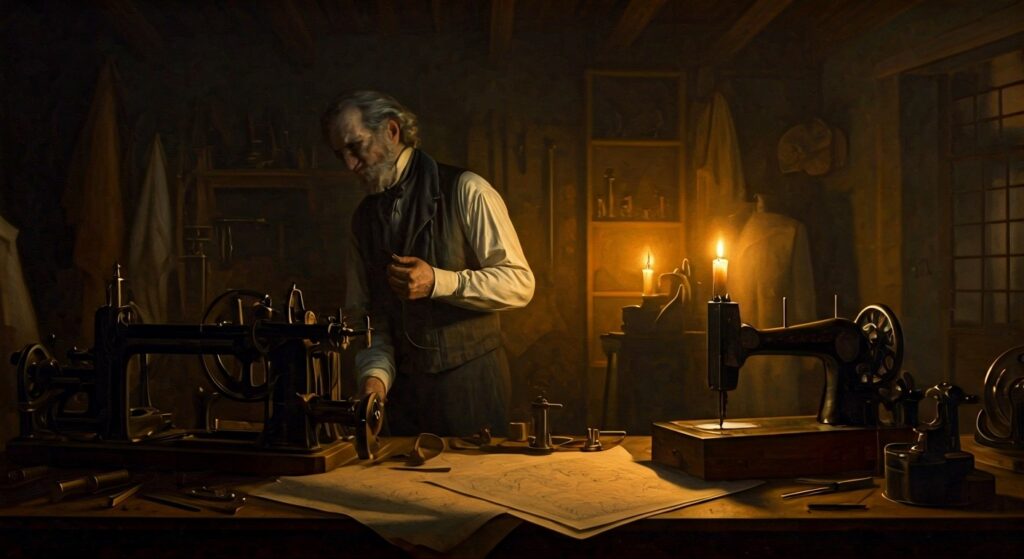
The chaos began in the 1830s when a prolific American inventor named Walter Hunt achieved the impossible. He engineered a functioning lockstitch sewing machine using an ingenious combination: an eye-pointed needle and an oscillating shuttle. It was the holy grail of the Industrial Revolution.
But Hunt harbored a fatal flaw for a 19th-century capitalist: he had a conscience.
Looking at his whirring, hyper-efficient machine, Hunt was struck by a sudden moral crisis. He realized his invention would put thousands of hand-seamstresses out of work overnight. Horrified by the economic devastation his brainchild might unleash, he made a shocking decision. He abandoned it. He never filed a patent, leaving a world-changing fortune sitting in the dark.
A Corset Maker’s Swindle
A decade later, another engineer named Elias Howe independently developed a remarkably similar lockstitch machine. Unlike Hunt, Howe had zero qualms about patenting his creation, securing his rights in 1846.
Howe was an undisputed engineering genius, but an absolutely terrible businessman. Unable to convince a single American investor to back his machine, a desperate Howe crossed the Atlantic to England. There, he fell into the clutches of a British corset maker who recognized Howe’s desperation, ruthlessly exploited his talents, swindled him out of his royalties, and left him utterly destitute.
By 1849, Howe scraped together just enough money to return to the United States. He arrived completely broke, hoping to start over. Instead, he stepped off the boat to a shocking revelation: the American market was suddenly flooded with sewing machines. And every single one of them was utilizing his patented eye-pointed needle.
Enter the Shakespearean Villain
The most prominent of these patent infringers was a man named Isaac Merritt Singer. Yes, that Singer.
Singer was a flamboyant, larger-than-life former Shakespearean actor turned ruthless entrepreneur. In 1850, Singer was asked to examine a faulty sewing machine. In a mere eleven days, he engineered crucial, world-changing improvements. He replaced the exhausting hand crank with a foot treadle and added a yielding presser foot, finally allowing for continuous, curved stitching.
Singer plastered his name on his machines and created the first truly practical, commercially viable sewing machine.
There was just one glaring problem: the core mechanism of Singer’s brilliant machine was a blatant, unapologetic rip-off of Elias Howe’s 1846 patent.
The Courtroom Gridlock
When Howe knocked on Singer’s door demanding his rightful royalties, Singer flat-out refused. The Sewing Machine War had officially begun.
The 1850s quickly devolved into a dizzying, cutthroat arena of lawsuits. Howe sued Singer. Singer sued Howe. Emerging manufacturers like Wheeler & Wilson and Grover & Baker jumped into the fray, and soon, everyone was suing everyone. Singer, playing the ultimate villain, even tracked down the obscure Walter Hunt and tried to use Hunt’s abandoned 1830s prototype to invalidate Howe’s patent.
But the courts weren’t having it. A judge ruled that because Hunt had abandoned his invention, Howe was the rightful patent holder. Howe was granted retroactive royalties, forcing Singer and every other manufacturer to pay him a cut for every single machine they had ever sold.
Despite Howe’s victory, the relentless litigation created a massive legal gridlock. The patents were so hopelessly tangled that no single manufacturer could build a complete, functional sewing machine without infringing on someone else’s intellectual property. The nascent fashion industry was on the brink of destroying itself before it even truly began.
The Lawyer Who Stitched It All Together
The breakthrough that saved our wardrobes didn’t come from an engineer or a fashion designer. It came from a lawyer.
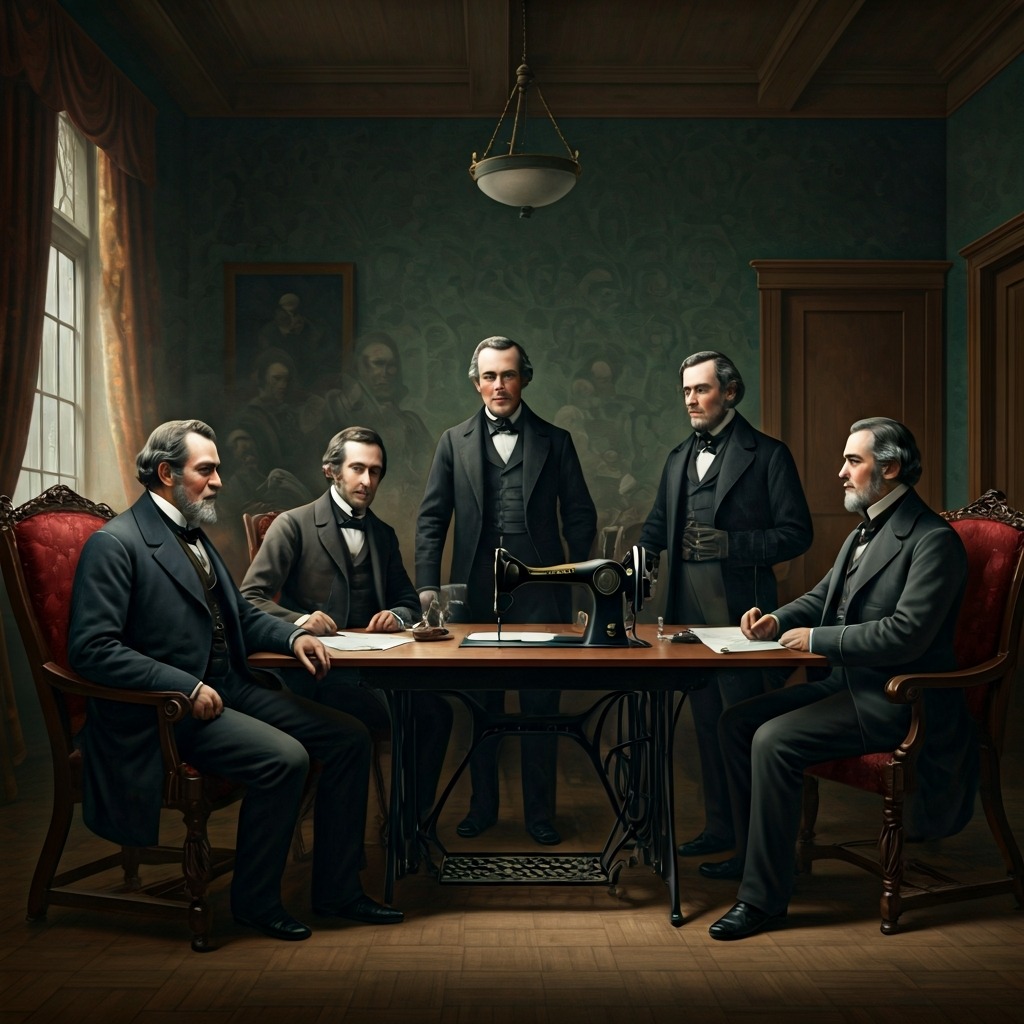
In 1856, Orlando B. Potter, the president of Grover & Baker, proposed a radical, unprecedented idea. Instead of suing each other into bankruptcy, the top four manufacturers should lay down their arms and merge their patents.
This truce formed the “Sewing Machine Combination,” the first major patent pool in United States history. Singer, Howe, Wheeler & Wilson, and Grover & Baker pooled nine crucial patents. From then on, anyone who wanted to manufacture a sewing machine had to pay a steep licensing fee to the Combination. And because of his ironclad 1846 patent, a portion of every single sale went directly into the pockets of Elias Howe.
The Price of Fast Fashion
The Combination successfully ended the Sewing Machine War, but it birthed a ruthless oligopoly. Smaller inventors and independent mechanics who couldn’t afford the exorbitant licensing fees were crushed, their businesses ruined, and their names entirely erased from history.
Meanwhile, the “Big Four” amassed staggering, unimaginable fortunes. Elias Howe died a multi-millionaire. Isaac Singer went on to pioneer modern consumerism by introducing installment purchasing, a revolutionary credit system that allowed middle-class families to afford his machines.
So, the next time you buy a dress off the rack or marvel at the intricate seams of a tailored coat, remember that the mass-produced clothing industry wasn’t born from a peaceful moment of inspiration. It was stitched together by bruised egos, stolen ideas, and a vicious legal war that changed the world forever.