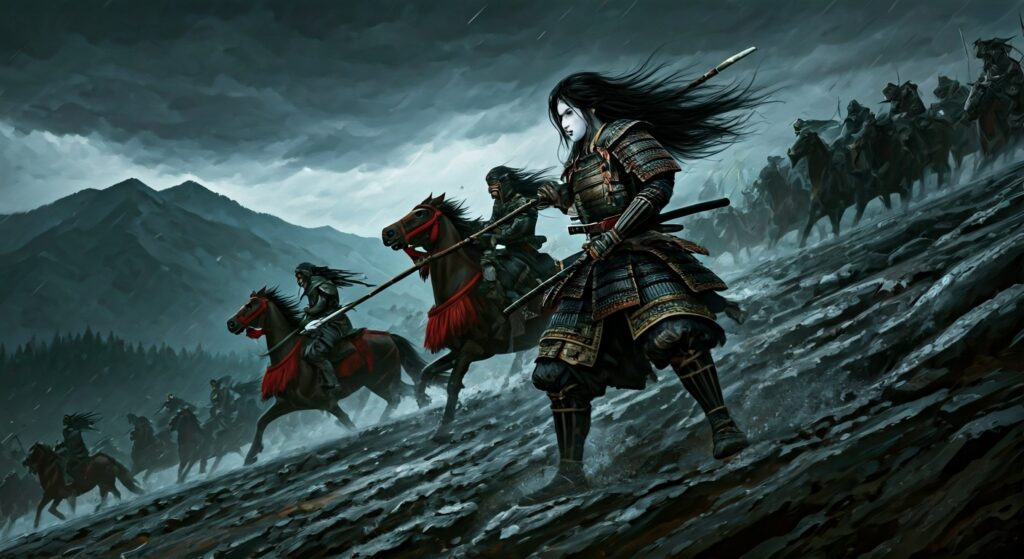
In the hyper-lethal, male-dominated world of 12th-century samurai, one name struck a unique, paralyzing terror into the hearts of Japan’s greatest warlords. She didn’t just participate in the brutal Genpei War; she orchestrated its carnage. She broke wild horses, commanded thousands of men, and collected the severed heads of enemy champions like macabre trophies. Her name was Tomoe Gozen.
Her story is one of unimaginable physical strength, fierce loyalty, and a legendary final act of defiance that still echoes through history.
A Warrior Worth a Thousand
The Genpei War (1180–1185) was an era-defining bloodbath between the rival Taira and Minamoto clans that fundamentally reshaped Japan. Amidst this chaos rose Tomoe, serving under the aggressive and powerful general Minamoto no Yoshinaka. Whether she was his wife, his concubine, or simply his most fiercely loyal retainer remains debated by historians. But what no one debates is her lethality.
The primary source for her existence is the monumental 13th-century epic, the Tale of the Heike. The text doesn’t mince words when describing her prowess. It notes her striking beauty—pale skin and long, flowing hair—before pivoting to the only metric that mattered in the mud and blood: she was a remarkably strong archer and a swordswoman “worth a thousand, ready to confront a demon or a god, mounted or on foot.”
While other women of her era were confined to the domestic sphere or strictly defensive roles as onna-musha (female warriors), Tomoe was an offensive powerhouse. Yoshinaka trusted her implicitly, appointing her as a leading commander.
The Headhunter of Kurikara
Tomoe wasn’t directing troops from the safety of a distant pavilion. She was in the vanguard. Managing a massive cavalry unit in the 12th century was a logistical nightmare of feeding horses, repairing armor, and maintaining discipline. Yet at the Battle of Kurikara in 1183, Tomoe commanded a sweeping contingent of horsemen, playing a crucial role in a victory that temporarily drove the Taira out of Kyoto.
But her reputation was truly cemented by a gruesome penchant for headhunting. In samurai culture, taking the head of a defeated enemy was standard practice to prove valor and claim a reward. For a woman to do it, however, was unthinkable. Tomoe didn’t just pick off foot soldiers; she actively sought out the strongest enemy champions, defeated them in single combat, and claimed their heads as trophies.
She became a psychological weapon. Imagine the terror of a seasoned samurai, confident in his armor and training, watching Tomoe Gozen charge down a perilous mountain descent—a feat she was famous for surviving unscathed—hunting for her next kill.
The Slaughter at Awazu
Every legend demands a tragic climax, and Tomoe’s arrived in 1184 at the Battle of Awazu.
Yoshinaka’s ruthless political maneuvers had alienated his own clan, prompting his cousin to send a massive army to crush him. Heavily outnumbered, Yoshinaka’s forces were systematically decimated. The battlefield became a slaughterhouse.
Soon, Yoshinaka was reduced to a desperate rear guard of only five to ten warriors. Among them, drenched in the blood of her enemies, was Tomoe.
Knowing the end was imminent, Yoshinaka issued a final, heartbreaking command: she must flee. To die alongside a woman, he claimed, would be a permanent stain on his honor. Bound by duty yet reluctant to abandon her lord, the general who had slain the greatest champions of the Taira clan agreed to obey.
But she refused to leave quietly. She intended to give Yoshinaka one final, terrifying display of her loyalty.
The Final Grapple
Scanning the chaotic, corpse-strewn battlefield, Tomoe sought a worthy final opponent. Her eyes locked onto Onda no Hachiro Moroshige, a famously massive and powerful warrior from the Musashi province who was leading a unit of thirty men.
Tomoe didn’t hesitate. She kicked her horse into a dead sprint, charging directly into the teeth of Moroshige’s ranks.
She rode violently alongside the giant, their horses crashing together in a symphony of shrieking beasts and shattering armor. Before Moroshige could react, Tomoe reached out and seized him in a brutal grapple. With terrifying, raw strength, she dragged the fully armored samurai out of his saddle and onto her own. Pinning him against the pommel, she drew her blade and decapitated him in the center of the swirling melee.
Casting his severed head aside, she discarded her heavy armor and spurred her horse toward the eastern provinces, vanishing into the mist.
A Ghost in the Mist
What happened to Tomoe Gozen after Awazu remains one of history’s most tantalizing mysteries.
Because her exploits were immortalized in an epic poem originally chanted by blind monks, the line between fact and fiction blurs. Some legends claim she was captured by the samurai Wada Yoshimori, forced into marriage, and birthed a legendary strongman. Others whisper she became a Buddhist nun, living to the age of 90, spending her twilight years praying for Yoshinaka’s soul. The darkest tale suggests she retrieved her lord’s severed head and walked into the sea, drowning herself to remain by his side for eternity.
We may never know her true fate. Yet the ambiguity only deepens her aura. Tomoe Gozen remains the ultimate subversion of feudal order—a terrifyingly beautiful warrior who outfought, out-rode, and out-slayed the greatest men of her age.