When China’s first emperor, Qin Shi Huang, prepared for the afterlife, he didn’t just build a grave—he engineered an impenetrable, subterranean fortress designed to ensure his reign would never end.
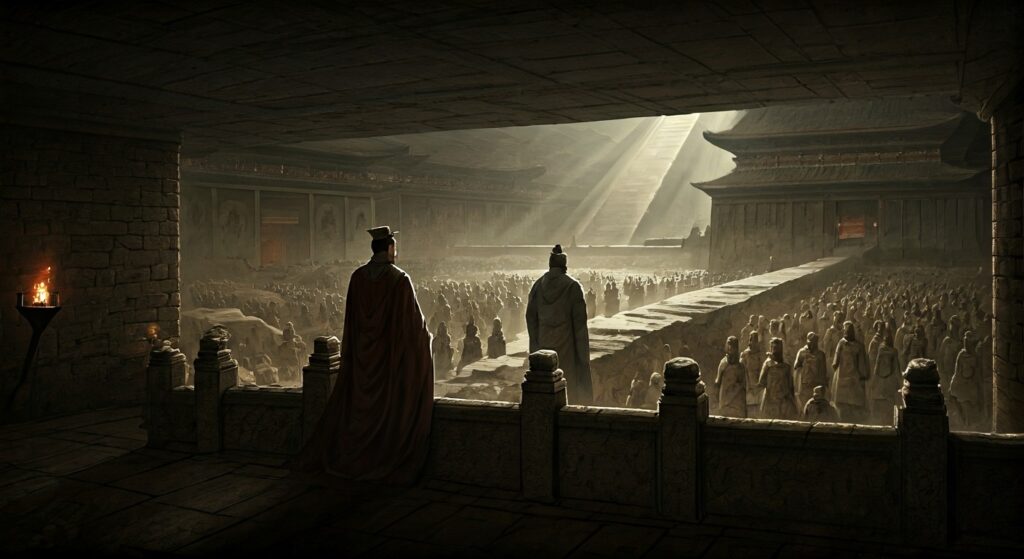
You’ve likely seen the faces of the Terracotta Army. An underground garrison of 8,000 life-sized clay soldiers standing at attention is an undeniable testament to absolute power. But those silent warriors, buried near the Emperor following his death in 210 BCE, are merely the perimeter defense.
The real treasure—and the true danger—is still locked inside.
Deep within the central tomb mound at Mount Li lies a secret so audacious that historians dismissed it as pure fiction for over two millennia. Beneath the earth sits a sealed palace allegedly flowing with literal rivers of liquid metal.
A Supervillain’s Lair Beneath the Earth
For centuries, everything the world knew about the Emperor’s actual burial chamber came from a single, legendary scouting report: the Records of the Grand Historian. Written by Sima Qian roughly a century after Qin Shi Huang’s death, the text describes a tomb that reads less like a resting place and more like a mythical labyrinth.
According to Sima Qian, the tomb was rigged with hair-trigger crossbows, mechanically set to skewer any grave robber foolish enough to break the seal. But these lethal booby traps were just the beginning.
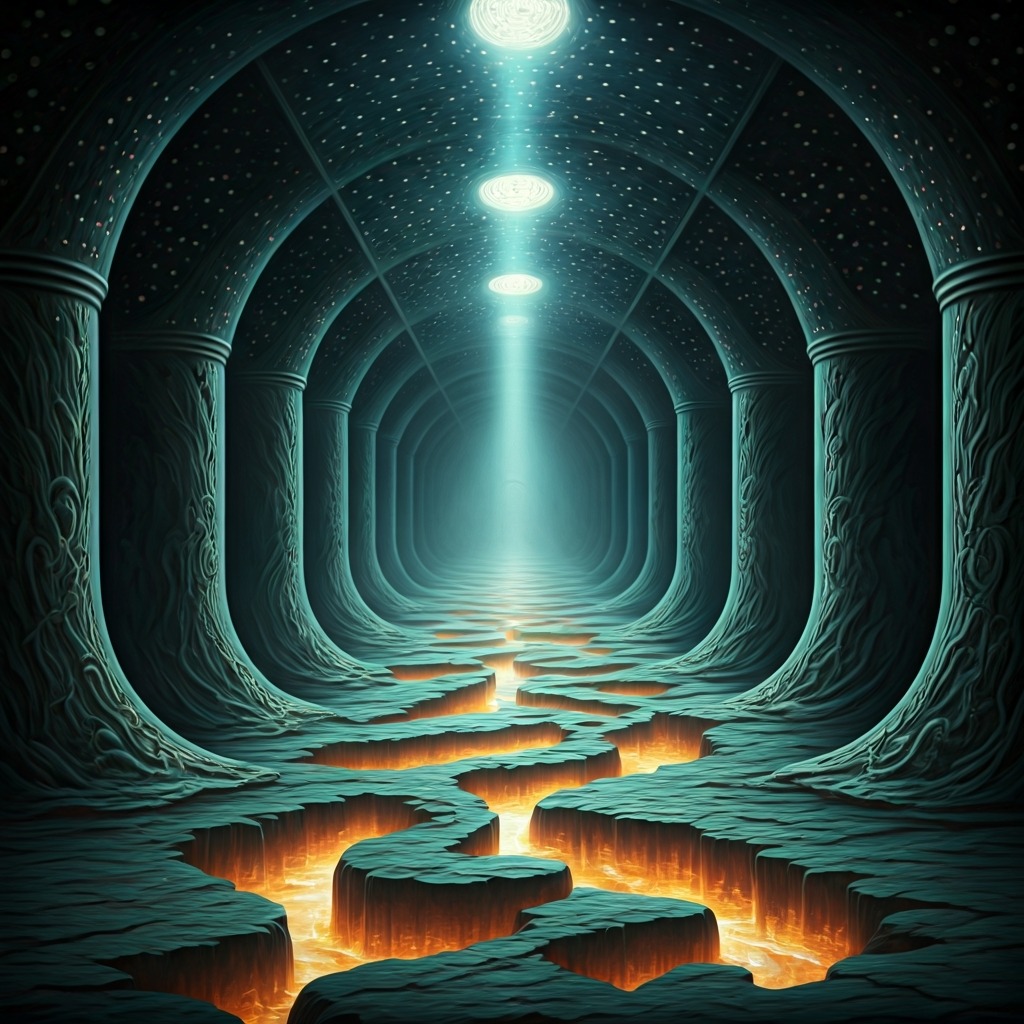
Inside, the ceiling was said to mimic the night sky, glittering with pearls and precious gems arranged as cosmic constellations. Below this starry canopy, the floor was a massive, scale-model map of the Emperor’s vast domain.
Then, Sima Qian dropped a detail so wild it defied belief: the tomb featured mechanical devices that pumped endless rivers of quicksilver—liquid mercury—to simulate the Yellow River, the Yangtze, and the great ocean, flowing eternally in the dark.
The Deadly Irony of Immortality
The logistics required to source that much cinnabar, extract the toxic mercury, and engineer a subterranean hydraulic system in the ancient world are staggering. But why mercury?
In ancient China, this heavy, shimmering liquid was believed to possess mystical properties. It was the ultimate elixir, a substance thought to grant immortality and divine power.
Here is where history takes a dark, deeply ironic turn. In his obsessive, paranoid quest to live forever, Qin Shi Huang regularly consumed mercury pills. Instead of granting him eternal life, the heavy metal poisoned his mind and body, driving him to madness and ultimately killing him at the premature age of 49. Surrounding his corpse with a literal ocean of the very substance that murdered him was the ultimate, tragic monument to his obsession.
When the Soil Speaks: Science Catches Up to Myth
For over two thousand years, modern scholars read Sima Qian’s account and laughed it off. A starry ceiling and some traps were plausible, but mechanical rivers of liquid mercury? That was surely ancient propaganda.
Then, science caught up to the myth.
In the 1980s, and much more extensively in the early 2000s, researchers decided to put the legend to the test. They ran soil resistivity and core sampling tests on the massive, unexcavated earthen mound sitting above the tomb.
The results sent shockwaves through the archaeological world. They didn’t just find traces of mercury; they discovered highly anomalous concentrations in the soil, measuring up to 100 times the natural background rate. Even more chilling? When scientists mapped out the distribution pattern of these toxic anomalies, it perfectly aligned with the major water systems of the ancient Qin Empire.
Sima Qian wasn’t exaggerating. The toxic rivers are real, and they are still down there.
The Ultimate “Do Not Disturb” Sign
If we know the greatest archaeological treasure in human history is sitting right under our feet, why haven’t we cracked it open?
First, there is the incredibly lethal threat of toxic mercury vapor. Breaking the seal on a 2,200-year-old toxic terrarium is a logistical nightmare that could severely poison an excavation team.
Second, our current technology simply isn’t good enough to save what’s inside. Archaeologists learned a brutal lesson when they first unearthed the Terracotta Army. The warriors were originally painted in brilliant, lifelike colors. But within minutes of being exposed to dry, modern air, the vibrant paint curled, flaked off, and disintegrated, leaving them a uniform clay gray. No one wants to be the person responsible for accidentally turning a pristine, jewel-encrusted cosmic ceiling to dust.
Add in a deep cultural respect for the dead, and the lingering, spine-tingling mythos of those ancient crossbow traps, and you have a perfect standoff.
For now, Qin Shi Huang remains undefeated. His toxic, liquid-metal rivers continue to flow undisturbed in the dark—a monument to a man who conquered the world, and successfully locked the door behind him.