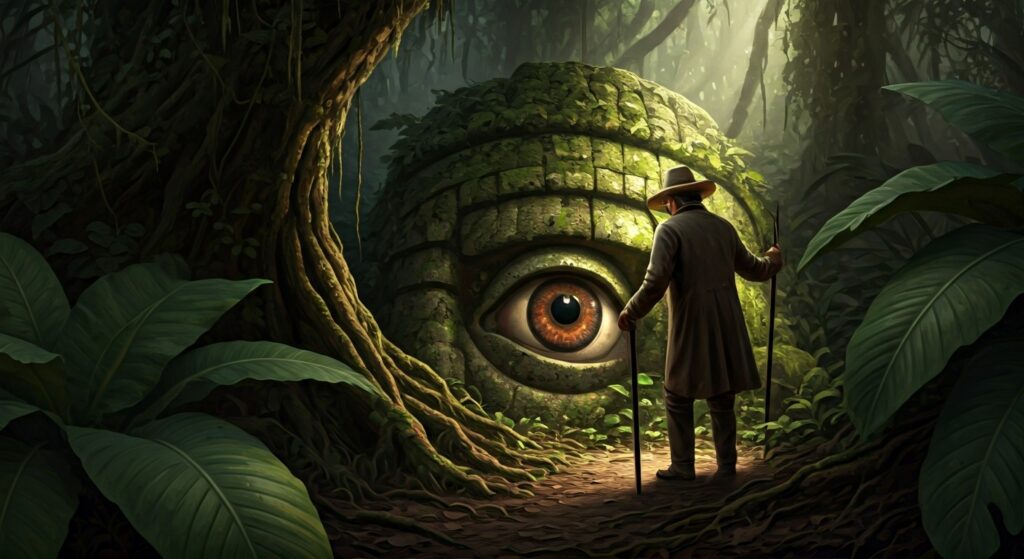
Deep in the sweltering, unforgiving jungles of the Mexican Gulf Coast, a monumental secret lay buried for over two millennia. In 1862, a Mexican scholar wandering the dense brush of Tres Zapotes stumbled upon an anomaly protruding from the earth. It wasn’t a ruin or a relic—it was a massive, unblinking eye carved from stone.
This was the world’s first glimpse of the Olmec colossal heads, a discovery that would eventually unveil Mesoamerica’s “mother culture.” But it wasn’t until archaeologist Matthew Stirling began full-scale excavations in the mid-20th century that the staggering, terrifying scale of this civilization came to light.
To date, seventeen of these megalithic sentinels have been unearthed across ancient sites like San Lorenzo, La Venta, and Tres Zapotes. Carved from solid blocks of volcanic basalt, the heads are intimidatingly massive. Towering up to 11 feet tall and weighing as much as 40 tons, they are a marvel of ancient engineering. But their sheer size isn’t what keeps archaeologists awake at night. It’s the impossible logistics of their creation.
An Impossible Commute
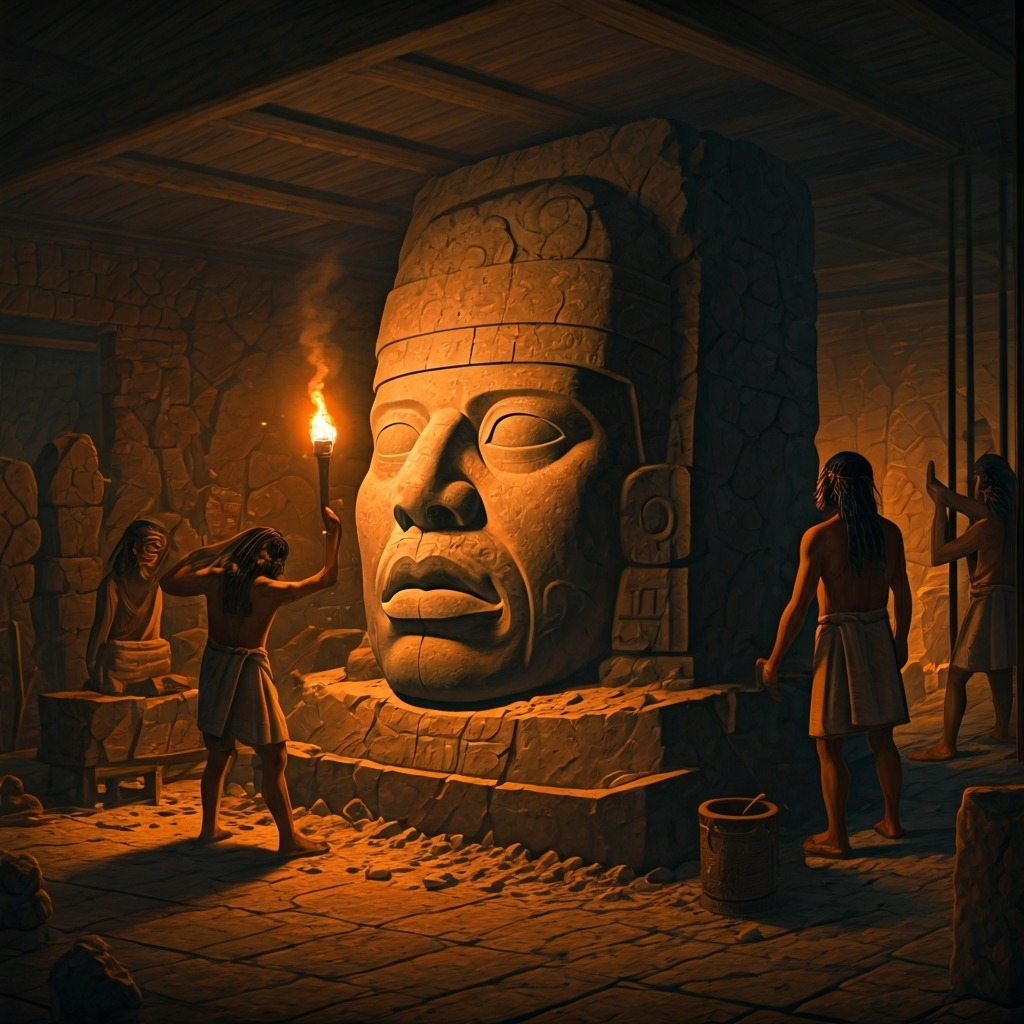
If you assume the Olmecs utilized an arsenal of iron chisels to carve these behemoths, think again. Operating between 1200 and 400 BCE, they lacked metal tools entirely. Instead, they relied on immense patience, using stone hammers, abrasives, and water to painstakingly grind and shape the unforgiving basalt.
Yet, the true mystery lies in the commute. The basalt wasn’t sourced locally. It was quarried from the Tuxtla Mountains, over 50 miles away from the major Olmec cities.
Consider the reality of this landscape: dense jungle, treacherous swamps, and winding rivers. Now consider that the Olmecs possessed neither functional wheels nor beasts of burden. Transporting a 40-ton boulder across 50 miles of hostile terrain was a monumental feat of human endurance. Scholars theorize that it required a highly coordinated army of thousands of laborers. The megaliths were likely dragged overland on wooden sledges gliding over rollers, then carefully transferred onto massive balsa rafts to navigate the region’s turbulent river network. One wrong move, and months of labor would sink to the bottom of the Gulf.
Portraits in Stone
When you stand before one of these colossal heads, you aren’t looking at a generic deity or a mythical creature. You are staring directly into the eyes of a specific, all-powerful human being.
Each head is masterfully detailed and highly individualized, featuring unique expressions and distinct headdresses. This level of personalization strongly suggests they are portraits of specific rulers. For a time, their distinct facial characteristics—broad noses, fleshy lips, and prominent cheeks—sparked fringe theories of ancient trans-Atlantic voyages. Today, modern geneticists and historians overwhelmingly agree that these features accurately reflect the indigenous populations of the region. These were the faces of local kings, immortalized in volcanic rock to watch over their domains.
The Ultimate Power Move
But there is one final, brilliant twist to the story of the colossal heads—a revelation that fundamentally changes how we view these ancient masterpieces.
Archaeological evidence suggests that some of these heads weren’t originally carved as heads at all. They were massive stone thrones. Scholars now believe that upon a ruler’s death, his magnificent seat of power was tipped backward and meticulously recarved into a colossal head.
This wasn’t a mere recycling effort; it was a deeply spiritual and political act. By transforming the throne into a portrait of the deceased king, the Olmecs created a permanent monument to his reign while simultaneously neutralizing the potent spiritual energy embedded in his seat of authority.
Today, these seventeen faces stand as silent, awe-inspiring testaments to the organizational genius, artistic mastery, and profound spiritual life of Mesoamerica’s first great civilization. They remain a haunting reminder that human ingenuity doesn’t need wheels or iron to leave a mark that lasts for millennia.