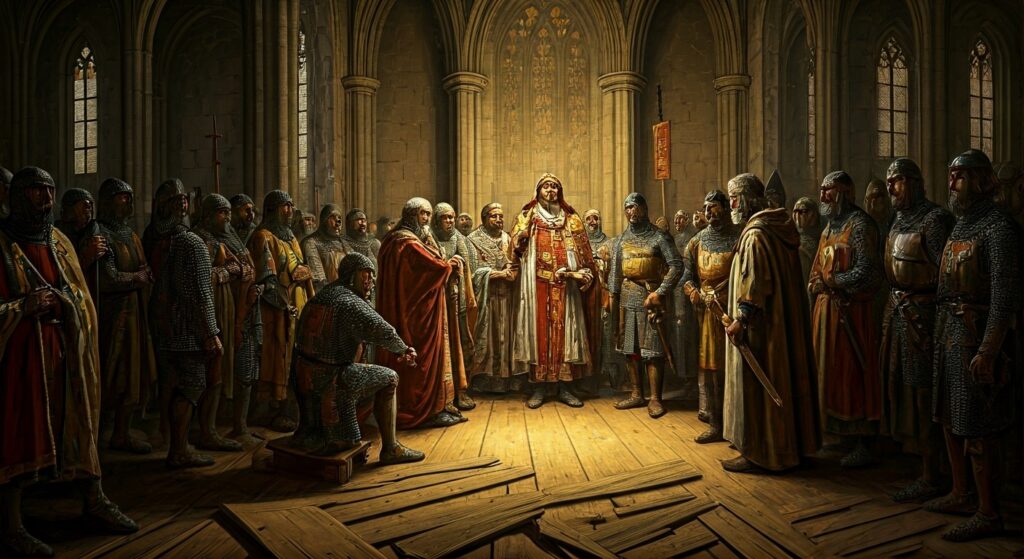
The air inside the Peterskloster monastery on July 26, 1184, was thick with tension—and the suffocating heat of a medieval summer. King Heinrich VI, the future Holy Roman Emperor, had summoned the most powerful men in Europe to Erfurt, Thuringia. His mission was urgent: to mediate a vicious, blood-soaked feud between Landgrave Ludwig III of Thuringia and Archbishop Conrad of Mainz. If left unchecked, their bitter rivalry threatened to tear the empire apart.
To force a peace, Heinrich convened a massive diet, or Hoftag. It was the medieval equivalent of a high-stakes mafia sit-down. Dozens of elite nobles, battle-hardened knights, and high-ranking clergy answered the royal summons, crowding into an upper-story room of the church. They arrived clad in heavy chainmail and armor, carrying broadswords and projecting massive egos.
But as the negotiations began, a silent, deadly threat lurked just beneath their feet.
The Weight of an Empire
The medieval architecture of St. Peter’s Church was magnificent, but it was never engineered to hold the immense, concentrated weight of a densely packed crowd of heavily armored men. As the empire’s elite stood shoulder-to-shoulder, hashing out the future of Germany, the wooden floorboards beneath them began to bow.
Without warning, the timber gave an agonizing groan.
Then, the floor simply vanished.
It wasn’t a localized break; it was a catastrophic structural failure. As dozens of men plummeted downward, the kinetic energy of their armored bodies crashing onto the floor below triggered a massive chain reaction. The second floor instantly collapsed under the sudden, violent impact.
The most powerful men in the Holy Roman Empire were falling into the dark. But they didn’t just land in an empty basement.
Into the Abyss
Beneath the monastery lay a massive, deep cesspit—the latrine for the entire facility. Because Peterskloster was a bustling hub of monks and travelers, this pit had been accumulating liquid human waste for decades.
The scene that unfolded was pure, unimaginable nightmare fuel. Between 60 and 100 nobles and dignitaries plunged directly into the churning, toxic abyss.
While some died instantly from the brutal physical trauma of the fall and falling debris, the majority suffered a far more agonizing fate. Dozens of Europe’s most formidable warlords and politicians tragically drowned in the liquid excrement. Those who managed to fight their way to the surface and keep their heads above the muck were quickly overcome by the invisible killer lurking in the dark: decades of trapped sewer gas. As they gasped for air, toxic plumes of methane and carbon dioxide suffocated them.
In the blink of an eye, a generation of regional leadership—including Count Gozmar III of Ziegenhain, Count Heinrich of Schwarzburg, and Friedrich of Kirchberg—was literally wiped out in the filth.
The King on the Ledge
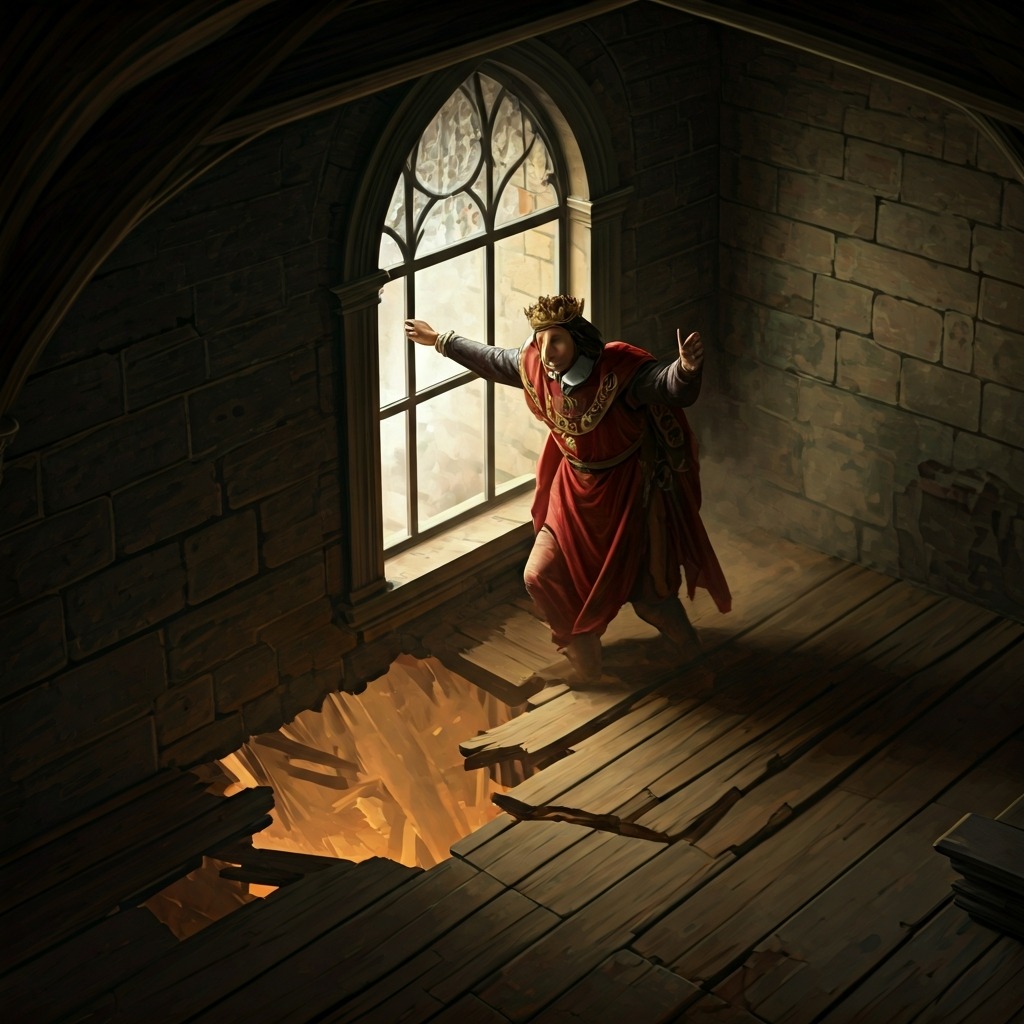
As the floor violently disintegrated and the screams of dying men echoed from the pit below, King Heinrich VI narrowly escaped the abyss.
In a miraculous twist of fate, the King had been seated in an alcove—a stone-walled window niche built with a solid masonry floor. As the wooden room collapsed around him, Heinrich desperately clung to the iron window frame. He found himself stranded on a tiny stone ledge, suspended over a deadly drop into a sea of sewage, watching his royal court perish.
He remained trapped on that precarious perch until rescuers could finally navigate the wreckage and raise ladders to bring him down. Landgrave Ludwig III—one of the men whose bitter feud had necessitated the gathering—also miraculously survived the fall, though he was pulled from the muck severely injured.
The Erfurter Latrinensturz (Erfurt Latrine Disaster) abruptly halted all political mediation and completely upended the power dynamics of the Holy Roman Empire. It remains one of history’s most bizarre, gruesome, and humiliating tragedies—a stark reminder that no matter how much power you wield, you are always at the mercy of the floorboards beneath your feet.