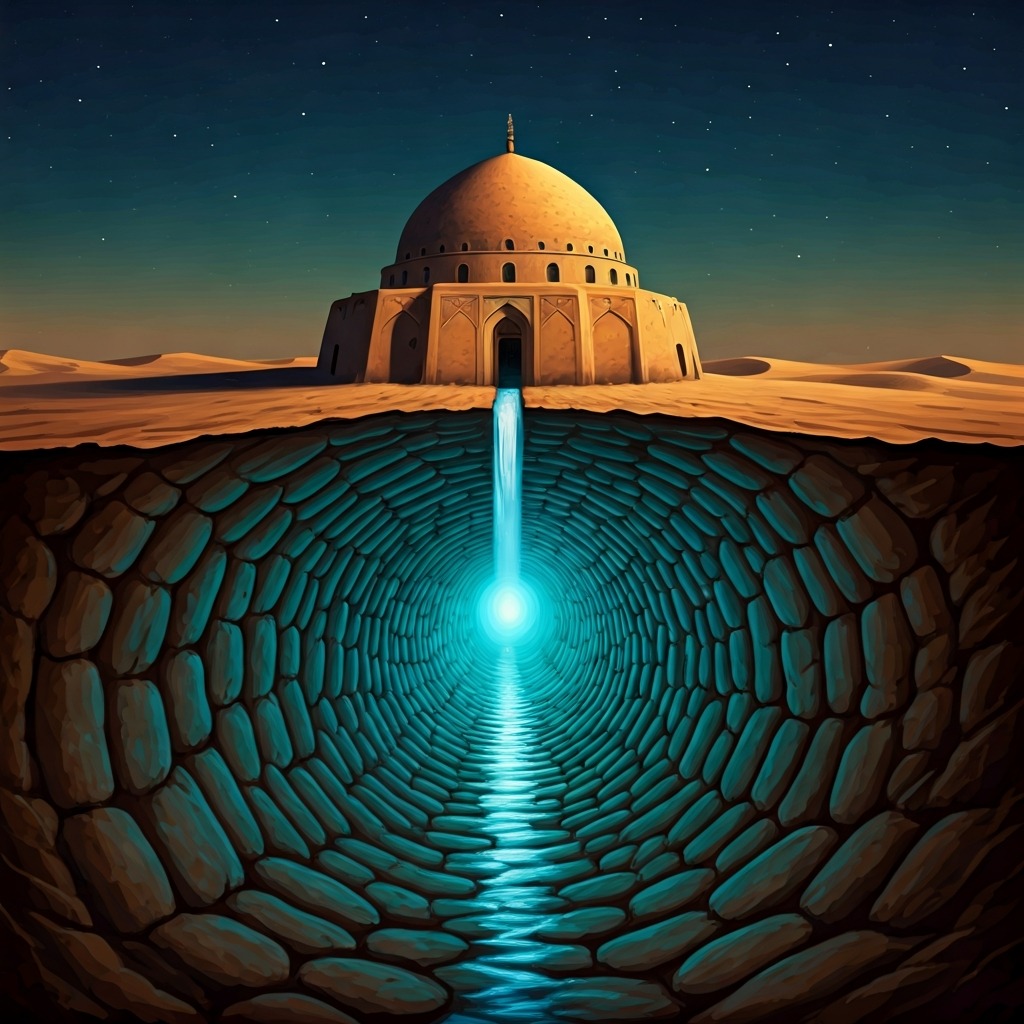
Three thousand years ago, the Iranian plateau was a merciless wasteland. The sun baked the earth into a cracked, lifeless crust. By all logic, this arid expanse should have been a graveyard for any civilization attempting to take root. Yet, against all odds, ancient Persia didn’t just survive here—it thrived. Lush orchards of pistachios and pomegranates bloomed in the dust. Vast, glittering cities rose from the baked earth.
How did they do it? They didn’t pray for rain. They went underground.
Welcome to the subterranean world of the ancient Middle East, where a 3,000-year-old engineering marvel defied the laws of nature and altered the course of human history.
The Desert’s Hidden Lifeline
To build an empire in the desert, you need water. But in a landscape where the sun is a relentless enemy, open-air canals were a fool’s errand. The scorching heat would evaporate the water long before it could reach a thirsty mouth or a dying crop.
The ancient Persians, however, realized that the jagged mountains bordering their desert basins held a secret. Deep beneath the alluvial fans at the base of these peaks lay rich, hidden aquifers. The challenge wasn’t finding the water—it was moving it dozens of miles across a blistering desert without losing a single drop to the sky.
Their solution was the qanat, a passive, gravity-driven aqueduct system completely concealed beneath the earth. It was a masterstroke of environmental manipulation, but building it required a descent into absolute darkness.
Journey Into the Pitch-Black: The Muqannis
Constructing a qanat was a terrifying, high-stakes endeavor. It began by sinking a massive vertical shaft called the madar chah, or “mother well,” deep into the water table at the base of a mountain. Once water was struck, the real nightmare began.
Specialized diggers known as muqannis were tasked with excavating a tunnel from the destination—a city or farming village—all the way back to the mother well. Working by the dim, flickering light of oil lamps, these ancient engineers carved through solid rock and compacted soil. The air was thin, the heat stifling, and the threat of a cave-in was a constant, looming specter.
To keep the diggers from suffocating, and to haul away the excavated earth, vertical access shafts were dug every 20 to 30 meters. If you fly over Iran today, the remains of these shafts look like a line of giant, unearthly craters marching across the desert floor.
The Deadly Mathematics of Water
The true genius of the qanat lay in its sheer mathematical precision. The tunnel had to slope downwards to allow gravity to pull the water toward the city, but the margin for error was virtually zero.
If the muqannis dug the slope too steeply, the rushing water would scour the tunnel walls, eventually causing the entire system to collapse and bury the workers alive. If the slope was too shallow, the water would stagnate, breeding disease and failing to reach its destination.
Without lasers, GPS, or modern surveying equipment, these engineers maintained a perfect, gentle gradient over miles of absolute darkness. It was a high-wire act of subterranean mathematics where a single miscalculation meant death.
Ice in the Scorching Wasteland
Because the qanat system was entirely underground, it prevented massive evaporation losses. But the Persians didn’t stop at mere survival—they integrated this water into their architecture with a swagger that remains astonishing today.
They routed the freezing underground water directly through the basements of desert homes. Above these homes, they built badgirs, towering windcatchers that funneled hot desert air down into the basement. As the blistering air passed over the cold qanat water, it cooled dramatically and circulated through the house. It was, quite literally, ancient air conditioning.
Even more unbelievable, the qanats supplied water to yakhchals—massive, insulated domed structures. During the freezing desert nights, qanat water was channeled into shallow pools to freeze. The ice was then collected and stored in the yakhchal, allowing ancient Persians to enjoy ice and chilled treats in the dead of a 100-degree summer.
Whispers in the Earth
The qanat system was so unbelievably successful that it revolutionized water management across the ancient world. The technology rippled outward, traveling to North Africa, crossing into Spain, and reaching as far east as the Turpan basin in China.
Today, thousands of these ancient subterranean rivers are still fully operational. Recognized as UNESCO World Heritage sites, they are a living testament to human ingenuity. They stand as a powerful reminder that the most enduring technology isn’t about violently conquering nature, but listening to it, understanding its secrets, and gently guiding it through the dark.