If someone told you a shadowy cabal chartered private aircraft to drop bombs on American citizens, you’d likely assume it was dystopian fiction or a wild conspiracy theory. But this isn’t Hollywood. It happened right here on U.S. soil.
In the late summer of 1921, the deep, shadowy woods of West Virginia transformed into a brutal warzone, hosting the largest armed conflict on American soil since the Civil War.
Welcome to the Battle of Blair Mountain.
The Company Trap
To understand the sheer explosive rage that fueled this uprising, you have to understand the brutal reality of the “Mine Wars.” For decades, Appalachian coal miners were trapped in a system of industrial slavery.
Imagine an existence where your employer owns your home, your church, and your doctor. You aren’t even paid in U.S. dollars; you receive company scrip—a fabricated currency valid only at the company store, where prices are astronomically inflated. It was a closed loop of exploitation.
If you dared to whisper the word “union,” you were swiftly evicted and brutalized by the Baldwin-Felts Detective Agency, a ruthless private security force acting as the coal barons’ personal hit squad.
A Brazen Assassination
Every powder keg needs a spark. On August 1, 1921, the match was struck.
Sid Hatfield, the pro-union police chief of Matewan, West Virginia, was a local legend. A year prior, he had famously gunned down several Baldwin-Felts detectives during the “Matewan Massacre.” To the miners, Hatfield was a folk hero; to the coal operators, he was a dangerous liability.
In a move straight out of a mafia playbook, Baldwin-Felts detectives ambushed Hatfield, gunning him down in broad daylight on the steps of the McDowell County Courthouse.
The hit was designed to send a chilling message. Instead, it ignited an inferno.
Seeing Red in the Deep Woods
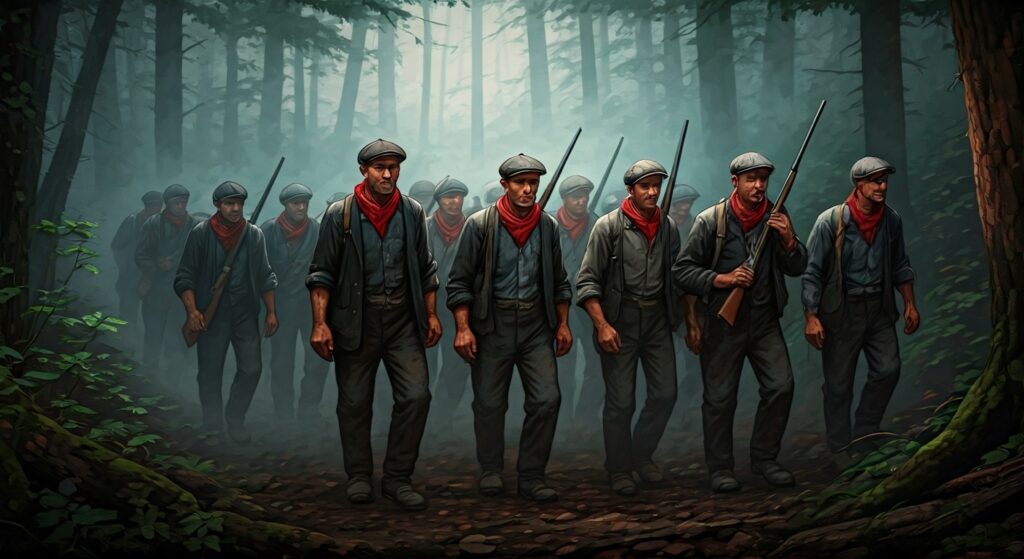
The assassination outraged miners across the state. By late August, an estimated 10,000 heavily armed coal miners had gathered near Marmet, West Virginia. Their mission was absolute: march south to Mingo County, overthrow the corrupt local government’s martial law, and forcefully unionize the southern coalfields.
To distinguish friend from foe in the dense Appalachian forests, the miners tied red bandanas around their necks. This brilliant tactical flair popularized the term “redneck” as a powerful symbol of working-class solidarity.
This was no disorganized mob. Many were battle-hardened veterans of World War I, bringing military discipline, advanced tactical knowledge, and a fierce brotherhood to the uprising. They were marching to war.
The Sheriff’s Private Army
Standing between 10,000 angry miners and Mingo County was Blair Mountain—and a man named Don Chafin.
Sheriff Chafin was a fiercely anti-union lawman, heavily bankrolled by the coal operators. Tasked with halting the miners’ advance, Chafin assembled a private army of roughly 3,000 men: a lethal mix of state police, deputies, and heavily armed civilian mercenaries. He dug in, establishing a fortified defensive line stretching for miles along the mountain’s ridge.
When the miners hit that ridge, the forest erupted.
Terror from the Skies
The Battle of Blair Mountain quickly became a horrifying echo of the Western Front. The dense forests rattled with machine-gun fire and the crack of trench warfare.
Then, the coal operators did the unthinkable.
In a shocking escalation, Chafin’s forces chartered private biplanes to fly over the miners’ positions. From the open cockpits, they dropped homemade pipe bombs and tear gas onto the men below. American citizens were subjected to aerial bombardment on U.S. soil by a private corporate army.
The operators justified the carnage by branding the miners as radical insurrectionists threatening capitalism. The miners viewed their fight as a righteous crusade for basic human rights.
The Federal Ultimatum
The sheer scale of the bloodshed finally forced Washington’s hand. Terrified of a full-scale rebellion, President Warren G. Harding threatened martial law and dispatched federal troops, including the U.S. Army Air Service.
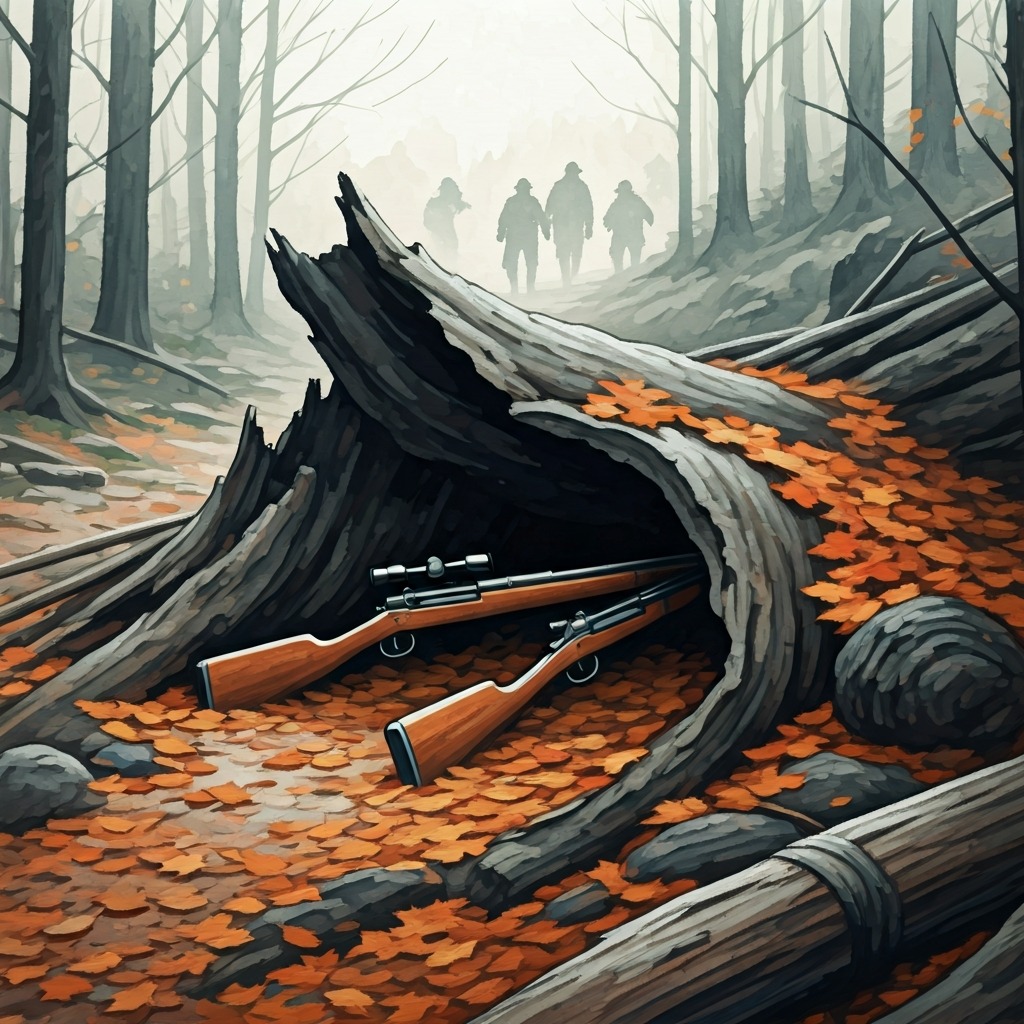
On September 2, the federal forces arrived. The miners, many of whom had just fought under the American flag in Europe, refused to fire upon the uniform of the United States military. They laid down their weapons, hiding their rifles in the hollows of the mountains, and melted back into the trees.
The Price of Defeat
In the immediate aftermath, Blair Mountain was a crushing defeat for the United Mine Workers of America. Union membership in West Virginia plummeted. The state went on a legal rampage, indicting over 900 miners on charges ranging from murder to literal treason.
Yet, history plays a long game. The smoke cleared, but the national spotlight remained fixed on the horrifying truths of the Appalachian coalfields. The blood spilled on Blair Mountain planted the seeds for the New Deal labor legislation of the 1930s. Laws like the Wagner Act of 1935 would eventually grant workers the legal right to unionize and collectively bargain.
The miners lost the battle, but their war forced a nation to change its laws.