Imagine a bustling, obscenely wealthy city. A cosmopolitan powerhouse of ancient trade where the world’s most formidable empires came to flaunt their riches. Now, imagine that entire metropolis just… vanishing. Poof. Gone without a trace.
Welcome to the ultimate historical cold case: the Lost City of Rhapta, widely known today as the Atlantis of Africa.
For centuries, this booming emporium dominated the coast of Southeast Africa—a region the ancients called Azania. It was the ancient equivalent of a billionaire’s playground, a place where fortunes were made on the shifting monsoon winds. But after the 3rd century, Rhapta fell off the map entirely. No ruins. No forwarding address. Just a ghost story whispered through the corridors of time.
The Ancient World’s Best-Kept Secret
How do we even know a city existed if we cannot find a single stone of it? The answer lies in ancient maritime gossip.
Our primary breadcrumb comes from the Periplus of the Erythraean Sea, written around 50 CE. Think of the Periplus as the ultimate navigational manual and insider’s guide for ancient maritime trade, penned by an anonymous merchant from Roman Egypt. A century later, Claudius Ptolemy’s Geography (circa 150 CE) elevated Rhapta’s legend even further, upgrading its status from a mere market town to a full-blown “metropolis.”
The name “Rhapta” itself offers a tantalizing clue about the people who walked its streets. It derives from the ancient Greek word rhaptein, meaning “to sew.” The locals, it turns out, did not use iron nails for their wooden boats. Instead, they masterfully stitched the planks together using coir, a remarkably tough coconut fiber. These sewn ships navigated the treacherous coastal waters, carrying goods that would eventually reach the grandest palaces of Rome and beyond.
A Billionaire’s Playground at the Edge of the Map
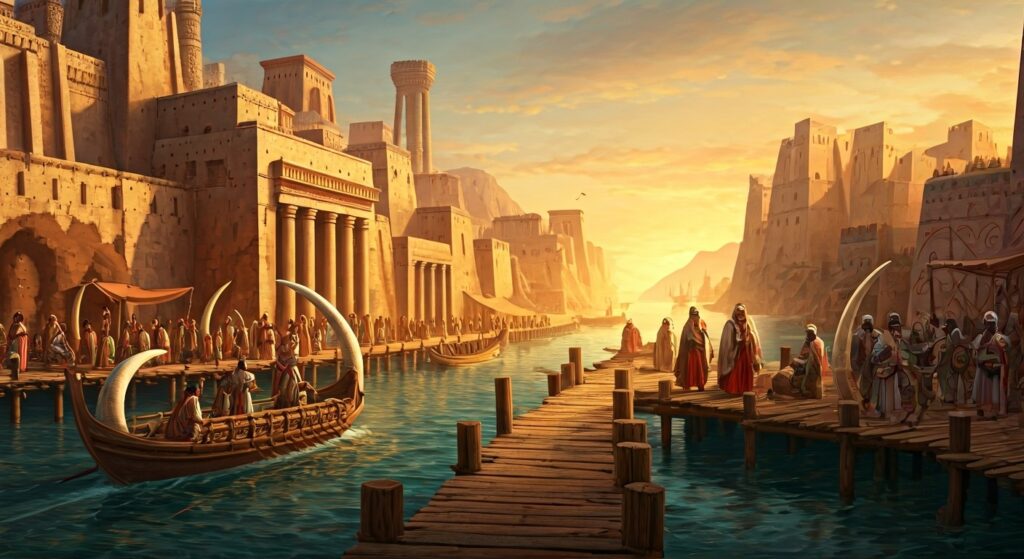
Rhapta was not just a rest stop; it was the southernmost anchor of a massive, globalized trade network. By riding the predictable monsoon winds—sailing down the African coast between November and March, and catching the breeze back between April and October—merchants from the Roman Empire, Arabia, and India flocked to Rhapta’s bustling docks.
The wealth flowing through this port was staggering. Rhapta grew fabulously rich exporting luxury goods that the ancient elite craved: mountains of ivory, rhinoceros horn, tortoiseshell, and shimmering nautilus shells. In return, Red Sea and Persian Gulf merchants unloaded iron weapons, glass vessels, metal tools, and the occasional shipment of wine and wheat.
But the true legacy of Rhapta lies in its people. The Periplus reveals that Rhapta was nominally under the control of a Mapharitic chief from southwestern Arabia, managed by merchants from Muza (modern-day Yemen). These Arab sea captains did not just drop off goods and leave. They settled down. They learned the local languages. They intermarried with the indigenous African populations. This early genetic and cultural blending was the ancient precursor to the magnificent Swahili civilization that would go on to dominate the East African coast centuries later.
The Day the Docks Went Silent
So, how does a thriving, cosmopolitan metropolis simply disappear?
By the 3rd or 4th century CE, the historical texts go completely silent. The leading theories are as dramatic as any Hollywood thriller. Some historians point to the economic crises of the late Roman Empire, arguing that when the global luxury market crashed, Rhapta’s economy flatlined, leading to mass abandonment. Others suspect a devastating outbreak of disease wiped out the densely packed population.
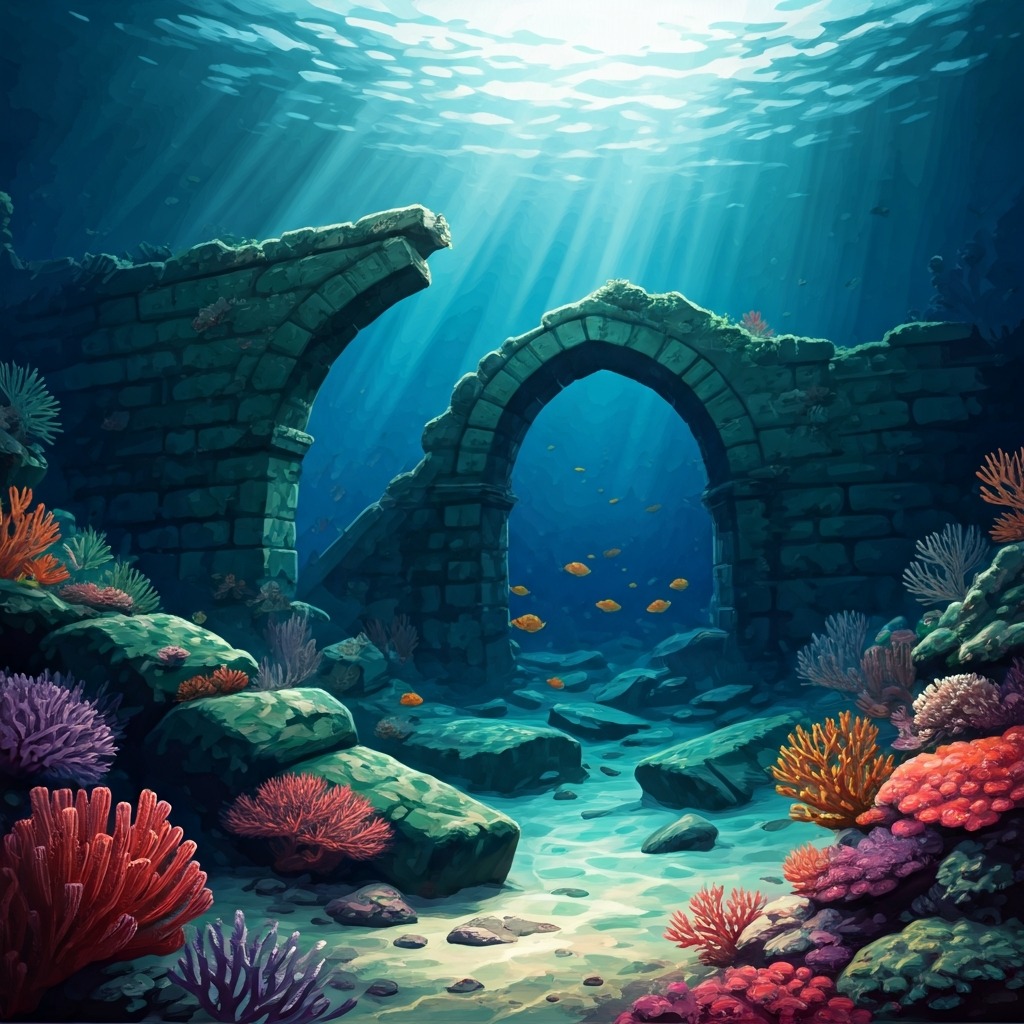
But the most terrifying theories are environmental. If Rhapta was built on a river delta, a massive flood or a sudden shift in the river’s course could have destroyed the city overnight—or left it landlocked and economically dead. Or perhaps, driven by coastal subsidence and rising sea levels, the Indian Ocean simply opened its jaws and swallowed the metropolis whole.
A Submerged Secret in the Deep
For over a century, archaeologists have combed the coastlines of modern-day Kenya and Tanzania. They have scoured the Rufiji River Delta, the Pangani River mouth, Dar es Salaam, and the island of Kilwa Kisiwani. Every expedition ended in the same frustrating result: nothing.
Then, in 2016, the mystery blew wide open.
A scuba diver named Alan Sutton was exploring the waters off the coast of Mafia Island, Tanzania, when he stumbled upon something breathtaking: massive, submerged stone structures. We are talking enormous, interlocking blocks stretching across the ocean floor.
The archaeological world held its breath. Had we finally found the Atlantis of Africa?
Prominent Tanzanian archaeologist Felix Chami immediately urged caution. While the underwater ruins are undeniably mind-blowing, they could belong to a much later Swahili settlement, a forgotten Portuguese fort, or—in a cruel twist of fate—they could just be a highly unusual, natural geological formation.
Until a diver pulls a piece of 1st-century Roman glass or a shard of ancient Arabian pottery from those submerged stones, the true location of Africa’s first metropolis remains locked away. Somewhere out there, beneath the shifting sands or the rolling waves of the Indian Ocean, Rhapta is still waiting to be found.