In the annals of science, breakthroughs are usually defined by sudden eureka moments, blinding flashes of light, or glorious, accidental explosions. But in a quiet corner of Australia, a trap was set in 1927 for a mystery so agonizingly slow, it makes watching paint dry look like a high-speed chase.
Forget time machines and particle accelerators. We are going to explore a scientific enigma where the greatest suspense comes from waiting decades for a single, solitary drop to fall.
The Illusion of Stone
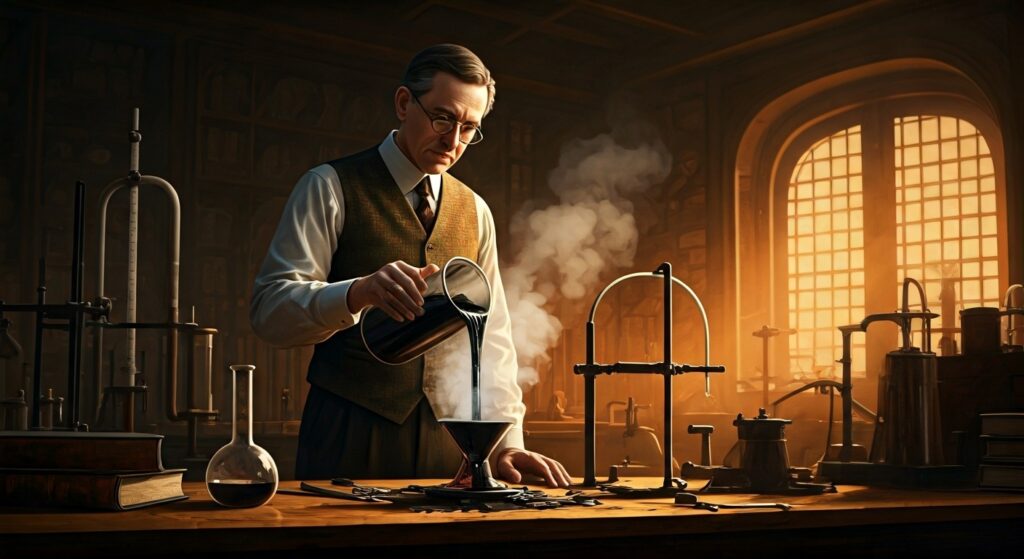
In 1927, Professor Thomas Parnell of the University of Queensland wanted to prove a mind-bending point to his physics students: human eyes are easily deceived, and the very concept of a “solid” is an illusion.
He chose a substance called pitch—a thick, black derivative of coal tar. Strike it with a hammer at room temperature, and it shatters into jagged shards like glass. To any rational observer, pitch is a rock. But Parnell knew its bizarre secret. It was actually a highly viscous liquid in disguise, and he was determined to catch it in the act.
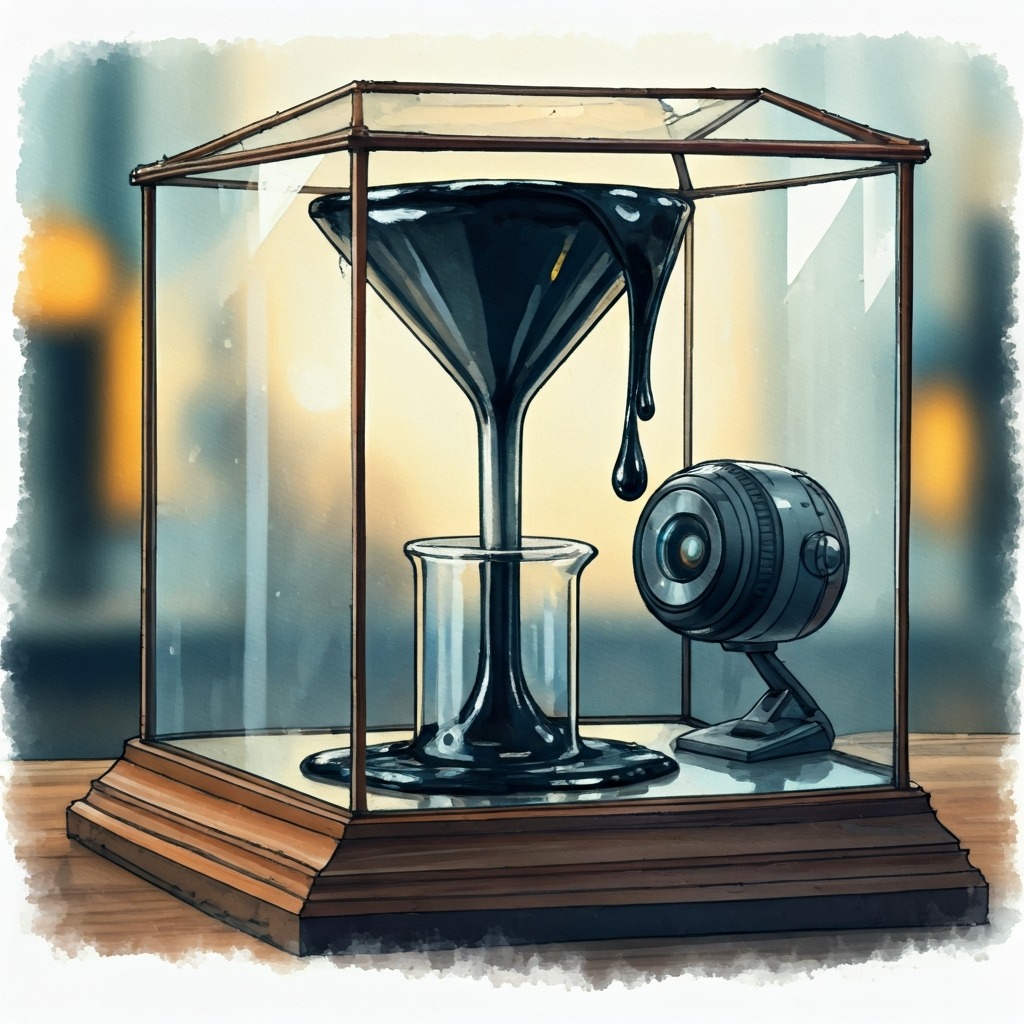
To prove it, he heated a sample, poured it into a sealed glass funnel, and waited. He didn’t wait a few hours or a few days. He let the black sludge settle for three entire years. Finally, in 1930, Parnell sliced the sealed stem of the funnel. The trap was set. The gravity-driven descent had begun.
The Agony of the Drop
Once the stem was cut, the pitch began to flow—but at a rate that openly mocked the human lifespan. Parnell had unwittingly initiated what Guinness World Records now recognizes as the world’s longest-running laboratory experiment.
Drops of pitch form and fall roughly once every seven to thirteen years. Through this seemingly eternal process, scientists eventually calculated that the viscosity of pitch is a staggering 230 billion times that of water.
The first drop finally fell in 1938. The second in 1947. Then 1954, 1962, and 1970. But here is the most maddening, suspenseful detail of this century-long endeavor: for decades, not a single human being ever witnessed a drop fall in person.
The Custodian’s Cruel Curse
Enter Professor John Mainstone, who became the custodian of the experiment in 1961. Mainstone watched over the pitch for more than fifty years, dedicating his life to this tar-like enigma. Yet, he became the victim of a cosmic joke. He missed the drop. Every. Single. Time.
In 1977, Mainstone missed the monumental event by a mere day.
In 1988, the pitch was bulging, practically hanging by a microscopic thread. Mainstone, desperate for a quick reprieve, stepped out of the laboratory to grab a cup of coffee. He was gone for exactly five minutes. When he returned, the drop had fallen.
By the year 2000, Mainstone wasn’t taking any chances. Anticipating the drop, he set up a webcam to capture the historic moment. But in a twist of fate so cruel it belongs in a psychological thriller, a poorly timed power outage and a technical glitch caused the camera to fail at the exact moment the pitch snapped.
The universe, it seemed, was determined to keep the pitch drop a secret. The sheer absurdity of the situation earned Parnell and Mainstone the 2005 Ig Nobel Prize in Physics—a satirical award honoring achievements that first make people laugh, and then make them think.
A Rival’s Triumph and a Tragic End
Unbeknownst to many, Queensland wasn’t the only institution playing the waiting game. A similar pitch drop experiment had been quietly running at Trinity College Dublin since 1944.
In July 2013, the unthinkable happened. Scientists at Trinity College finally managed to catch a drop falling on camera. For the first time in human history, the elusive descent of pitch was visually recorded.
Tragically, just a month later in August 2013, Professor Mainstone passed away. He had dedicated half a century to the Queensland experiment, never once seeing his beloved pitch fall.
When Queensland’s ninth drop occurred in April 2014 under the watch of its new custodian, Professor Andrew White, it was captured by a modern continuous livestream. However, the drop didn’t fall on its own; it snapped when White was changing the beaker beneath it. The streak technically remained unbroken—it had still not been witnessed falling purely on its own, unassisted, in person.
The Unblinking Watch
Today, the legendary funnel sits in a display case at the University of Queensland. It is heavily monitored by webcams, watched by thousands of online viewers who refuse to blink, all eagerly awaiting the tenth drop.
Current calculations suggest that the next drop will fall sometime in the late 2020s. Until then, the pitch continues its microscopic, invisible march downward—a silent, maddening testament to the weirdness of fluid dynamics and the absolute limits of human patience. The watch continues. Just don’t look away.