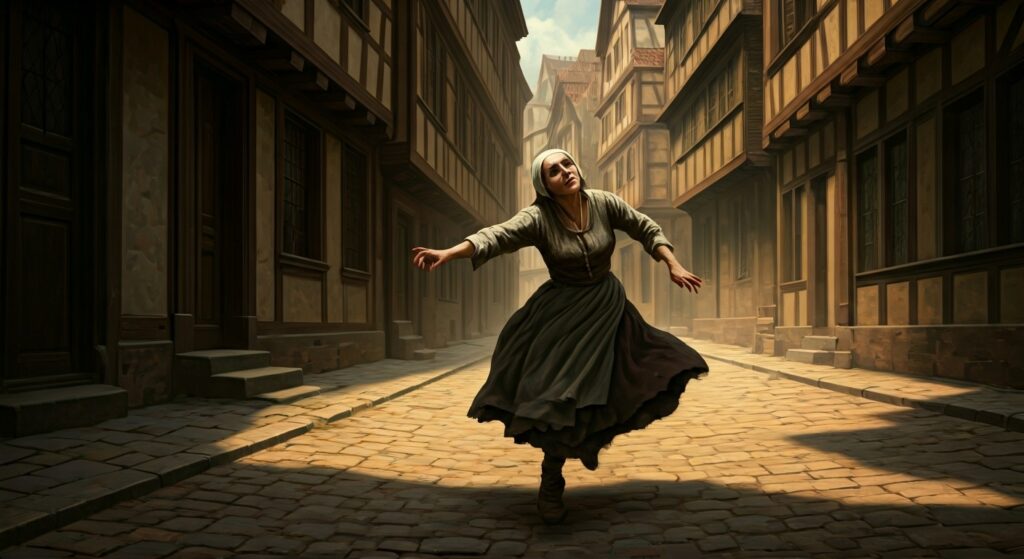
It is mid-July 1518. The streets of Strasbourg are suffocating under the summer heat, but the true nightmare is about to begin with a single, silent step. A woman named Frau Troffea steps out of her home and into a narrow, unpaved alley. She doesn’t speak. She doesn’t scream. Instead, she begins to dance.
A Macabre Solo
There is no music playing in the shadows of the city. Frau Troffea is not celebrating a wedding or a bountiful harvest. Her face is a blank, joyless mask, her movements frantic, violent, and entirely involuntary.
She dances for hours until she collapses in the dirt from sheer physical exhaustion. But the moment her eyes flutter open and her muscles twitch back to life, she stands right back up and resumes her manic contortions. She keeps this up for days.
In any other era, she might have been quietly isolated and treated. But this is the 16th-century Holy Roman Empire, a powder keg of superstition and despair. Within a week, Frau Troffea is no longer dancing alone. Over thirty people have joined her in the streets, entirely consumed by the same uncontrollable compulsion.
The Contagion Spreads
By August, the bizarre local oddity has spiraled into a full-blown horror story. The number of the afflicted swells to an estimated 400 individuals.
This is no joyful folk festival. It is a waking nightmare. Men, women, and children are trapped in a dissociative trance, their bodies twitching in agony as they dance until their feet literally bleed. The brutal summer sun beats down on them, but they cannot stop. They are prisoners inside their own flesh.
Soon, the cobblestones run red. Dancers begin dropping dead in the streets from strokes, heart attacks, and sheer physical exhaustion. The city of Strasbourg is watching its citizens violently dance themselves to death, and the authorities are utterly powerless to stop it.
A Lethal Prescription
Panicking as the death toll rises, the city council summons local physicians. The doctors rule out astrological anomalies and demonic possession. Instead, they diagnose the epidemic as a “natural disease” caused by “hot blood.”
Their prescribed cure? The victims simply need to dance it out.
It remains one of the most catastrophic medical decisions in human history. The authorities clear out the guildhalls and erect massive wooden stages in the public markets. They even hire professional musicians—drummers, pipers, and horn players—to keep the afflicted moving.
They essentially throw gasoline on a psychological fire. The booming music and the grotesque spectacle of the designated dancing areas only attract more onlookers. Caught in the sheer psychological magnetism of the event, perfectly healthy spectators are sucked into the manic marathon.
Blood, Red Shoes, and a Saint’s Curse
Realizing their catastrophic mistake, the authorities abruptly ban all public dancing and music. The stages are torn down.
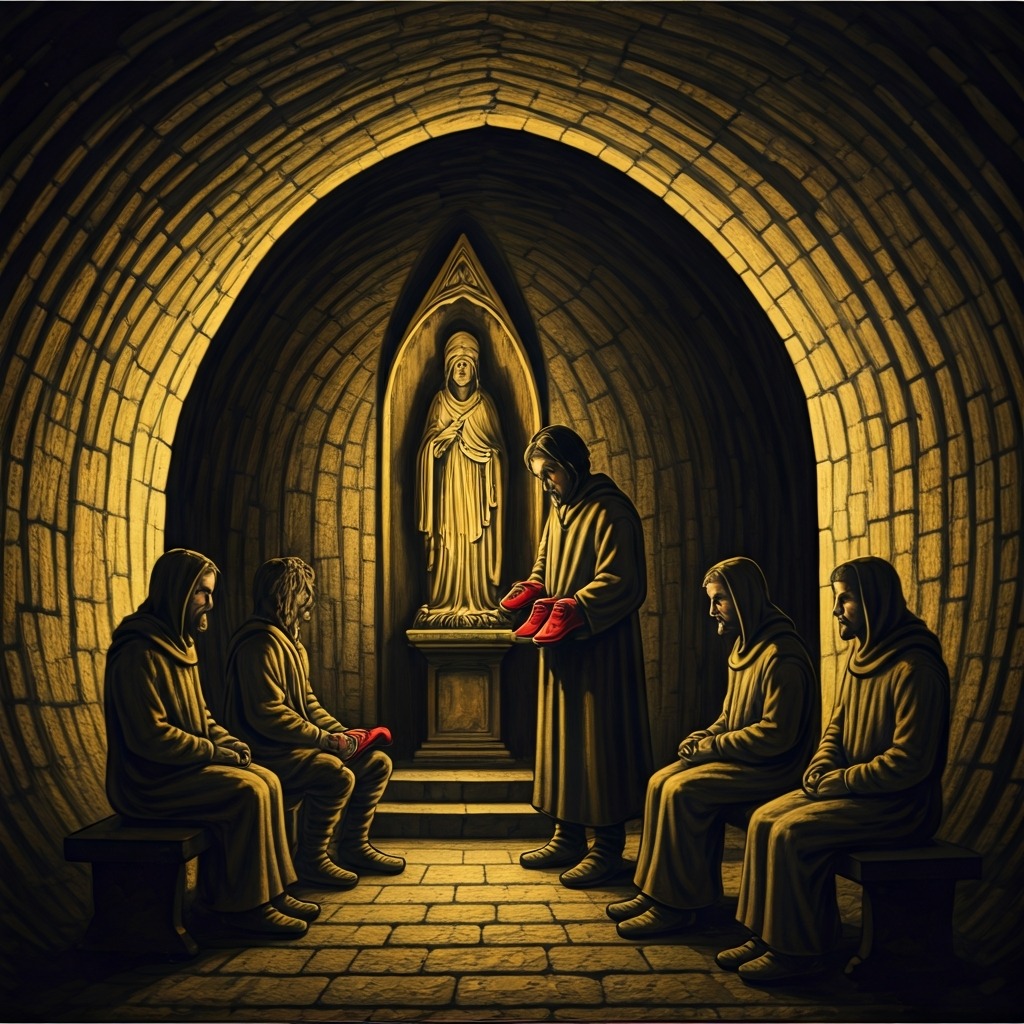
The remaining dancers, severely weakened and bleeding, are loaded onto wagons and hauled off to a shrine dedicated to St. Vitus in the nearby caves of Saverne. In a deeply eerie ritual, the victims’ bloody feet are placed into special red shoes, and they are led around a wooden effigy of the saint.
Slowly, the frantic twitching slows. The trance begins to break. By early September, the Dancing Plague of 1518 finally subsides, leaving a traumatized city in its wake.
The Anatomy of a Nightmare
How does an entire city catch a dancing disease?
For centuries, the popular theory was Ergotism, also known as St. Anthony’s Fire. Ergot is a psychoactive mold that grows on damp rye stalks and is chemically related to LSD, known to cause terrifying hallucinations and violent spasms. But there is a glaring flaw in this theory: ergot poisoning severely restricts blood flow to the extremities. It makes it physically impossible for someone to stay on their feet and dance continuously for days.
The real answer is much darker, and it lies in the breaking point of the human mind.
Modern medical historians point to Mass Psychogenic Illness (MPI)—a devastating outbreak of mass hysteria. Strasbourg in 1518 was a city drowning in misery. The populace was reeling from consecutive catastrophic harvests. Famine was rampant, bread prices were astronomically high, and brutal outbreaks of syphilis and leprosy were tearing through the population. The people were starving, grieving, and spiritually desperate.
This immense, crushing psychological stress created the perfect breeding ground for a mass dissociative trance. But why dancing?
The answer lies in St. Vitus. The people of the Holy Roman Empire held a deep-seated, terrifying belief that St. Vitus—a Christian martyr—had the power to curse sinners by forcing them to dance uncontrollably. In a society pushed to the absolute brink of starvation and despair, this cultural fear became a self-fulfilling prophecy.
When Frau Troffea’s mind finally snapped under the weight of her reality, she began to dance. And when her traumatized, highly superstitious neighbors saw her, it triggered a latent, collective terror. The psychological contagion swept through the city like a virus.
The Dancing Plague wasn’t a biological infection; it was the physical manifestation of a society’s collective trauma. It stands as a chilling reminder that the human mind is capable of overriding the body in the most bizarre and terrifying ways imaginable.