Imagine waking up in the 11th century with a terrifying affliction. Your neck begins to swell with weeping, unsightly lesions. You are a peasant, your life is already a brutal slog of manual labor, and now you bear the mark of a highly stigmatized disease. But salvation won’t come from a doctor or a primitive apothecary. It will come from the bare, jeweled hands of a king.
Long before modern political campaigns and influencer PR stunts, the most powerful rulers in the world convinced the masses that they possessed magical, disease-curing hands. It was a centuries-long propaganda war fought with gold coins, rosewater, and oozing neck sores.
The Biological Loophole
This grotesque condition was known historically as the “King’s Evil,” but today we know it as scrofula, a localized form of tuberculosis. It was painful, highly visible, and seemingly incurable. But it harbored a biological secret that would alter the course of European history.
Scrofula is a chronic disease, but it is rarely fatal. More importantly, it is characterized by natural periods of spontaneous remission and relapse. One month your neck is covered in lesions; a few months later, the swelling miraculously shrinks on its own.
To a terrified medieval peasant, this unexplained remission looked like magic. To a calculating monarch, it looked like the ultimate political weapon.
A Divine PR Stunt
The logic was brilliantly simple: if a king is anointed by God to rule, shouldn’t he possess godly powers?
The practice of the “Royal Touch” began in the 11th century, immediately sparking a bitter geopolitical rivalry. In England, the origin is traditionally traced back to Edward the Confessor, while the French fiercely claimed the miracle started with their own Robert II or Philip I.
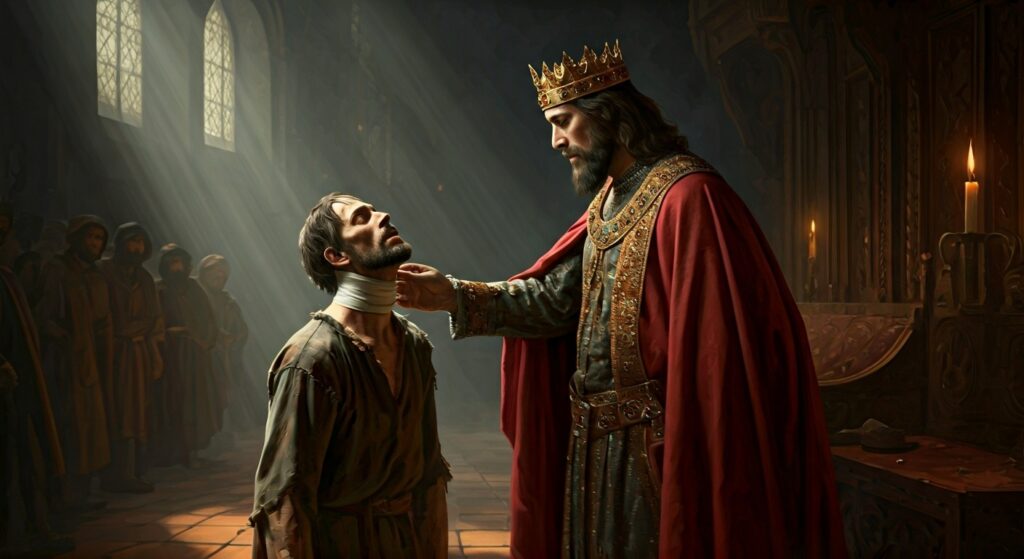
This wasn’t just a medical clinic; it was the ultimate display of dominance. By “curing” the sick, these monarchs were visually and physically proving their Divine Right to rule to the masses. Every time a peasant’s lesions naturally shrank months after a royal encounter, the remission was hailed as a divine miracle. The king’s magical status was cemented, and his rivals across the English Channel looked just a little less holy.
Blood, Gold, and Rosewater
Over the centuries, what started as a simple blessing mutated into a highly choreographed, massive public spectacle. Peasants would travel hundreds of miles, desperate for a cure.
The ceremony was incredibly theatrical. The monarch, seated in state and surrounded by chanting clergy, would wash their hands in fragrant rosewater. As religious liturgy echoed through the hall, the sovereign would press their bare hands directly against the infected, oozing necks of the afflicted.
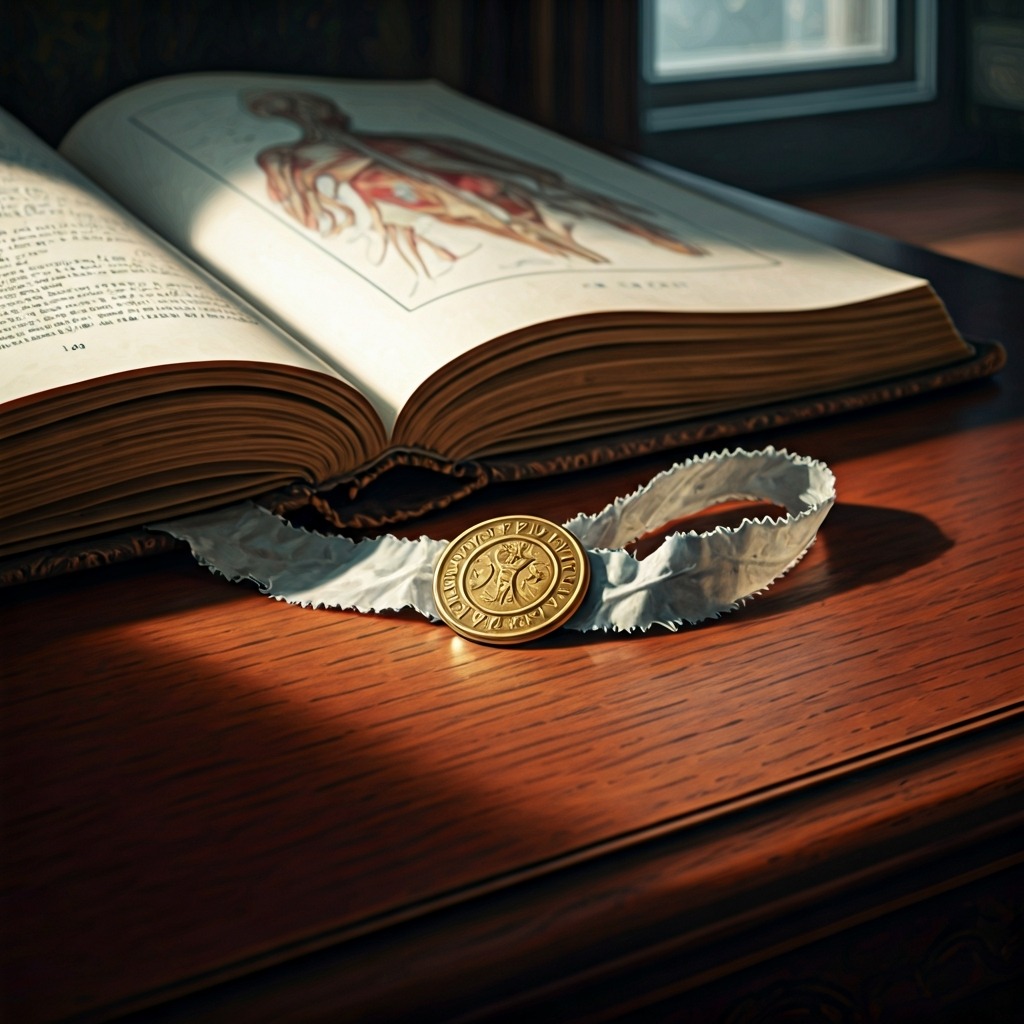
But there was another, far more lucrative reason the peasantry flocked to these events. In England, the ceremony concluded with the gifting of a “touch-piece”—a solid gold coin hung around the patient’s neck on a pristine white ribbon.
Officially, this coin was considered a holy amulet to ward off the disease. Unofficially? It was free wealth. Skeptics of the era quietly noted that the promise of solid gold was likely a massive incentive for the sudden, miraculous spikes in cases of the “King’s Evil.”
The Zenith of the Sun King
The Royal Touch reached absolute peak hysteria in the 17th century. Following the bloody chaos of the English Civil War, King Charles II needed a way to aggressively legitimize his restoration to the throne. His strategy? Touch everyone. Over the course of his reign, Charles II reportedly laid his hands on nearly 100,000 people.
Across the water, the French weren’t about to be outdone. Louis XIV—the legendary Sun King—touched thousands of his subjects, dramatically uttering the phrase, “The King touches you, God heals you.” It was the ultimate intersection of the placebo effect, confirmation bias, and political theater.
The Death of Magic
But all good shows eventually get canceled. As the Enlightenment swept through Europe, bringing with it a wave of medical and political skepticism, the Royal Touch started to look less like a miracle and more like an embarrassing parlor trick.
When the Dutch-born William III took the English throne, he was thoroughly disgusted by the practice. He viewed it as absurd superstition and largely refused to participate. On one rare occasion where he was cornered into performing the touch, he famously placed his hand on the patient and delivered the most iconic, withering line of the 17th century: “God give you better health and more sense.”
Queen Anne briefly revived the practice in the early 18th century—even touching a young Samuel Johnson, who kept his gold touch-piece for the rest of his life—but the writing was on the wall. George I permanently abolished it in England, viewing it as outdated superstition.
The French held on a little longer. In a truly desperate, anachronistic bid to restore the mystique of the absolute monarchy, Charles X revived the ceremony in 1825. He touched over a hundred patients. It didn’t work. The magic was dead, the people were disillusioned, and he was soon deposed.
For hundreds of years, the Royal Touch offered the poorest members of society a rare moment of intimate contact with their sovereign, a glimmer of hope, and a bit of gold. For the kings, it was the ultimate tool of statecraft—a beautifully messy reminder that humans have always been willing to believe in a little bit of magic, especially when it pays.