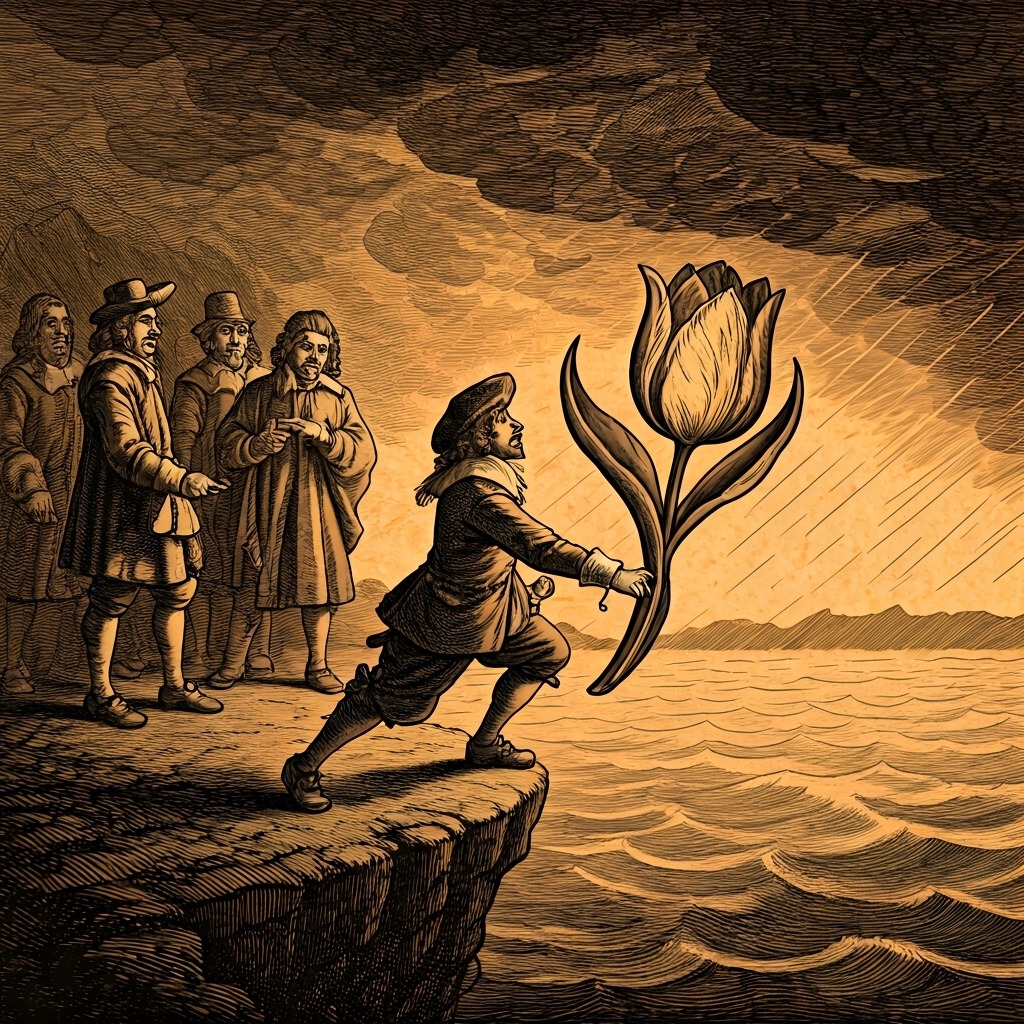
In the bitter winter of 1636, a single flower bulb buried in the freezing Dutch mud was worth more than a grand, luxurious mansion on the most fashionable canal in Amsterdam. Men were trading their life savings, their inheritances, and their futures for a product they had never seen, from sellers who didn’t yet own it.
Welcome to the legendary Tulip Mania. You’ve likely heard the story: a nation gripped by floral fever, a catastrophic market crash, and a mighty empire brought to its knees by a flower.
But there is a dark, invisible mystery lurking beneath the soil of this famous financial ruin. The true story of the Dutch tulip crash is far more deceptive—and far more fascinating—than the myth you’ve been sold.
The Most Expensive Secret in the Dirt
During the Dutch Golden Age, unprecedented wealth poured into the Netherlands. But the newly minted merchant class didn’t just want money; they wanted to flaunt it. They found their ultimate status symbol in a fragile, exotic import from the Ottoman Empire: the tulip.
However, high society had no interest in basic, solid-colored blooms. The haute couture of 17th-century botany centered entirely on “broken” bulbs. These impossibly rare tulips erupted in spectacular, flame-like streaks of contrasting colors. The crown jewel was the Semper Augustus, a breathtaking flower painted with striking blood-red stripes against a pure white canvas. To own one was to be a god among the Amsterdam elite.
Desperate botanists tried everything to force standard bulbs to “break” into these stunning patterns, mixing pigeon dung and plaster into the soil, praying for a miracle.
What they didn’t know was that these magnificent streaks were not a genetic triumph. They were the symptoms of a lethal disease.
A Beautiful, Deadly Infection
The breathtaking beauty of the Semper Augustus was actually caused by the Tulip Breaking Virus, a pathogen transmitted by aphids. The very thing that made the flower so visually intoxicating was slowly killing it.
The virus weakened the bulbs, making them incredibly difficult to propagate. This created a brutal, natural scarcity: the more beautiful the flower, the closer it was to death, and the fewer offspring it would produce. This deadly biological limitation drove prices into the stratosphere.
Trading Air and Shadows
As demand for these diseased, dying masterpieces surged, a massive logistical nightmare emerged. Tulips bloom in the spring and sleep in the summer. Physical bulbs could only be safely uprooted and traded between June and September.
How do you feed an insatiable, year-round obsession when the product is buried in the freezing mud? You invent a futures market.
Buyers and sellers began meeting in the back rooms of smoke-filled taverns to trade paper contracts for bulbs still in the ground. The Dutch, possessing a razor-sharp sense of irony, wryly called this windhandel, or the “wind trade.” They were literally trading air.
By the autumn of 1636, the suspense in these taverns reached a fever pitch. The bubble inflated to legendary proportions. A highly skilled craftsman earned about 300 guilders a year. A single, virus-riddled Semper Augustus bulb was changing hands for upwards of 10,000 guilders.
The Day the Music Died
Every thriller needs a breaking point. Ours arrived abruptly in February 1637, inside a tavern in the city of Haarlem.
It started as a routine bulb auction. The auctioneer called out an exorbitant asking price for a lot of tulips.
Silence.
Nobody bid. He lowered the price. Still silence. Panic rippled through the room, spilled into the freezing streets, and swept across the country. In an instant, the collective delusion shattered. The bottom fell out of the market, and those incredibly expensive paper contracts became virtually worthless overnight.
The Greatest Financial Illusion Ever Told
If you know the legend of Tulip Mania, you know the tragic aftermath: widespread national ruin, desperate peasants dying in poverty, and a catastrophic economic depression. This cinematic narrative was cemented into history by Scottish journalist Charles Mackay in his famous 1841 book, Extraordinary Popular Delusions and the Madness of Crowds.
It’s a fantastic story. But it’s a complete lie.
Modern historians and economists have dug into the archives and completely upended Mackay’s narrative. The shocking twist? The economic fallout of the tulip crash was entirely negligible.
The general public was never involved in the windhandel. The trade was confined to a small, exclusive circle of wealthy merchants who could afford to gamble. Researchers have found fewer than half a dozen individuals who experienced genuine financial ruin. The broader Dutch economy—the strongest in the world at the time—didn’t even blink.
So why did the myth of a catastrophic, nation-destroying crash survive for centuries?
Look no further than the Calvinist moralists of the 17th century. To these strict religious figures, the sudden, immense wealth of the Dutch Golden Age was terrifying. They viewed the speculative trading of flowers as a grave sin—a toxic cocktail of greed and vanity.
When the market corrected itself in 1637, these moralists gleefully seized the moment. They flooded the streets with satirical pamphlets and dramatic woodcuts depicting foolish “florists” chasing illusions of wealth straight into hell.
Two centuries later, Charles Mackay took those highly biased, satirical pamphlets and treated them as literal, objective historical records. He accidentally turned a localized luxury market correction into the greatest financial myth in global history.
In the end, the true madness wasn’t the crash itself. It was the enduring power of a good story, spun by critics who simply couldn’t stand the sight of people spending fortunes on something as fleeting, frivolous, and utterly beautiful as a dying flower.