A Shadow on the Horizon
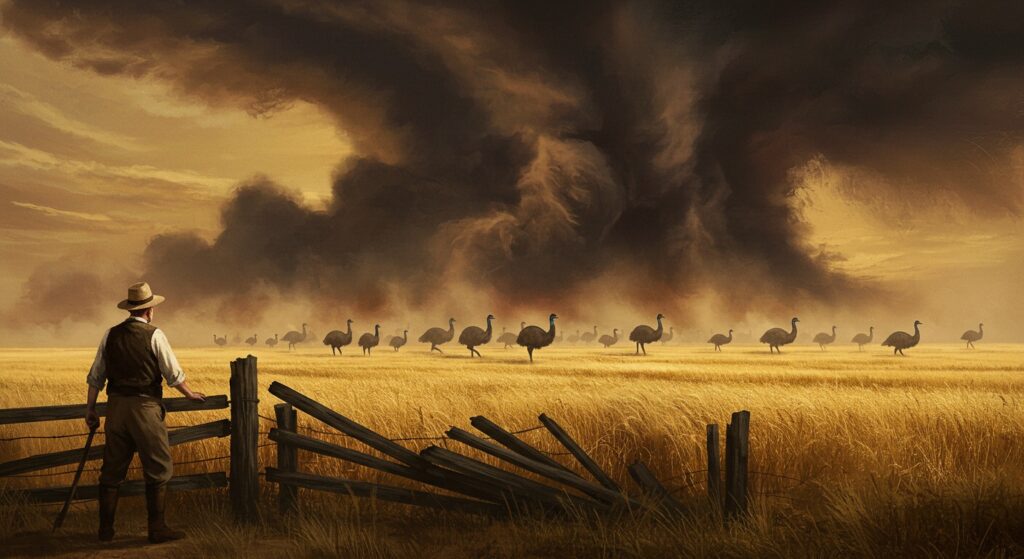
Imagine standing on the edge of your livelihood, the harsh Western Australian sun beating down on your fragile wheat fields, only to see the horizon darken. It isn’t a storm rolling in. It is a relentless, feathered tide of 20,000 giant birds marching directly toward your farm.
Following the brutal, blood-soaked campaigns of World War I, the Australian government offered a promise of peace to its returning veterans, providing them with parcels of land in Western Australia to farm wheat. These battle-hardened men traded their Lee-Enfield rifles for plows, desperate for a quiet life. But the outback was unforgiving. As the Great Depression tightened its grip, these fledgling farms were pushed to the absolute brink of financial ruin.
Then came a threat no military manual could have prepared them for.
Driven by a desperate, instinctual search for water, an estimated 20,000 emus migrated inland, descending upon the Campion district like a plague. These flightless behemoths didn’t just consume the wheat; they obliterated it. Their massive, muscular frames tore through perimeter fences with terrifying ease, rolling out the red carpet for hordes of rabbits to swarm in and devour whatever the birds left behind. For the veterans, it was total agricultural annihilation.
The Plea for Heavy Artillery
Desperate times call for devastating measures. The farmers, remembering their military training in the trenches of Europe, knew that standard pest control wouldn’t stop an invasion of this magnitude. They bypassed local agricultural boards and went straight to the top, appealing directly to the Minister of Defence, Sir George Pearce.
Pearce agreed that the situation required a martial solution. In November 1932, the Australian military was officially deployed to wage war on the birds. Under the command of Major G.P.W. Meredith of the Royal Australian Artillery, a specialized strike force was assembled. Their arsenal? Two Lewis automatic machine guns and 10,000 rounds of heavy ammunition.
The military brass expected a swift, decisive eradication. They assumed the birds would fall easily before the terrifying might of modern automatic weaponry.
They were dead wrong.
The Ambush That Wasn’t
The first major engagement of the Great Emu War was designed to be a tactical masterstroke. Major Meredith and his men tracked a flock of roughly 1,000 emus to a local dam. The soldiers quietly set up their Lewis guns in the brush, fingers hovering over the triggers, waiting for the birds to gather in a tight, vulnerable cluster.
The order to fire was given.
But the emus proved to be highly elusive and unnervingly intelligent adversaries. Armed with exceptional eyesight and razor-sharp reflexes, the birds instantly detected the threat. As the first shots tore through the air, they didn’t flock together in panic. Instead, they scattered in erratic, unpredictable patterns, executing evasive maneuvers that would make a fighter pilot envious.
These creatures were built for survival. Capable of running at speeds up to 50 kilometers per hour, they rapidly outpaced the soldiers’ firing arcs. To make matters worse, just as the troops thought they had a bead on the fleeing flock, the primary machine gun jammed. When the dust finally settled, only a dozen birds lay dead. The rest of the thousand-strong flock had vanished like ghosts into the outback.
Mechanized Warfare Meets the Outback
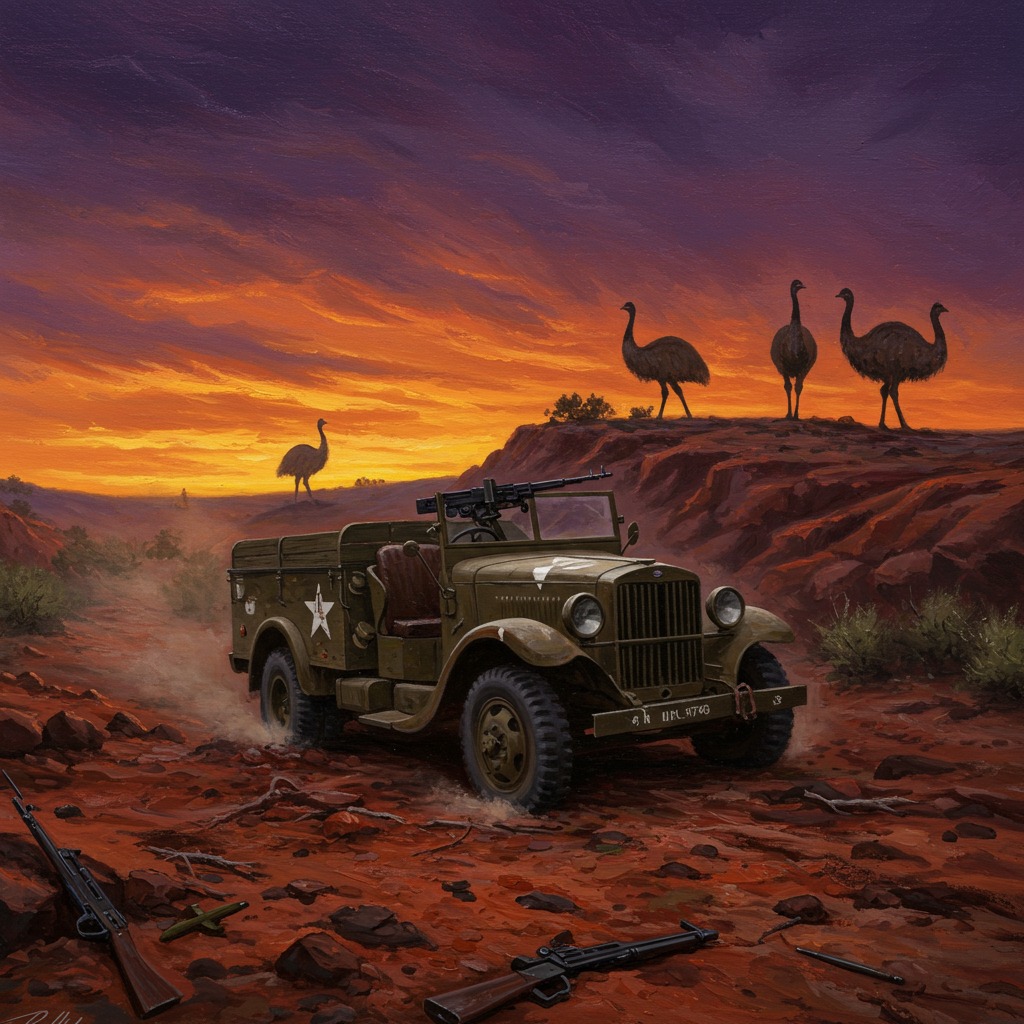
Refusing to be outmaneuvered by avians, Major Meredith decided to escalate his tactics. If the emus were going to run, the military would chase them down. The soldiers mounted a Lewis machine gun onto the back of a truck, creating a makeshift armored cavalry unit designed to run the birds into the ground.
It was a spectacular disaster.
The rugged, uneven terrain of the Western Australian outback was no place for a high-speed pursuit. The truck violently bucked and heaved over the landscape, completely unable to keep pace with the agile birds. The gunner, desperately clinging to his weapon, was thrown about so violently that he was unable to fire a single shot due to the bumpy ride. The emus simply glided over the rough earth, leaving the coughing, sputtering military vehicle choking in their dust.
The Victorious Feathered Horde
By early December 1932, the military campaign had devolved into a farce. After nearly a month of exhausting, futile skirmishes, and the expenditure of thousands of rounds of heavy ammunition, the results were staggering—and entirely humiliating for the military. Only an estimated 200 to 1,000 emus had been killed.
The press caught wind of the debacle, and widespread public mockery soon followed. Major Meredith, utterly bewildered by the resilience of his enemy, famously compared the emus to Zulu warriors. He marveled at their incredible hardiness, noting with sheer disbelief their ability to sustain non-fatal bullet wounds and just keep running, treating military-grade gunfire like minor mosquito bites.
Facing international ridicule and mounting costs, the Australian government officially withdrew the military forces. The Great Emu War was over. The birds had won.
Ultimately, it wasn’t brute military force that saved the wheat fields of Western Australia, but a far simpler economic solution. In the following years, the government introduced a highly effective bounty system, turning the farmers themselves into the ultimate pest controllers. Tens of thousands of emus were culled, finally restoring balance to the region.
Yet, the legend of the 1932 campaign remains—a humbling, hilarious reminder of the sheer unpredictability of nature, and the absolute folly of bringing a machine gun to a bird fight.