We trust the ground beneath our feet. We trust the towering concrete walls holding back our rivers. But what happens when the very earth we build our monuments upon is quietly waiting to dissolve?
In the 1920s, Los Angeles was a booming metropolis with a fatal flaw: it was a thirsty city in a semi-arid basin. The man who quenched that thirst was William Mulholland, a brilliant, self-taught engineer who had already achieved the impossible by building the Los Angeles Aqueduct. But with droughts looming and angry Owens Valley farmers sabotaging the water supply with dynamite, LA needed a massive, fail-safe reserve.
Enter the St. Francis Dam. Constructed between 1924 and 1926 in San Francisquito Canyon, forty miles northwest of Los Angeles, it was a colossal, curved concrete gravity dam. It was an engineering marvel designed to hold back over 12.4 billion gallons of water.
But almost as soon as the reservoir began to fill, the concrete leviathan began to whisper its warnings.
The Bleeding Foundation
Cracks and minor leaks are standard in massive concrete dams—a fact that usually keeps engineers calm but gives the rest of us a healthy dose of anxiety. However, the leaks at the St. Francis Dam deeply unsettled the dam keeper, Tony Harnischfeger.
On the morning of March 12, 1928, Harnischfeger noticed something terrifying: a brand-new leak. And it wasn’t just water; it was discharging muddy water. In the engineering world, muddy seepage is the ultimate red flag. It means the water is actively eroding the dam’s foundation.
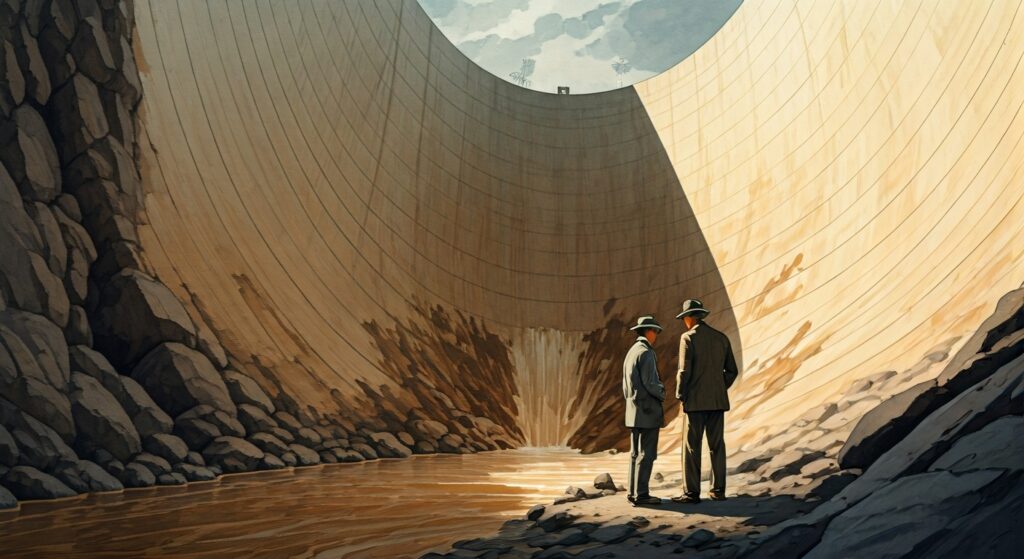
Harnischfeger frantically called Mulholland. Within hours, Mulholland and his chief assistant, Harvey Van Norman, were standing at the base of the dam, inspecting the seepage. They looked at the muddy water. They looked at the towering concrete wall. And they made a fatal miscalculation.
Mulholland concluded that the muddy water was simply runoff from nearby road construction, not foundation erosion. He declared the dam completely safe and headed back to Los Angeles. But the water was coming, regardless of what the chief engineer believed.
Midnight in the Canyon
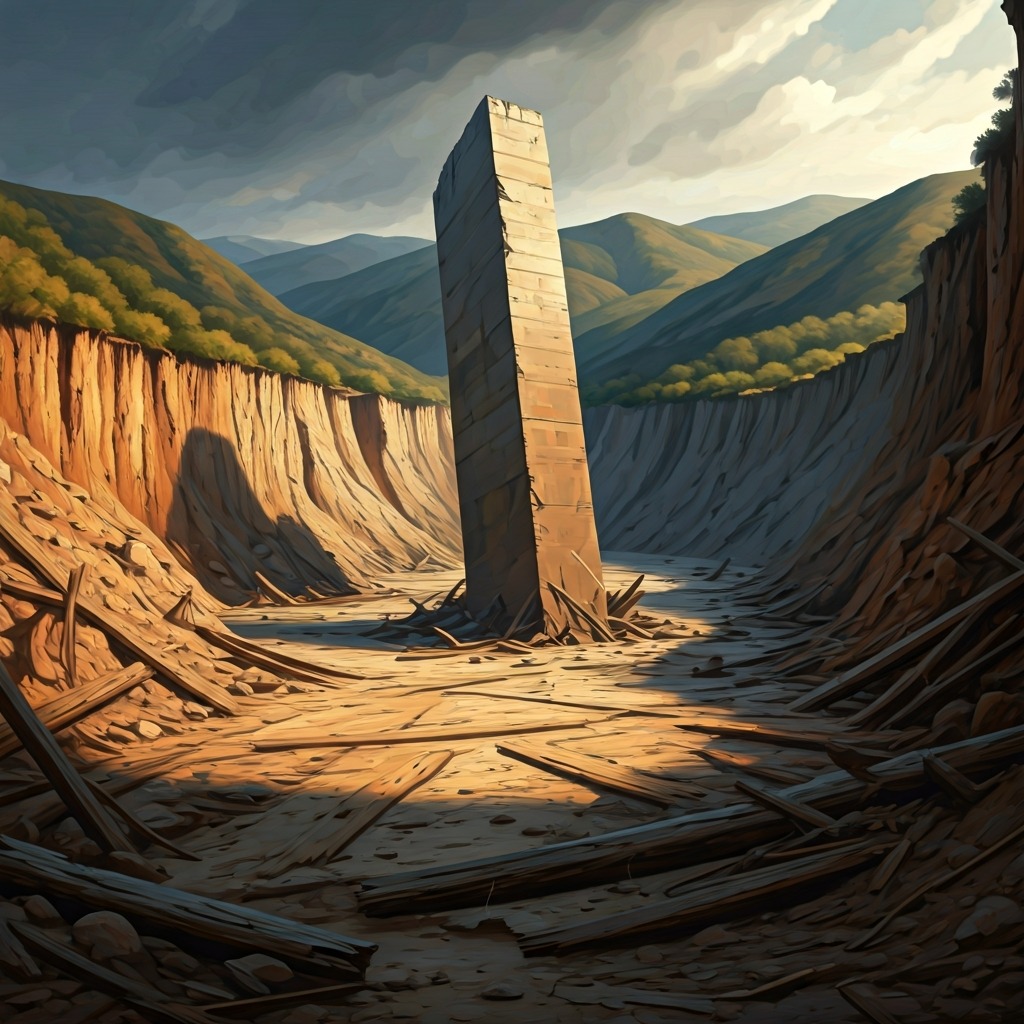
At 11:57 PM that very same night, the St. Francis Dam catastrophically failed.
There were no survivors to describe the exact moment of collapse. Harnischfeger and his family, asleep in their cottage just below the dam, were the first casualties. In an instant, a 140-foot-high wall of water roared into the pitch-black canyon.
The floodwaters, moving at incredible speed, slammed into Southern California Edison’s Powerhouse No. 2. It instantly killed 64 of the 73 workers and their families sleeping in the adjacent village. The deluge became a terrifying battering ram of mud, boulders, and massive concrete blocks weighing thousands of tons.
As the water surged into the Santa Clara River Valley, it became a 54-mile race to the Pacific Ocean. Towns like Castaic Junction, Piru, Fillmore, Bardsdale, and Santa Paula were squarely in its path.
The only thing standing between the sleeping towns and total annihilation were a few incredibly brave night owls. Telephone operators like Louise Gipe refused to abandon their switchboards, frantically calling residents to wake them up. Meanwhile, motorcycle police officers, most notably Thornton Edwards—who would later be dubbed the “Paul Revere of the Santa Clara”—raced furiously ahead of the floodwaters, sirens wailing in the dark, kicking down doors to evacuate families.
Despite their heroism, the devastation was apocalyptic. It remains the second-greatest loss of life in California’s history, surpassed only by the 1906 San Francisco earthquake. The official death toll is listed at 431, but modern historians and geologists estimate it easily exceeded 500, as countless undocumented transient farm workers were swept out to sea or buried beneath feet of mud.
“I Envy the Dead”
The disaster utterly broke William Mulholland.
During the coroner’s inquest, the once-proud visionary didn’t deflect or point fingers. A devastated, weeping Mulholland took the stand and accepted full responsibility. “Don’t blame anybody else, you just fasten it on me,” he told the room. “If there is an error of human judgment, I was the human… I envy the dead.”
He was ultimately cleared of criminal charges, but his career was over. He retired in disgrace and lived the rest of his life in deep isolation until his death in 1935.
But the question remained: Why did the dam fail? Mulholland’s concrete was strong. His mathematical design for the dam’s structure was sound. So what went wrong?
The Invisible Saboteur
This is where the history of science takes a massive, foundational leap forward. Modern investigations have largely exonerated Mulholland of gross negligence, though not of hubris.
The true culprit was hiding deep underground. The dam had been built directly on top of a paleolandslide—an ancient, massive geological failure waiting to be reawakened.
Worse still was the bedrock itself. The dam’s eastern abutment rested on a rock formation called Pelona Schist, while the western side sat on Sespe conglomerate. To the naked eye, it looked like solid rock. But these specific formations were highly unstable and subject to a terrifying geological process called “slaking.” When saturated with water, the rock literally dissolved. It lost all structural integrity and turned to mush.
In the 1920s, the field of “engineering geology” simply did not exist. Mulholland, for all his self-taught brilliance in civil engineering, didn’t have the geological background to recognize that the very earth he was building on was a trap.
The St. Francis Dam disaster changed everything. It forced lawmakers and scientists to realize that a structure is only as strong as the ground beneath it. The tragedy directly led to the creation of the California Dam Safety Act, mandating that all dams be evaluated by independent panels of experts, integrating both civil engineering and geology.
It effectively birthed the modern field of engineering geology. Every time you drive over a dam, or marvel at a massive reservoir, you are protected by the hard-learned lessons of that terrifying midnight in 1928.