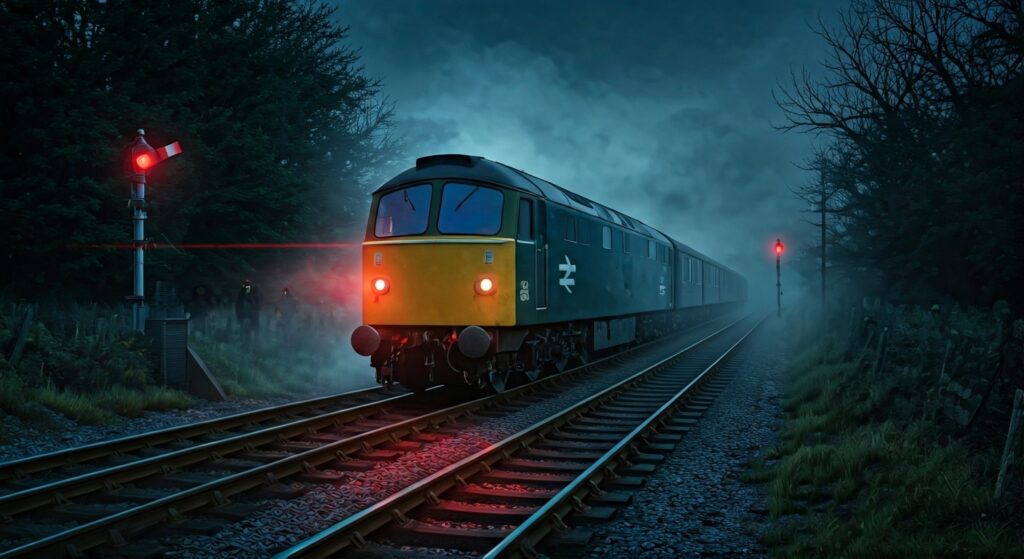
The pitch-black British countryside was silent, save for the rhythmic, deafening roar of the Royal Mail ‘Up Special’. It was the dead of night on August 8, 1963, and the massive locomotive was tearing down the tracks on its overnight route from Glasgow to London. Inside, postal workers sorted letters, completely unaware that they were hurtling toward one of the most audacious traps ever set in modern history.
Suddenly, the train driver spotted a glowing red signal at Sears Crossing in Buckinghamshire. He engaged the brakes, bringing the tons of steel to a screeching, sparking halt.
It wasn’t a malfunction. It was a meticulously calculated ambush.
Waiting in the darkness was a 15-member gang led by criminal mastermind Bruce Reynolds. Their method for stopping the unstoppable was brilliantly, terrifyingly simple: they had covered the track’s green signal with a glove and used a basic six-volt battery to illuminate the red light. The train had stopped exactly where they wanted it. The heist of the century had begun.
The Phantom Informant
To pull off a robbery of this magnitude, Reynolds and his crew needed more than just a battery and a glove; they needed inside information. They found it in an enigmatic figure known to the underworld only as ‘The Ulsterman.’
Decades later, this phantom informant was identified as Patrick McKenna, a man with intimate knowledge of the railway’s most closely guarded secrets. McKenna had handed the gang the ultimate tip-off: the train’s High-Value Package (HVP) carriage was brimming with worn banknotes heading straight to the Royal Mint for destruction.
It was untraceable, unmarked cash. For a thief, it was the holy grail.
Blood on the Tracks
Pop culture has spent decades romanticizing the Great Train Robbery as a cheeky, non-violent gentleman’s caper—a cinematic strike against the establishment. But the reality of the underworld is rarely that clean, and this night was no exception.
When the train stopped, the gang swarmed the cabin. In the ensuing chaos, the train’s driver, Jack Mills, was brutally bludgeoned over the head with a metal bar. Bleeding heavily and suffering from severe trauma, Mills was forced to drive the uncoupled HVP carriage further down the track to a rendezvous point at Bridego Bridge.
Mills never fully recovered from his traumatic brain injuries, ultimately dying in 1970. His tragic fate shatters the myth of the victimless crime, anchoring this legendary heist in brutal reality.
A Record-Breaking Haul
Once positioned at Bridego Bridge, the gang functioned like a well-oiled machine. They formed a human chain in the dark, rapidly unloading 120 heavy sacks of cash from the carriage and tossing them into a fleet of waiting Land Rovers.
The haul was staggering: £2.6 million. Adjusted for inflation, that is equivalent to over £50 million today. Before the authorities even realized what had happened, the gang vanished into the night, leaving behind nothing but an idling train and a bleeding driver.
Hubris and a Game of Monopoly
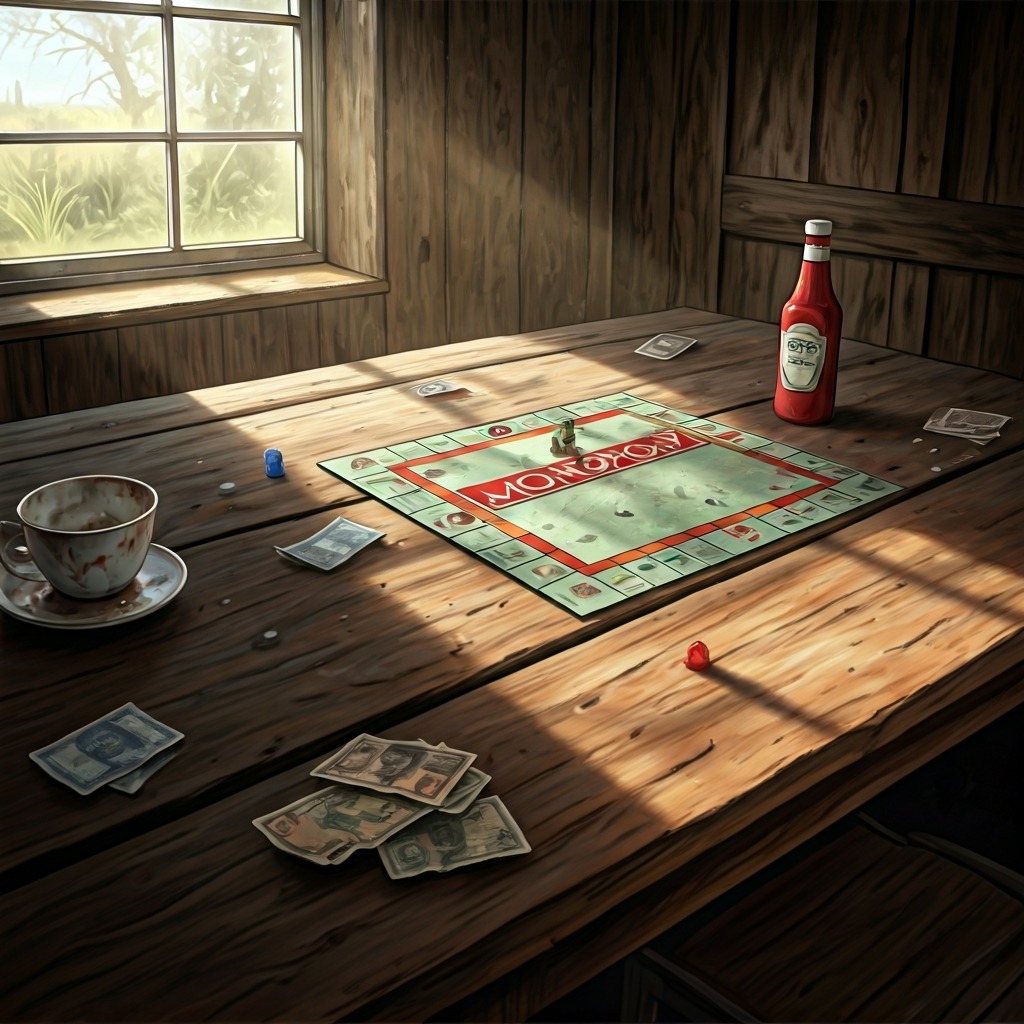
The crew retreated to Leatherslade Farm, a secluded hideout they had purchased specifically for the operation. Flushed with adrenaline and unimaginable wealth, they kicked back to celebrate. In a display of sheer hubris, they famously played a game of Monopoly using real, stolen banknotes.
But arrogance always demands a toll. The gang had hired a cleaner to burn down the farm and destroy all evidence of their presence before they scattered. The cleaner took the money, but failed to strike the match.
When a relentless police manhunt—led by Detective Chief Superintendent Tommy Butler of the Flying Squad—descended on the farm, they didn’t just find an empty hideout. They found a forensic goldmine. The gang had left a treasure trove of fingerprints on a ketchup bottle, a teacup, and, most poetically, that very Monopoly board.
Fugitives and Punk Rock Legends
That single forensic slip-up sparked one of the most legendary manhunts in British history. Most of the gang members, including Gordon Goody, Charlie Wilson, and Roy James, were swiftly apprehended. In 1964, a highly embarrassed British establishment handed down draconian sentences of up to 30 years to set an example.
But the story refused to end behind bars.
In 1964, Charlie Wilson managed a daring breakout from HMP Winson Green. The following year, Ronnie Biggs famously scaled the walls of Wandsworth Prison, fleeing first to Australia and then to Brazil. Biggs became a literal fugitive celebrity, living openly in the sun, mocking British authorities for decades, and even recording music with the Sex Pistols. He eventually surrendered and returned to the UK in 2001 due to failing health. Meanwhile, fellow robber Buster Edwards fled to Mexico before eventually surrendering—a saga so dramatic it was later adapted into a Hollywood film.
The Dual Legacy of a Masterpiece Crime
Today, the Great Train Robbery remains a deeply polarizing historical event. From one angle, it is a legendary tale of working-class anti-heroes who executed a brilliant, cinematic strike against the state. From another, it is a stark, sobering reminder of the devastating human cost of crime, forever embodied by the suffering of Jack Mills.
It is a story of brilliance and brutality, of incredible luck and foolish mistakes. Above all, it is proof that sometimes, the most unbelievable thrillers are the ones that actually happened.