Forget bank heists and Cold War espionage. The most audacious crime of the late 20th century didn’t happen in a vault or a secret bunker—it happened simultaneously in the living rooms of millions. It was a flawless, high-tech heist executed by a cyberpunk phantom who hijacked a city’s airwaves, terrorized its television sets, and vanished into the static without a trace.
Signal Lost: The First Intrusion
The date was November 22, 1987. It was a chilly Sunday evening in Chicago, and thousands of families were settling in front of the warm glow of their cathode-ray tube TVs.
At 9:14 PM, during WGN-TV’s primetime newscast, sports anchor Dan Roan was delivering highlights on the Chicago Bears. Suddenly, the broadcast signal wavered. The screen went pitch black.
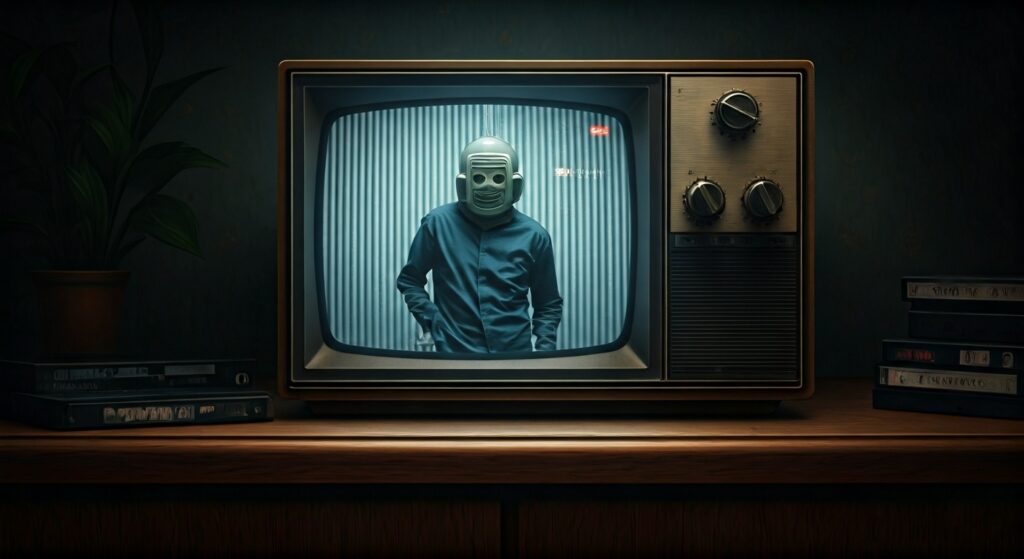
When the picture returned, Dan Roan was gone. In his place was an unidentified figure wearing a stiff, eerie rubber mask of Max Headroom—the fictional British artificial intelligence character who was at the absolute height of his pop-culture fame. The figure swayed erratically in front of a rotating panel of corrugated metal, a low-budget practical effect designed to mimic the character’s signature computer-generated background.
For 25 agonizing seconds, the masked intruder stared into the living rooms of Chicago. There was no audio, just an unsettling, silent dance. Behind the scenes, WGN engineers scrambled in a blind panic, frantically switching their studio-to-transmitter links to bypass the intrusion. They managed to wrestle back control of the broadcast, snapping the feed back to a highly confused sports desk.
The station assumed it was a bizarre, isolated prank. But the masked phantom was just warming up.
A Time Lord Interrupted
Two hours later, at 11:15 PM, the local PBS affiliate WTTW was broadcasting an episode of the sci-fi classic Doctor Who.
This time, the intruder wasn’t silent.
The screen flickered, the Time Lord vanished, and the eerie Max Headroom imposter returned—accompanied by heavily distorted, nightmarish audio. For the next 90 seconds, the hijacker subjected viewers to a chaotic, rambling monologue that felt like a fever dream.
He mocked WGN sports pundit Chuck Swirsky, branding him a “freaking liberal.” He held up a can of Pepsi while reciting the Coca-Cola slogan “Catch the Wave”—a darkly comedic jab, considering the real Max Headroom was a Coke spokesman. He inexplicably hummed the theme song to the obscure 1950s cartoon Clutch Cargo. Referencing WGN’s famous acronym, he proudly proclaimed he had made a “giant masterpiece for all the greatest world newspaper nerds.”
Then, the broadcast took a turn for the truly surreal.
The figure pulled down his pants to expose his bare buttocks. An unidentified female accomplice, dressed in a French maid outfit, stepped into the frame and began spanking him with a flyswatter while the man screamed, “They are coming to get me!”
WTTW engineers were completely helpless. Unlike WGN, there was no engineer on duty at their Sears Tower transmitter at that late hour to cut the feed. The broadcast eventually ended on its own, snapping back to Doctor Who as if the 90 seconds of sheer, unadulterated madness had never happened.
The Invisible Heist in the Sky
The morning after, Chicago was in an uproar. How does someone break into a television station without ever setting foot inside the building?
The Federal Communications Commission (FCC) and the FBI immediately launched an extensive, high-stakes investigation. Treating the intrusion like a major cybercrime, they quickly realized the sheer technical magnitude of what had occurred.
The hijackers hadn’t broken into the studios. They had successfully overpowered the stations’ microwave studio-to-transmitter links (STL). To pull this off, the perpetrators didn’t just need a rubber mask and a flyswatter; they needed incredibly expensive, sophisticated broadcasting equipment and a masterful understanding of radio frequency engineering.
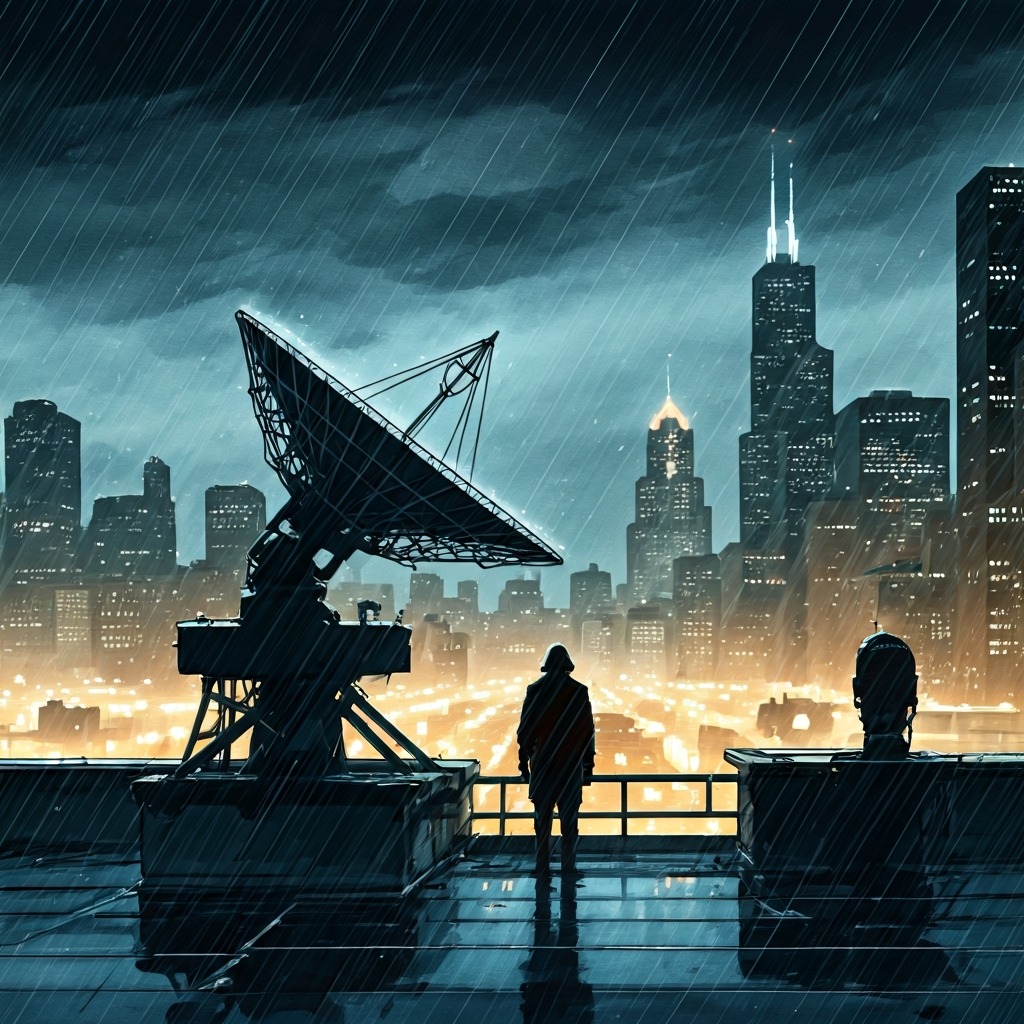
Investigators concluded that the hijackers likely positioned their own high-powered microwave dish on a rooftop or a high-rise building with a direct, unobstructed line of sight to the receivers on the John Hancock Center and the Sears Tower. They had effectively blasted their own signal through the Chicago skyline, drowning out the legitimate broadcasts with sheer electronic force.
Chasing Ghosts in the Static
Despite the high-profile nature of the crime—which carried a maximum penalty of $100,000 and a year in federal prison—the trail went ice cold.
Over the decades, the vacuum of evidence has been filled with endless theories. Many broadcast experts remain convinced it was an inside job, likely executed by a disgruntled engineer or someone deeply embedded in Chicago’s underground hacker and phone phreaking scenes.
In the 2010s, the internet latched onto a popular theory pointing to an eccentric local man and his brother, both of whom supposedly had the technical chops to pull it off. However, exhaustive investigations by journalists ultimately found no concrete evidence to support the claim, and the suspects remain nothing more than ghosts in the machine.
Today, the Max Headroom incident stands as one of the most infamous and surreal unsolved mysteries in television history. It was a brilliant, terrifying flash of cyberpunk rebellion that exposed the hidden vulnerabilities of analog broadcasting. And perhaps the most baffling detail of all? The perpetrators pulled off a flawless, high-tech heist requiring immense skill and thousands of dollars in equipment, all just to get spanked with a flyswatter on live television.