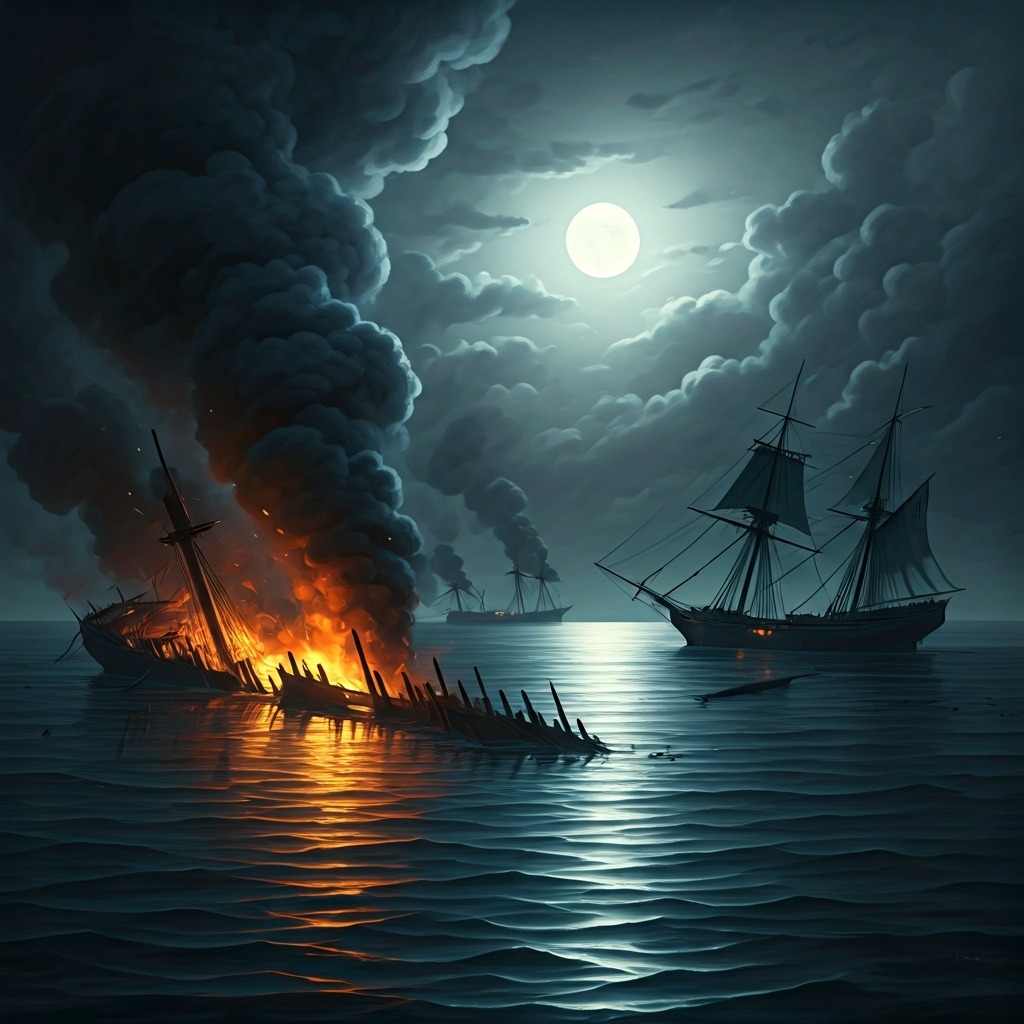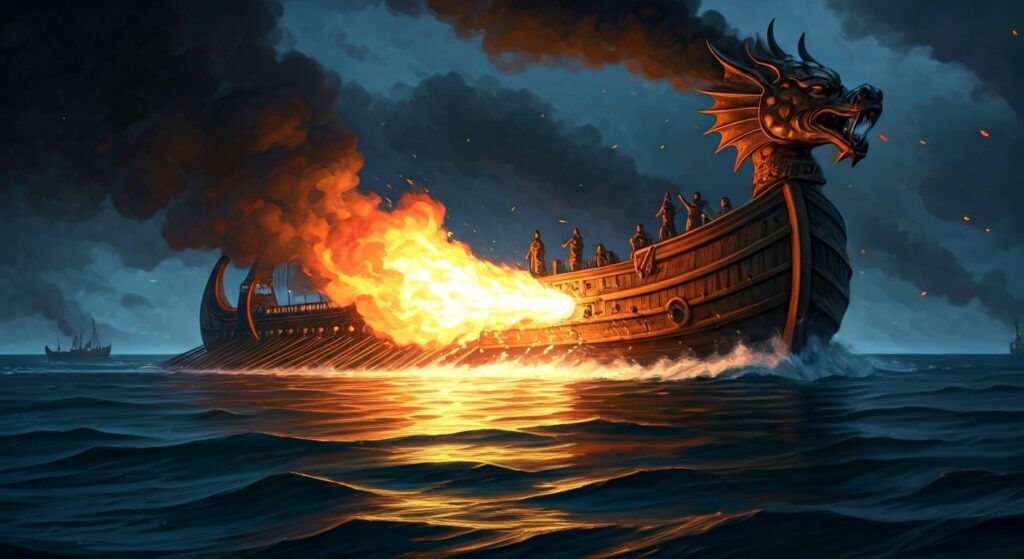
Imagine you are an eighth-century sailor. You are miles from shore, surrounded by the dark, unforgiving waters of the Mediterranean. Suddenly, the enemy ships bearing down on you don’t fire arrows. They don’t attempt to ram your hull. Instead, they unleash a roaring, mechanized beast that vomits liquid hellfire across the waves. And the most terrifying part? The water doesn’t extinguish the flames. It makes them burn hotter.
This was the brutal reality of facing the Byzantine Empire’s ultimate naval superweapon: Greek Fire. It was an invention so devastating it saved an empire, yet so shrouded in mystery that its exact formula remains one of history’s greatest unsolved puzzles.
The Architect of the Apocalypse
The year was 672 AD, and the Byzantine Empire was on the brink of annihilation. The Umayyad Caliphate was expanding at a terrifying pace, and an enormous fleet was bearing down on Constantinople.
Enter Callinicus of Heliopolis, a Jewish architect and refugee fleeing the Arab conquests in Syria. Callinicus didn’t arrive in the Byzantine capital empty-handed. He brought with him an invention that would fundamentally alter the course of history. When the enemy fleet arrived for the first Arab siege (674–678 AD), Callinicus’s creation was finally unleashed.
The Byzantine warships, known as dromons, sailed out to meet the invaders. What followed wasn’t a battle; it was an incineration. The massive enemy fleets were obliterated in a firestorm, halting Islamic expansion into Eastern Europe and saving the empire from total collapse.
Boiling Seas and Liquid Hell
The psychological warfare of Greek Fire was just as devastating as its physical toll. Contemporary accounts describe a deafening, roaring noise and thick, choking smoke preceding the flames.
But the true horror lay in the substance itself. It was incredibly adhesive. If it hit a ship, it clung to the wooden hull, eating through the timber. If it hit a sailor, it clung to their flesh. And if a panicked victim dove into the sea? They were out of luck. Greek Fire famously burned on water. In fact, historical accounts suggest that water actually ignited the substance or intensified the flames.
Traditional firefighting was completely useless. To extinguish Greek Fire, you had to smother it with sand to deprive it of oxygen, or douse it in strong vinegar or old urine.
The Anatomy of an Ancient Flamethrower
While the chemistry of the weapon was a stroke of dark genius, the delivery system was a masterpiece of ancient engineering. This wasn’t just a matter of throwing flaming rags over the bow.
The Byzantines equipped their dromons with a complex mechanical system hidden below deck. The liquid was heated in pressurized vats and then pumped through bronze tubes called siphons mounted on the prows of the ships. This required an incredibly advanced grasp of pneumatics and hydraulics.
They didn’t stop at naval cannons, either. Byzantine engineers developed portable versions, including hand-held siphons (cheirosiphones) for siege warfare, and clay pots filled with the viscous liquid that essentially functioned as early hand grenades.
A Recipe Guarded by Angels
Greek Fire was the most closely guarded state secret of the ancient world. Emperor Constantine VII Porphyrogenitus went so far as to write in his manual De Administrando Imperio that the recipe was delivered to the first Christian Emperor, Constantine the Great, by an angel. He claimed that anyone who dared reveal the formula would be struck down by divine wrath.
The secrecy was brutally effective. To this day, the exact chemical formula remains lost to history. Modern chemists and historians suspect the base ingredient was naphtha—crude liquid petroleum—sourced from seepages in the Crimea or the Middle East. To make it sticky and burn hotter, they likely thickened it with pine resin and mixed in sulfur. The terrifying ability to burn on water strongly points to the inclusion of quicklime (calcium oxide), which creates a fierce exothermic reaction when exposed to moisture, though some historians argue the pressurized delivery system alone could account for the ignition.
Vanished into the Fog of Time
How does an empire lose the very weapon that made it invincible?
It wasn’t stolen in a daring heist, and it wasn’t destroyed in a single tragic event. The loss of Greek Fire was a slow, agonizing fade brought on by imperial collapse.
The Byzantines heavily compartmentalized the knowledge to protect it. The laborers extracting the naphtha didn’t know the chemists who mixed it, and the chemists didn’t know the engineers building the bronze siphons. Only a tiny handful of elites ever understood the complete system.
As the Byzantine Empire slowly fractured and lost the territories where the raw materials were sourced, the chain of knowledge weakened. When the empire was shattered during the Fourth Crusade in 1204, the chain snapped completely. By the time gunpowder artillery rolled around in the 14th and 15th centuries, Greek Fire had already faded into myth.
Today, it exists only in the ashes of the ships it destroyed and the terrifying legends it left behind—the ultimate ancient weapon of mass destruction that the ocean itself couldn’t swallow.