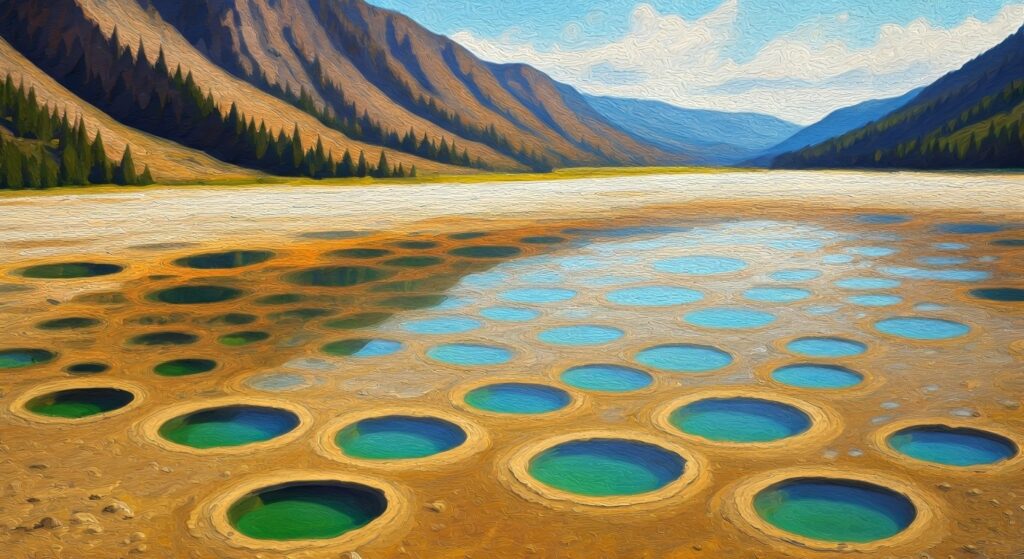
Tucked away in the rugged expanse of British Columbia’s Similkameen Valley lies a body of water that harbors a bizarre, almost alien secret. For half the year, it masquerades as a perfectly ordinary, serene lake, locked in the bitter cold of the Canadian winter. But when the scorching summer sun beats down, the water doesn’t just evaporate—it peels back to reveal something straight out of a science fiction novel.
The Lake That Changes Its Skin
As the intense summer heat bakes the valley, the receding waters of the lake reveal hundreds of massive, perfectly circular pools. From above, the landscape transforms into a colossal, shifting mosaic. These spots aren’t just a trick of the light; they shift from pale, milky yellows to deep, vibrant greens and startling, otherworldly blues.
This mesmerizing phenomenon is driven by an extraordinarily high concentration of minerals—magnesium sulfate, calcium, sodium sulfates, and even traces of silver and titanium. The shifting colors of the pools depend entirely on the specific mineral composition left behind in the mud and the seasonal precipitation. But long before modern geologists arrived to catalog its staggering chemical makeup, this endorheic lake was already the center of a profound, ancient mystery.
The Living Apothecary
To the Syilx (Okanagan) First Nations, this is not a mere geological oddity. It is Kliluk, a profoundly sacred site of physical and spiritual healing.
For thousands of years, the Syilx people revered the lake as a living apothecary. The true intrigue lies in the sheer, almost magical specificity of the lake’s power: the Syilx discovered that each individual pool possessed its own distinct therapeutic properties. One pool, rich in a specific mineral balance, might be used to soothe aching joints, while an adjacent circle could heal skin ailments or treat battle wounds. It was a naturally occurring pharmacy, drawing Indigenous peoples from across the region who sought the lake’s restorative magic.
Harvested for Destruction
But history is rarely a peaceful, linear story. The dawn of the 20th century brought dark clouds to the Similkameen Valley, and the sacred sanctity of Kliluk was violently interrupted.
During World War I, the very minerals that had been used for millennia to heal human bodies were suddenly highly sought after to destroy them. The lake was subjected to intense ecological desecration as its rich deposits were heavily harvested to manufacture ammunition for the global war effort. The sacred site was systematically stripped of its ancient, mineral-rich armor to fuel artillery shells overseas, leaving a devastating, toxic mark on the landscape.
The Decades-Long Standoff
Even after the guns of Europe fell silent, Kliluk’s survival was far from guaranteed. By the late 20th century, the land had fallen into the hands of a private owner who looked at the kaleidoscopic pools and saw only dollar signs. He drafted aggressive plans to drain the area and pave over the ancient apothecary to construct a commercial spa and roadside amusement attraction.
What followed was a tense, decades-long standoff. The Syilx people refused to let their sacred sanctuary be erased. They launched a relentless campaign to protect Kliluk, fiercely advocating for the preservation of its fragile ecology and cultural sanctity against the looming threat of bulldozers.
The suspense finally broke in 2001. After years of hard-fought negotiations, the First Nations successfully partnered with the Canadian government to purchase the land, effectively returning Kliluk to Indigenous stewardship.
Today, if you drive along Highway 3, you can still witness this breathtaking wonder. It is now heavily fenced off, protecting the delicate mineral crusts and honoring the site’s profound cultural weight. You can no longer walk among the pools, but standing at the edge, looking out over the vibrant kaleidoscope of colors, the history is palpable. It stands as a vivid, beautiful reminder that some magic in this world is real—and worth fighting for.