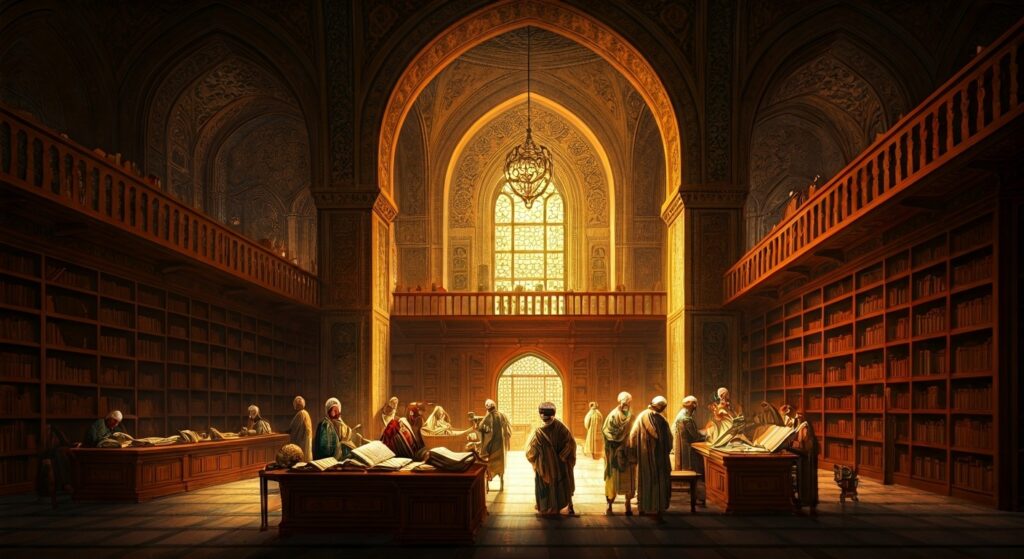
History is haunted by the ghosts of fallen empires, but few losses echo as loudly as the greatest treasure of the medieval world. It wasn’t a hoarded stockpile of diamonds or a chest of pirate gold. It was a building in 9th-century Baghdad—a place where the brightest minds of a generation raced to decode the secrets of the universe.
This was the Bayt al-Hikmah—the House of Wisdom. Established in the late 8th century by Abbasid Caliph Harun al-Rashid and vastly expanded by his son, Al-Ma’mun, it remains the intellectual crown jewel of the Islamic Golden Age. But what actually happened behind its walls is a story of obsession, genius, and ultimately, unimaginable tragedy.
A Bounty Paid in Pages
To understand the House of Wisdom, you must understand the intoxicating hunger for knowledge that gripped the Abbasid Empire. While Europe languished in the Dark Ages, Baghdad was practically vibrating with discovery.
Caliph Al-Ma’mun was a man obsessed. He didn’t just want a library; he wanted every scrap of human knowledge ever recorded. He initiated a massive, state-sponsored Translation Movement, dispatching emissaries across the globe to hunt down Persian, Indian, and Greek manuscripts. Al-Ma’mun didn’t just ask nicely for these texts—legend dictates he paid his top translators the weight of their translated books in solid gold.
The House of Wisdom became a dizzying, multicultural utopia. Muslims, Jews, Zoroastrians, and Christians worked shoulder-to-shoulder. The chief translator, a brilliant Nestorian Christian named Hunayn ibn Ishaq, produced precise, elegant Arabic translations of ancient medical titans like Galen and Hippocrates, essentially saving classical medicine from being lost to time.
The Men Who Calculated the Stars
This was no quiet reading room. It was a buzzing, high-stakes research academy where the blueprint of the modern world was quietly drafted.
Walk down the imagined halls of the House of Wisdom, and you might bump into Muhammad ibn Musa al-Khwarizmi. If you’ve ever groaned over a complex math equation, you have him to thank. Al-Khwarizmi developed the foundational concepts of algebra (the very word comes from his book Al-Jabr) and introduced the Hindu-Arabic numeral system—including the revolutionary concept of zero—to the Islamic world, which eventually passed it to Europe.
Down another corridor, the Banu Musa brothers were busy engineering automated mechanical devices, centuries before the concept of robotics existed. Meanwhile, Al-Kindi was daringly synthesizing Aristotelian philosophy with Islamic theology, proving that faith and reason could share the same space.
Al-Ma’mun even attached cutting-edge observatories to the institution. Here, scholars didn’t just read about the stars; they tracked celestial bodies, corrected Ptolemy’s flawed astronomical data, and accurately measured the Earth’s circumference. The bedrock of modern science was poured right there in Mesopotamia.
The Phantom Library
But here is where the mystery deepens. For centuries, popular history has pictured the House of Wisdom as a colossal, singular building—a sort of ancient, domed MIT.
Yet, when you look closely at the historical shadows, the architecture begins to blur. Modern historians argue that the House of Wisdom wasn’t a giant public university at all. Evidence suggests it began as a Sassanid-style state archive for Persian poetry and history, and that the broader Translation Movement was actually a decentralized, societal effort rather than the work of one single institution.
Was it a single grand palace of learning, or a sprawling, city-wide network of private collections and translation hubs? The exact physical structure remains a ghost, lost to the sands of Iraq. But regardless of its floor plan, the term Bayt al-Hikmah symbolizes something undeniably real: an era of unparalleled state sponsorship of knowledge.
The Day the Tigris Ran Black
All golden ages attract the attention of wolves.
On February 10, 1258, the Mongol Empire, led by the ruthless Hulagu Khan, breached the walls of Baghdad. The siege was brutal, swift, and apocalyptic. The city that had served as the intellectual heartbeat of the world was sacked, its magnificent architecture reduced to smoldering rubble.
The House of Wisdom—whether it was one grand building or a network of brilliant minds—was utterly destroyed.
Historical accounts from the time paint a picture so vivid and horrifying it still chills the blood. The Mongols emptied the great libraries, hurling countless priceless manuscripts into the Tigris River to use them as a makeshift bridge for their horses. It is said that the waters of the river ran black with the ink of thousands of discarded books, and red with the blood of the scholars who tried to protect them.
It was a devastating, incalculable loss for global intellectual heritage. The physical House of Wisdom was gone forever. Yet, the ideas forged in those rooms—the algebra, the medicine, the philosophy, the very concept of zero—had already slipped out into the world, quietly seeding the Renaissance and laying the blueprint for the future. The ink may have washed away in the river, but the wisdom survived.