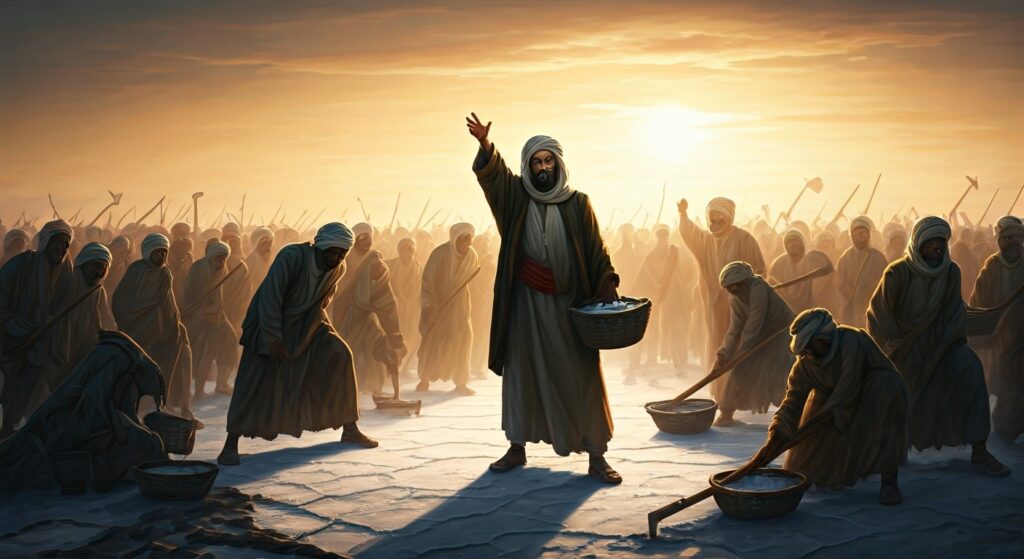
When we picture the Abbasid Caliphate of the 9th century, we envision the glittering Islamic Golden Age—a realm of brilliant mathematicians, towering libraries, and the bustling, opulent streets of Baghdad. But history is rarely just a highlight reel of human achievement. Beneath the unimaginable wealth of the Abbasid elite lay a dark, brutal foundation. And in the treacherous, salt-crusted marshes of southern Iraq, that foundation was about to violently fracture.
This is the story of the Zanj Rebellion (869–883 CE), a fourteen-year nightmare for the Caliphate and one of the most formidable, blood-soaked uprisings in Middle Eastern history.
A Golden Age Built on Salt and Sweat
To understand the sheer explosive power of this rebellion, one must travel south to the desolate Shatt al-Arab marshes near Basra. During the 9th century, wealthy Arab landowners sought to transform this waterlogged region into massive agricultural plantations. There was just one problem: the topsoil was choked by a thick, toxic crust of nitrous salt.
To clear it, the elite imported tens of thousands of enslaved laborers, known collectively as the Zanj. Primarily Bantu-speaking peoples captured from East Africa, they were forced into conditions that were nothing short of apocalyptic. Stripped of their freedom, they languished in squalid, overcrowded camps, surviving on meager rations while performing the backbreaking labor of peeling salt from the earth under the blistering Mesopotamian sun.
Desperate, heavily concentrated, and armed with heavy iron farm implements, the Zanj were a powder keg. All they needed was a spark.
The Enigmatic Poet Who Lit the Match
Enter Ali ibn Muhammad. An enigmatic poet of obscure origins, he boldly claimed direct descent from the Prophet Muhammad’s daughter, Fatima—a lineage Abbasid historians fiercely disputed. But Ali was more than a charismatic speaker; he was a master of psychological manipulation and timing.
Venturing into the salt camps, Ali began preaching a radical, egalitarian message deeply influenced by Kharijite theology. He told the enslaved laborers exactly what they needed to hear: that the most pious man should lead the community, regardless of his race or social standing. He did not just promise spiritual equality, however. He promised them land, unimaginable wealth, and—in a dark twist of vengeance—the enslavement of their former masters.
In September 869, the Zanj threw down their salt-baskets and raised their iron spades. The rebellion had begun.
The Swamps That Swallowed an Army
The Abbasids made a classic imperial mistake: they underestimated the underdogs. The military’s greatest asset was its heavily armored cavalry, but in the treacherous, canal-crossed topography of the southern Iraqi marshes, a horse in heavy armor is nothing but an anchor.
The Zanj brilliantly weaponized their environment. Armed initially with little more than clubs and farming tools, they vanished into the reeds, launching devastating guerrilla ambushes. They slaughtered Abbasid forces, stripping the dead of their weapons and horses. The rebellion rapidly snowballed. By 871, the Zanj achieved the unthinkable: they sacked the wealthy commercial hub of Basra, sending economic and psychological shockwaves all the way to the Caliph’s palace in Baghdad.
The City of the Chosen
This is where the story shifts from a chaotic uprising into a sophisticated revolution. The Zanj did not just want to burn the empire down; they wanted to build their own.
Deep within the impenetrable marshes, they constructed a highly organized capital city called al-Mukhtara, meaning “The Chosen.” Far from a lawless mob, the Zanj demonstrated astonishing administrative brilliance. They established courts of law, collected taxes, and even minted their own independent coinage to facilitate trade and legitimize their new state.
Yet, history harbors a grim nuance. While traditionally remembered as a massive slave revolt, it was actually a broader socio-economic revolution. The ranks of the Zanj swelled with disenfranchised Arab peasants, runaway serfs, and Bedouin tribesmen who all shared a burning hatred for the Abbasid elite. Furthermore, the Zanj were not modern abolitionists. As their state grew powerful, they captured and owned slaves themselves, reflecting the harsh socio-economic norms of the 9th century rather than a quest for universal human rights.
The Empire Strikes Back
For a decade, the Abbasids were too distracted by other regional conflicts to deal with the breakaway state in the swamps. But by 879, the Abbasid regent Al-Muwaffaq turned his terrifying, undivided attention to the south.
The sheer methodical ruthlessness of Al-Muwaffaq’s counter-offensive was staggering. He did not just send troops; he built a specialized riverine navy. He launched a suffocating blockade around al-Mukhtara, cutting off their food supply. Then, he deployed brilliant psychological warfare, offering generous amnesty, cold hard cash, and prestigious military commissions to any Zanj commanders who defected.
Starving, exhausted, and fractured by betrayal, the impregnable swamp fortress finally began to crumble. In 883, the defenses of al-Mukhtara collapsed. Ali ibn Muhammad was killed, and his head was sent to the Caliph on a silver platter.
The Abbasids had won, but it was a pyrrhic victory. The fourteen-year war had drained the imperial treasury and permanently devastated the agricultural infrastructure of southern Iraq, accelerating the eventual fragmentation of the Caliphate. Yet, the Zanj did not fight in vain. The sheer trauma of the uprising forced a permanent shift in the region’s economy. The Abbasids quietly abandoned the brutal, mass plantation-style agricultural slavery that had sparked the rebellion in the first place.
The Zanj may have been defeated, but they ensured the salt marshes of Mesopotamia would never claim another generation of chains.