The Invisible Torture Device
I still remember the cold dread of ninth-grade math class—the exact moment numbers were hijacked by letters. For millions of teenagers staring down a chalkboard littered with x’s and y’s, algebra feels like a sadistic, abstract torture device.
But trace the origins of those maddening equations back through time, and you won’t find a cruel professor trying to break your spirit. Instead, you will find yourself thrust into the dusty, cutthroat streets of a medieval metropolis, surrounded by merchants haggling over fortunes, surveyors carving up empires, and engineers taming rivers. The birth of algebra wasn’t an exercise in abstract theory. It was a desperate, brilliant weapon forged to conquer the everyday chaos of human life.
The City of Secrets and Scholars
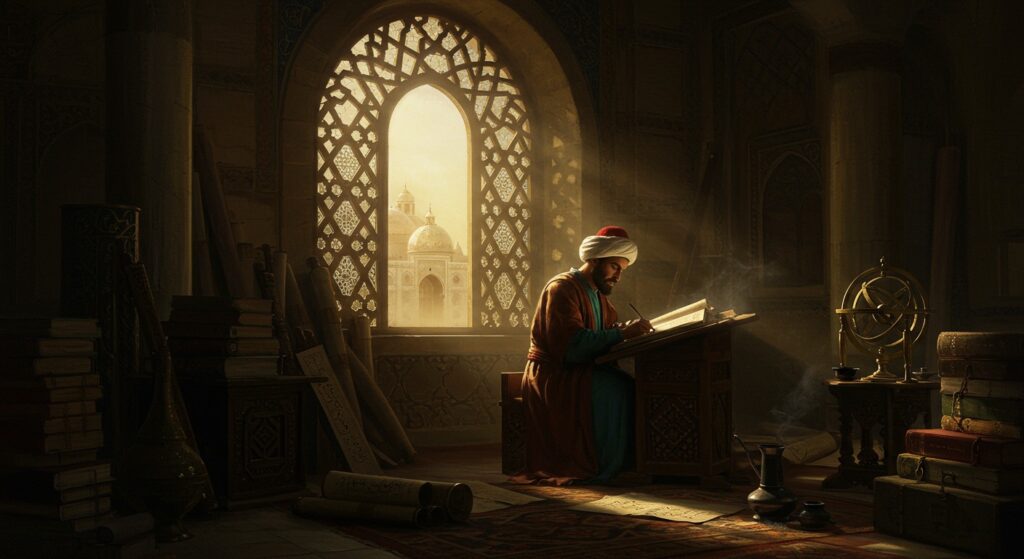
The year is 820 CE. Welcome to Baghdad, the beating heart of the Abbasid Caliphate and the epicenter of a global intellectual conquest. Under the watchful eye of Caliph al-Ma’mun, a legendary academy known as the House of Wisdom has risen. It is a sanctuary of intense mystery and immense power, where scholars hunt down the lost texts of antiquity to unlock the secrets of the universe.
Enter Muhammad ibn Musa al-Khwarizmi, a brilliant Persian astronomer with a mind for the practical. He looked at the booming Islamic empire and saw a society on the brink of drowning in its own bureaucratic and financial complexity.
Blood, Dirt, and Broken Fortunes
When a wealthy merchant died, dividing his estate wasn’t a simple coin toss. Islamic inheritance laws were a labyrinth of intricate fractional calculations required to distribute assets among wives, sons, daughters, and distant relatives. Add the mathematical nightmares of taxing vast, sprawling trade networks and surveying jagged plots of agricultural land, and the empire was begging for a standardized system of problem-solving.
Al-Khwarizmi didn’t write for the elite; he wrote a survival guide for the common man. He designed his groundbreaking treatise to calculate exactly what was required in cases of bitter inheritance disputes, lawsuits, and high-stakes trade.
He titled this revolutionary manual Al-Kitab al-Mukhtasar fi Hisab al-Jabr wal-Muqabala—The Compendious Book on Calculation by Completion and Balancing.
The Code of Completion
Hidden within that sprawling title lay a word that would alter the course of human history.
Al-Khwarizmi outlined two fundamental operations to untangle complex problems. The first was al-jabr, meaning “completion” or “restoring.” If a calculation contained a negative quantity, al-jabr was the act of moving it to the other side of the equation to make it positive.
The second was al-muqabala, or “balancing”—subtracting equal quantities from both sides to strip the problem down to its core.
Over centuries of translation, whispered across borders and tongues, the Arabic term al-jabr morphed into the word that haunts high schoolers today: algebra.
The Masterpiece Without Math
But here is the most mind-bending twist of al-Khwarizmi’s invention. If you were to unearth his original 9th-century manuscript, you wouldn’t even recognize it as a math book.
There were no x’s. There were no y’s. There wasn’t even an equal sign.
Al-Khwarizmi wrote his equations entirely in prose. To express what we would write as $x^2 + 10x = 39$, he penned a philosophical riddle: “What must be the square which, when increased by ten of its own roots, amounts to thirty-nine?” This stylistic approach, known today as rhetorical algebra, reads more like poetry than a modern math problem.
The Ghost in the Machine
While earlier civilizations like the Babylonians and Greeks had cracked specific mathematical puzzles, al-Khwarizmi did something unprecedented. He didn’t just solve isolated problems; he forged algebra into an independent, unstoppable discipline. He created systematic rules for solving equations, regardless of the numbers involved.
When his texts finally bled into Europe via Latin translations, the West didn’t just adopt his math—they inadvertently immortalized his name.
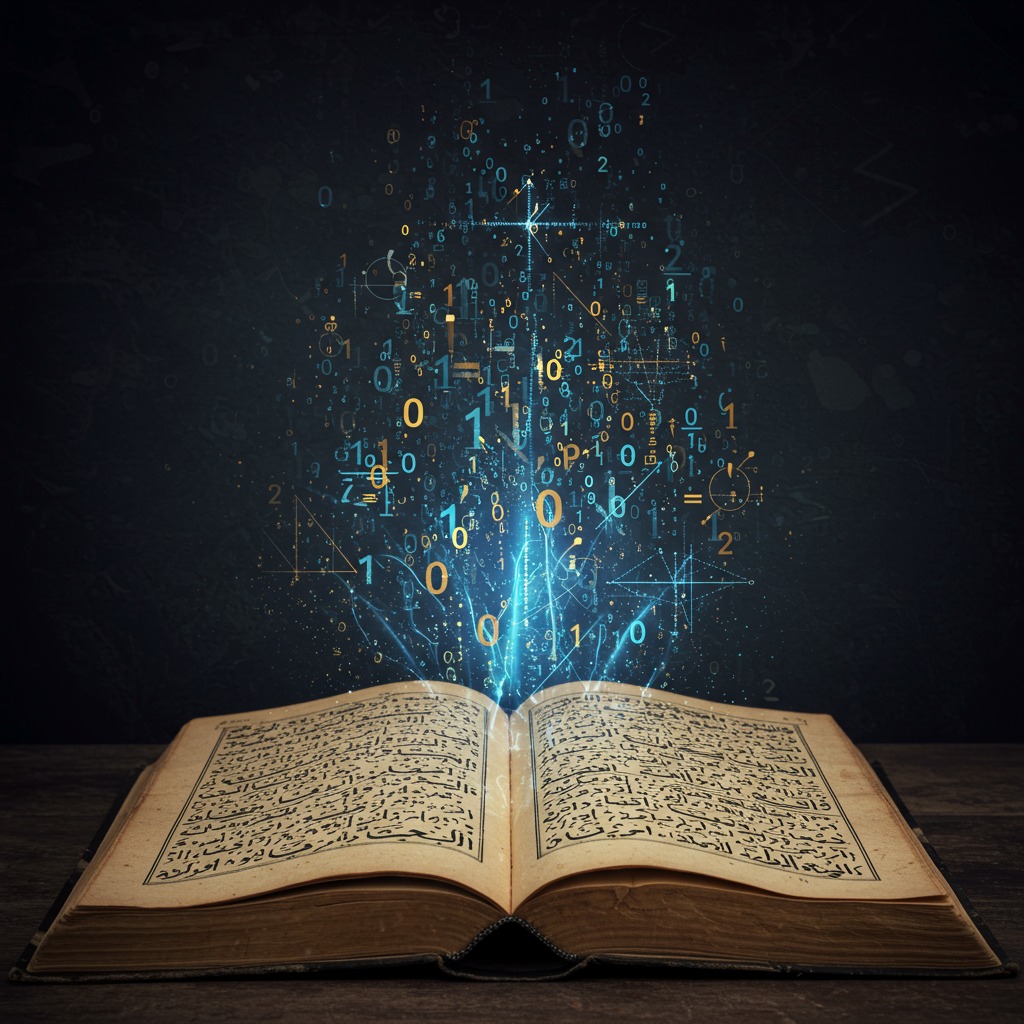
In Latin, “al-Khwarizmi” became Algoritmi. As his legend grew, his Latinized name evolved into a noun used to describe any systematic set of rules for calculations. Today, we call it an algorithm—the invisible, omnipotent code that powers our computers, curates our internet searches, and dictates our digital lives.
So, the next time you curse a complex equation or an eerily targeted digital ad, remember the Persian astronomer in the House of Wisdom. A practical guide written to settle medieval family feuds ended up laying the foundation for modern mathematics and the entire digital age.