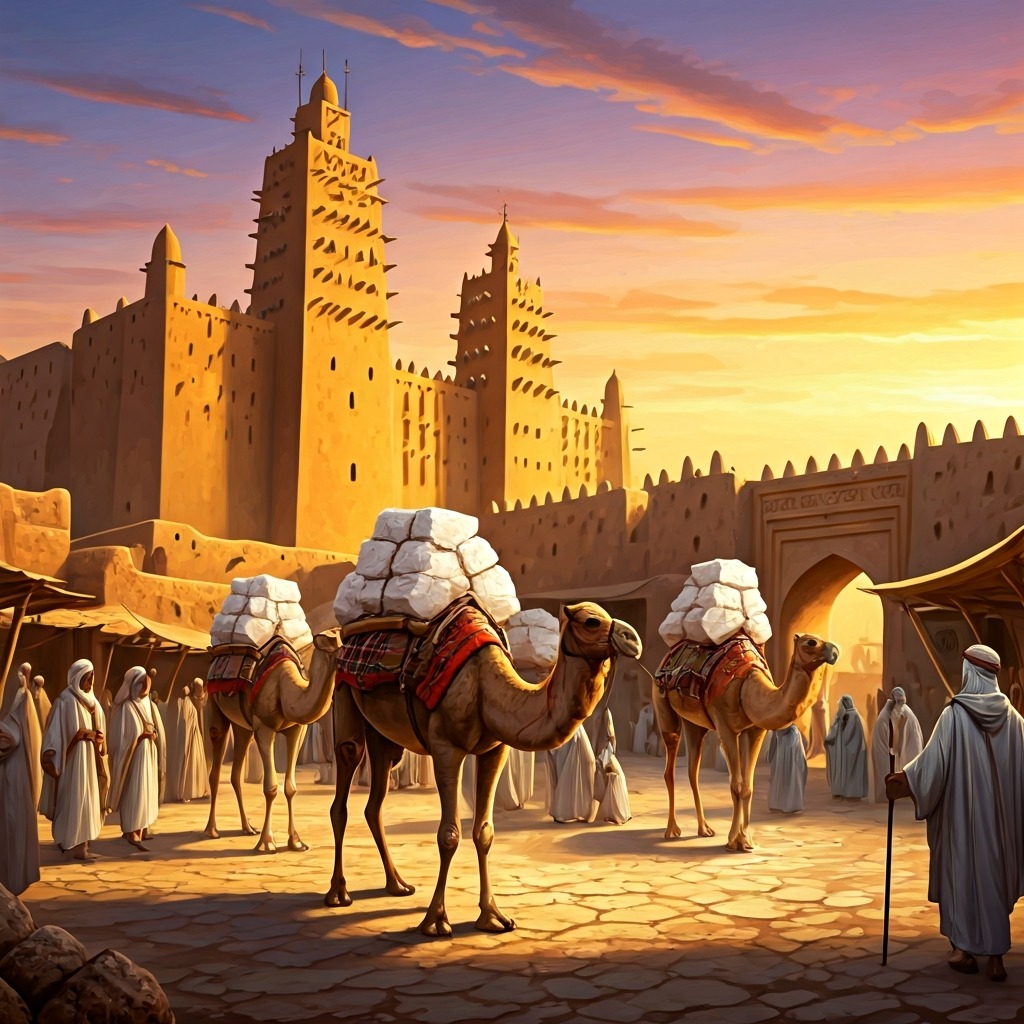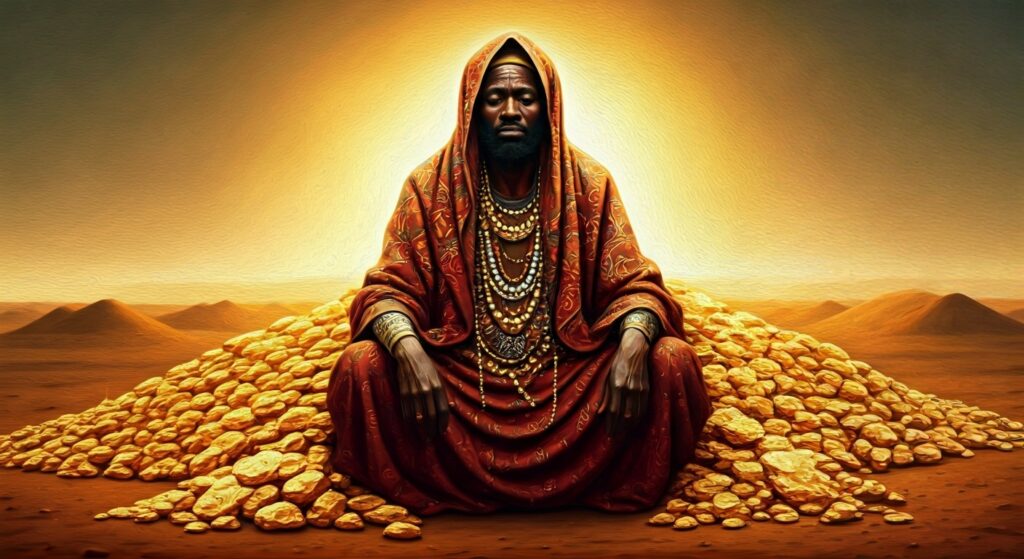
Imagine sitting on a literal mountain of gold. You can scoop it from the riverbanks, pry it from the soil, and trade it for anything your heart desires. You are unfathomably rich. Yet, a silent, invisible killer stalks you, and all the gold in the world cannot stop it.\n\nTo fight this enemy, you do not need weapons or armies. You need a rock. A specific, seemingly ordinary rock that currently sits on every dining table in the modern world.\n\nIn the scorching climates of medieval West Africa, salt was not a culinary luxury. It was a matter of life and death.\n\n## The Deadly Paradox of Plenty\n\nBetween the 8th and 16th centuries, regions in West Africa like the Senegal River valley, Bambuk, and the dense Akan forests glittered with unimaginable wealth. Gold was in absolute abundance. But these empires were missing a crucial element for survival.\n\nIn the blistering heat of the African sun, the human body rapidly sweats out vital minerals. Without salt to replace lost electrolytes, muscles cramp, organs fail, and the body eventually shuts down. Furthermore, before the advent of refrigeration, salt was the only mechanism to preserve meat and fish from rotting in the sweltering heat. The West Africans possessed the gold, but they desperately needed salt. And the only place to procure it in massive quantities lay hundreds of miles away, hidden within one of the most unforgiving environments on the planet.\n\n## The Desert of White Gold\n\nTo the north stretched the Sahara Desert, a sprawling, merciless ocean of scorching sand. But beneath that desolate wasteland lay the answer to West Africa’s prayers.\n\nDeep within the Sahara, in brutal, isolated outposts like Taghaza and Taoudenni, the earth was packed with massive salt deposits. It was a miserable, deadly place to live and labor, but the economic payoff was astronomical. Miners carved out enormous slabs of rock salt—slabs so massive and sturdy that, according to historical accounts, the miners actually constructed their homes from them.\n\nBut extracting the salt was only half the battle. How do you transport thousands of pounds of heavy rock across a seemingly endless, waterless desert to the civilizations that need it?\n\nEnter the Berber and Tuareg nomads, and their ultimate secret weapon: the Arabian camel. The introduction of these “ships of the desert” changed the course of history. Capable of surviving days without water while carrying crushing burdens across shifting dunes, camels allowed nomads to organize massive, highly coordinated caravans. Sometimes swelling to thousands of animals, these convoys hauled giant slabs of life-saving salt southward.\n\n## The Ultimate Meetup at the Edge of the World\n\nWhen these sprawling caravans finally emerged from the desert, they converged on bustling, cosmopolitan trading hubs situated at the very edge of the Sahara—legendary cities like Timbuktu, Gao, and Djenné.\n\nIn these electric marketplaces, the merchants of the desert met the traders of the forest. Heavy slabs of Saharan salt were unloaded and exchanged for shimmering gold dust, precious ivory, and exotic goods. While the famous legend that salt and gold were traded ounce-for-ounce is slightly romanticized—exchange rates fluctuated based on market conditions—make no mistake: in the deep interior of the continent, where salt was most scarce, it commanded prices so exorbitant it would make a modern billionaire sweat.\n\n## The Wealth That Built Empires\n\nThis was no simple swap of condiments for currency. This lucrative, high-stakes exchange fueled the rise of absolute powerhouses: the great West African empires of Ghana, Mali, and Songhai. The kings of these empires realized a fundamental truth of geopolitics: if you control the trade routes, you control the wealth of the world.\n\nWith the salt and gold came a massive conduit for cultural exchange. Along with their slabs of white gold, the caravans brought Islam, Arabic literacy, and stunning architectural styles that forever transformed the skyline of West Africa.\n\nThe sheer wealth generated by this network is difficult to overstate, but no one demonstrated it more spectacularly than Mansa Musa, the legendary ruler of the Mali Empire. During his 14th-century pilgrimage to Mecca, Mansa Musa brought so much gold—and distributed it so freely along his route—that he single-handedly disrupted regional economies, causing a hyperinflation crisis in Cairo that took years to stabilize. You do not crash a foreign economy by accident unless your empire’s pockets reach the earth’s core.\n\n## The True Price of Survival\n\nAt its heart, this epic saga of wealth, power, and empire was not driven by greed. It was driven by the most basic human instinct: the need to survive. The biological necessity of a simple mineral forged a complex, high-stakes global economic network that completely reshaped the geopolitical landscape of the medieval world.\n\nThe next time you casually reach for the salt shaker on your table, remember the empires built on its dust, and the men who crossed an ocean of sand to trade gold for a taste of survival.