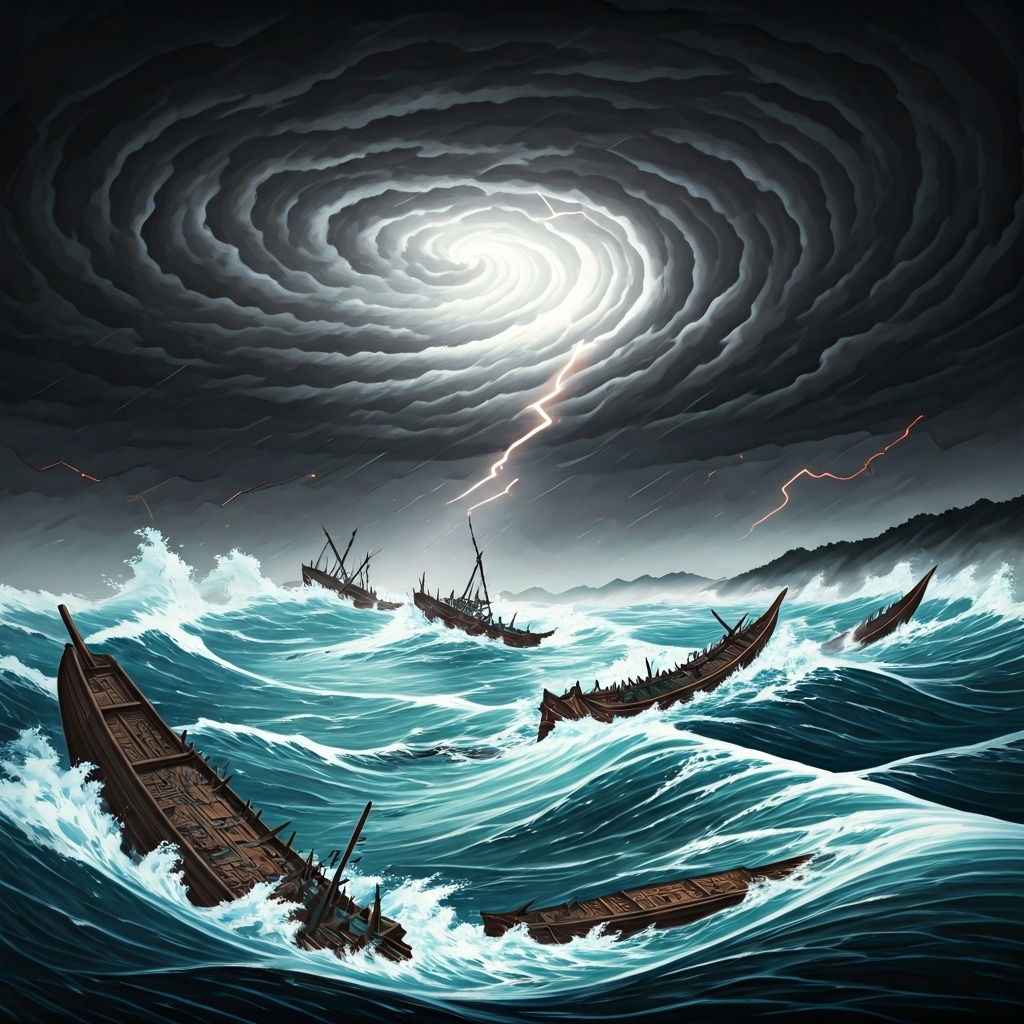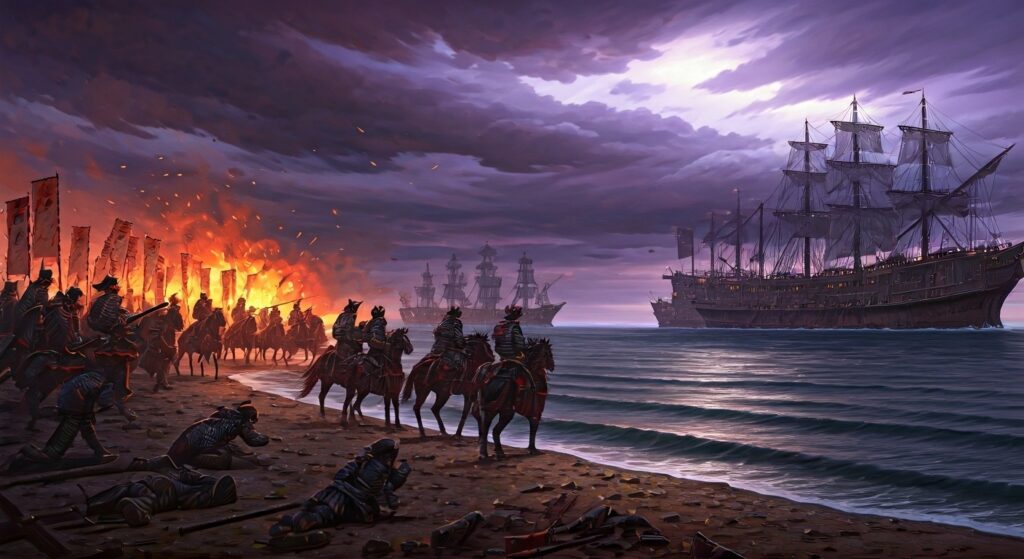
By the late 13th century, the Mongol Empire had swallowed China, Korea, and massive chunks of Eurasia. Under the ruthless command of Kublai Khan, they were the undisputed heavyweight champions of the world, riding a blood-soaked winning streak that seemed mathematically impossible to break. Having run out of continent to conquer, the Khan looked across the water. Japan was next.\n\nWhat followed is one of the most mind-bending, suspenseful clashes in military history—a story where human logistics collided with terrifying meteorological anomalies.\n\n## The Sky Catches Fire\n\nIn 1274, Kublai launched his first invasion. He sent an armada of roughly 900 ships and 40,000 men across the sea, landing at Hakata Bay. The local samurai rode out to meet them, expecting the traditional, honorable combat of one-on-one duels. The Mongols did not care about samurai etiquette. They responded with brutal, coordinated phalanx formations, poisoned arrows, and a terrifying innovation the Japanese had never seen: the world’s first use of explosive gunpowder bombs in naval warfare.\n\nThe samurai were completely outmatched. The deafening roar of the bombs panicked their horses and shattered their lines. By nightfall, the Japanese defenders were battered, bleeding, and pushed to the brink of total annihilation. Japan was hours away from becoming just another province in the Mongol war machine.\n\n## The First Breath of the Gods\n\nBut then, the atmosphere shifted. The wind began to howl, and the sky bruised a deep, unnatural purple. Fearing they might be stranded on hostile shores if their vessels were dashed against the rocks, the Mongol commanders made a tactical decision to retreat to their ships for the night. It was a fatal mistake.\n\nThe sudden storm rapidly intensified into a violent, screaming typhoon. Monstrous waves smashed the fleet together, sinking a third of the Mongol ships and forcing the battered survivors to flee back to the mainland. Japan had survived, but the samurai knew Kublai Khan was not a man who accepted defeat. The clock was ticking.\n\n## The Apocalyptic Armada\n\nKublai spent the next seven years plotting his revenge. The sheer logistical nightmare of what he built next defies comprehension. He didn’t just rebuild his army; he created an apocalyptic armada. In 1281, he unleashed a force that would remain one of the largest naval invasions in human history prior to D-Day: two massive fleets comprising over 4,000 ships and 140,000 troops.\n\nThe Japanese hadn’t been idle. They had constructed a massive, miles-long defensive stone wall along Hakata Bay. When the Mongols arrived, they found a fortified coastline and a desperate, hardened samurai defense. What followed was a grueling two-month standoff. The beaches ran red, but the Mongols couldn’t break the wall. However, numbers eventually dictate reality. The Mongols regrouped, preparing for a massive, coordinated assault that would finally crush the exhausted Japanese defenders. The end seemed entirely inevitable.\n\n## The Sky Tears Open\n\nJust as the Mongols prepared to deliver the killing blow, the ocean began to churn. The air grew heavy, and the horizon vanished behind a wall of black clouds. A second typhoon, exponentially more catastrophic than the first, slammed into Hakata Bay.\n\nThis monster of a storm raged for two unrelenting days. The screams of the Mongol soldiers were drowned out by the roar of the wind as massive waves shattered the armada like cheap toys. When the skies finally cleared, the devastation was absolute. Up to 80 percent of the Mongol fleet had been obliterated, and tens of thousands of Kublai Khan’s elite soldiers had drowned. The greatest contiguous land empire in human history had been halted in its tracks—not by an army, but by the weather.\n\nThe Japanese named these miraculous storms Kamikaze, meaning “Divine Wind.” To them, it was undeniable proof that the gods themselves were protecting their sacred islands.\n\n## Autopsy of a Miracle\n\nFor centuries, this event was treated purely as a mythic intervention. But the gritty reality of how the Mongols got so incredibly unlucky twice is a fascinating mix of geology and terrible supply chain management.\n\nIn 2015, researchers analyzing sediment cores from a coastal lake near the invasion site discovered something incredible: the late 13th century experienced an anomalous, extreme spike in typhoon activity. The Mongols didn’t just hit a bad storm; they sailed right into an era of hyper-active super-typhoons.\n\nBut Kublai Khan’s own impatience sealed his fate. Marine archaeologists diving on the shipwrecks discovered a fatal flaw in the Mongol armada. To meet the Khan’s impossible deadlines, shipwrights had cut corners. Many of the vessels weren’t deep-ocean warships at all; they were hastily constructed, flat-bottomed river boats entirely unsuited for the open sea. The flat-bottomed hulls had no keel to stabilize them, making them sitting ducks when the Divine Wind came howling through.\n\nThe psychological legacy of the Kamikaze was profound. It birthed a myth of Japanese invincibility that shaped the nation’s isolationist policies for centuries—a myth that would tragically be resurrected hundreds of years later. But back in the 13th century, it was simply the moment the earth itself rose up to swallow an unstoppable empire.