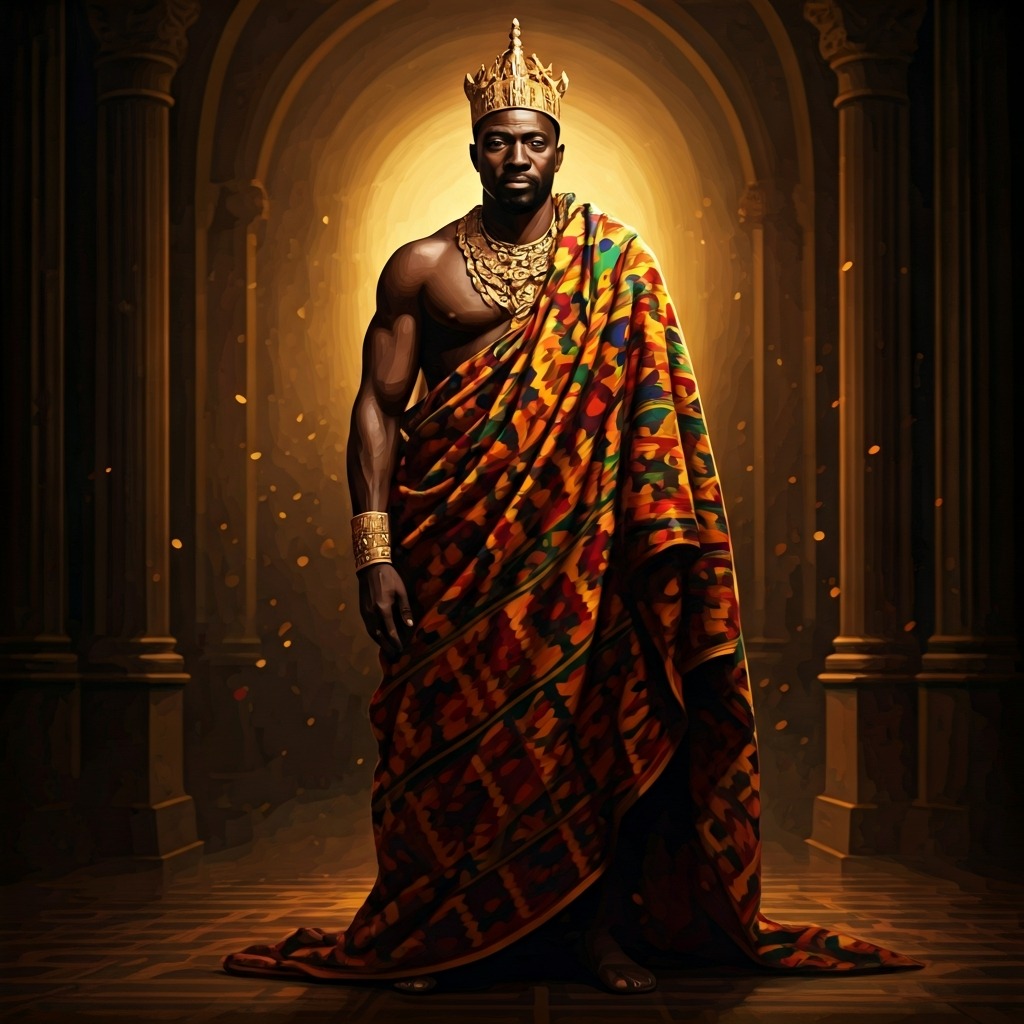
The Ultimate Power Move
History is full of conquerors who flaunted their dominance with crowns of gold or swords of steel. But deep within the lush, shadowy forests of 17th-century West Africa, the Ashanti Empire discovered a far more potent symbol of absolute power. It wasn’t forged in fire. It was woven.
The Trickster in the Trees
Legend has it that the secret was stolen from a god. In the dense, humid woods of modern-day Ghana, two hunters from the village of Bonwire—Ota Karaban and Kwaku Ameyaw—abandoned their pursuit of game when they stumbled upon a mesmerizing sight. Suspended between ancient trunks was a master architect at work: a giant spider.
In Akan mythology, the spider is the earthly manifestation of Anansi, the legendary trickster figure of immense cunning and wisdom. For days, the hunters stood hypnotized as the creature meticulously spun a web of impossible geometric complexity. They weren’t just watching a spider; they were witnessing a masterclass in design.
Determined to capture the trickster’s blueprint, Ota and Kwaku rushed back to their village. They twisted and wove the black and white fibers of a rough raffia tree, painstakingly replicating the intricate geometry of the web. When they finally succeeded, they took their creation straight to the top: Osei Tutu, the first Asantehene (Ashanti King). One look at the magnificent cloth, and the king claimed it on the spot, elevating Bonwire to the kingdom’s premier weaving center.
The Ultimate Royal Flex
While the spider legend is a brilliant origin story, the historical truth is even more audacious. Archaeologists note that strip-weaving had existed in West Africa since the 11th century. The Ashanti didn’t invent the loom—they weaponized it.
As the Ashanti Empire grew massively wealthy through gold and trade, rough raffia was no longer fit for a king. They needed something spectacular. In the 18th and 19th centuries, Ashanti royals began importing incredibly expensive, luxurious silk garments from Europe.
But they didn’t wear them.
In an unparalleled display of wealth and dominance, Ashanti weavers painstakingly unraveled these imported European silk garments, thread by thread. They destroyed foreign luxury items just to harvest the raw silk, weaving it back together on their own looms to create royal Kente cloth. Imagine buying a priceless designer suit today, only to shred it and knit your own scarf. It was a centuries-old sartorial power move that declared absolute supremacy.
Woven Secrets and Blood-Red Threads
What truly makes Kente a masterpiece isn’t just the stolen silk; it’s the mystery hidden in plain sight. Kente is a highly coded visual language. Every single color and pattern carries profound philosophical, historical, and moral significance. It is literally wearable text.
When an Ashanti king stepped out, he wasn’t just wearing clothes—he was broadcasting a message.
- Gold screamed unimaginable wealth, royalty, and spiritual purity.
- Black was a solemn nod to the ancestors, spiritual energy, and maturation.
- Green embodied the harvest, renewal, and the life-giving land.
- Blue whispered of peace and harmony.
- Red, however, was a silent alarm. It represented political passion, sacrificial rites, and the bloodshed of enemies.
The patterns themselves were named after specific proverbs, historical events, or powerful chiefs. A king could attend a diplomatic meeting wearing a Kente pattern that communicated a proverb about family unity—or he could drape himself in a design that served as a direct, silent threat to a rival chief.
The Legacy of the Loom
Originally, if you weren’t part of the Asantehene’s inner circle, you couldn’t even dream of wearing Kente. The king strictly controlled its production, reserving the most complex, mind-bending designs exclusively for himself.
Today, the secret of the spider’s web has escaped the royal courts. Kente has evolved into a global, powerful symbol of African heritage and pride. Yet, it still commands absolute respect. Traditionally worn toga-style by men and as elegant wrapped garments by women during sacred ceremonies, it remains the ultimate emblem of prestige.
The next time you see the brilliant geometric flash of Kente cloth, remember: you aren’t just looking at a beautiful fabric. You are reading a centuries-old message of power, born from a trickster spider, woven from the unraveled threads of European luxury, and forged in the heart of the Ashanti Empire.