By the late second century, the mighty Eastern Han Dynasty was a rotting behemoth. For centuries, it had stood as the undisputed superpower of the East. Yet, when its catastrophic collapse finally came, it wasn’t triggered by a clash of elite, heavily armored generals or a foreign invasion. It was brought to its knees by a grassroots apocalypse.
The Rot Within the Jade Palace
To understand how an empire falls, you must look at who holds the keys to the treasury. By the 180s AD, the Han Dynasty’s imperial court was a theater of absolute dysfunction. Corrupt eunuchs dominated the emperor’s inner circle, treating the national wealth as their personal piggy bank while isolating the throne from the realities of the realm.
Out in the provinces, the situation had devolved into a waking nightmare. An agrarian crisis had reached a boiling point. Famines and catastrophic floods wiped out entire harvests, yet the imperial tax collectors never stopped knocking. The peasantry was starving, desperate, and looking for a savior.
Enter an unlikely architect of doom: a wandering Daoist healer named Zhang Jue.
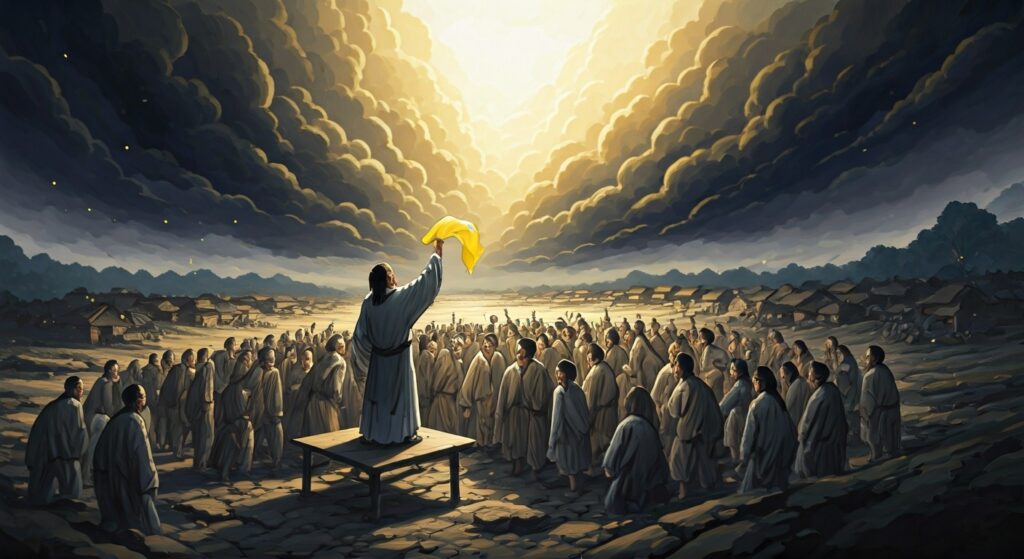
Zhang Jue didn’t have a formal army, but he possessed something far more dangerous: a message. He founded a clandestine sect known as the Way of Supreme Peace (Taiping Dao). Wandering the devastated countryside, he offered the desperate masses faith healing, magical water, and an egalitarian ideology that resonated deeply with people who had absolutely nothing left to lose.
Whispers of the Yellow Sky
What Zhang Jue pulled off remains a historical masterclass in underground logistics and mass organization. Operating entirely under the radar of the imperial court, he united hundreds of thousands of starving peasants across multiple provinces into a massive, synchronized network.
His weapon of choice was a terrifyingly brilliant prophecy. Zhang Jue’s followers began whispering a subversive slogan in the shadows: “The Azure Sky is already dead; the Yellow Sky will soon rise.”
To the Han court, this was high treason. The “Azure Sky” represented the Han Dynasty. Zhang Jue was preaching that the Han’s mandate from heaven had expired, and a new utopian era was imminent. Yellow symbolized the element of earth, which, according to ancient Chinese elemental theory, would naturally overcome the Han’s ruling element.
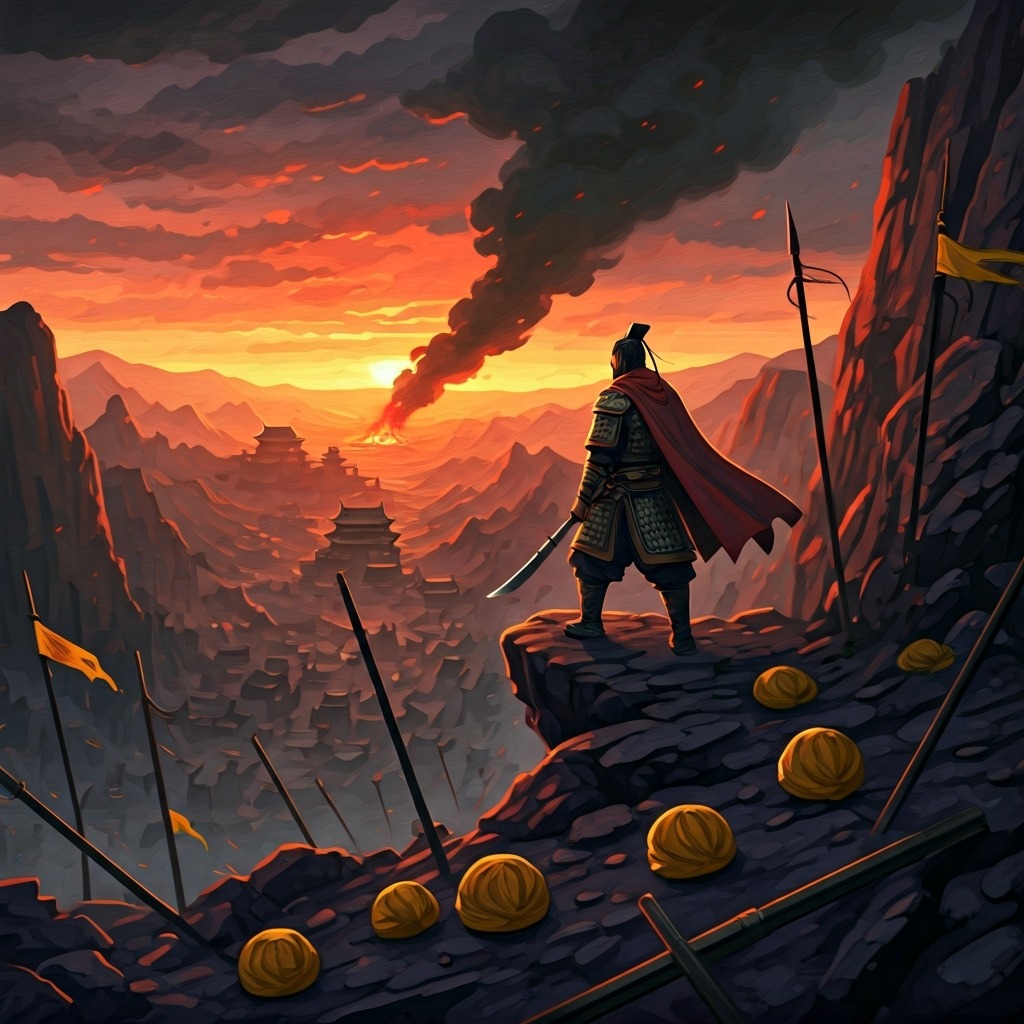
The tipping point arrived in 184 AD, the year of Jiazi in the traditional sexagenary cycle. The signal was given. Across the empire, hundreds of thousands of followers rose up simultaneously. To identify themselves in the chaos of battle, they wrapped yellow cloths around their heads. The Yellow Turban Rebellion had begun.
The Emperor’s Fatal Gamble
The sheer scale of the uprising posed an existential threat to the capital. The imperial army was stretched dangerously thin, and the yellow-clad rebels seemed to be everywhere at once.
In a state of absolute panic, Emperor Ling made a desperate decision that would seal the fate of his dynasty. He authorized regional magistrates and local warlords to raise their own independent armies to crush the insurgency. He effectively outsourced the survival of his empire to anyone with the wealth and ruthlessness to field a militia.
This frantic draft call brought a wave of legendary figures onto the historical stage. Imperial generals like Huangfu Song and Zhu Jun took command, but they were quickly joined by rising local talents—ambitious men whose names would soon echo through history, including Cao Cao, Liu Bei, and Sun Jian.
A Phantom Victory
From a purely military standpoint, the Han’s desperate gamble worked. The newly minted warlords were ruthless and highly efficient. Within a year, the main rebel forces were slaughtered. Zhang Jue died of an illness before he could witness the end of his movement, and his brothers were hunted down and executed.
But the imperial victory was a fatal illusion.
While the Yellow Turbans were defeated, the Han Dynasty had mortally wounded itself. By granting regional warlords the power to raise their own armies, the imperial court had permanently decentralized its military authority. Once these ambitious commanders tasted absolute power, they had no intention of giving it back.
This massive power vacuum plunged China into decades of brutal, unrelenting chaos, ultimately fracturing the empire and leading directly to the legendary, blood-soaked Three Kingdoms period.
Zhang Jue didn’t need to summon the mystical thunderstorms attributed to him in later folklore to destroy the Han Dynasty. He just needed to hand a starving man a yellow piece of cloth and point him toward the capital.