“Plain vanilla.” It is the universal shorthand for boring, standard, the default setting of the flavor world. But peel back the layers of history, and you will find that there is absolutely nothing “plain” about vanilla.
Before it became a baking staple, vanilla was a sacred, fiercely guarded treasure of the Americas. Its story is forged in forbidden romance, bloody sacrifices, global monopolies, and a centuries-old biological lock that baffled the greatest scientific minds of Europe—until it was picked by a twelve-year-old enslaved boy.
Let’s dive into the dark, intoxicating history of the world’s most misunderstood flavor.
The Blood of the Morning Star
Long before Europeans knew it existed, vanilla was cultivated exclusively by the Totonac people in the lush, tropical coastal region of Veracruz, Mexico. They didn’t see it as a mere ingredient; to them, the vanilla orchid was a sacred vine known as caxixanath, or the “hidden flower.”
According to Totonac mythology, the origin of vanilla is rooted in a tragic tale of forbidden love. Princess Tzacopontziza (whose name translates to Morning Star) was the exceptionally beautiful daughter of a powerful Totonac king. Because of her purity and royal blood, she was dedicated to Tonacayohua, the goddess of crops and sustenance. This high honor came with a heavy price: the princess was sworn to remain chaste forever.
But the human heart rarely follows the rules of the gods. A handsome commoner named Zkatka (Flying Deer) fell deeply in love with her. Knowing their affection was a death sentence, the two lovers fled into the dense forest to elope.
Their freedom was agonizingly brief. They were hunted down by the high priests of Tonacayohua and captured. As punishment for their sacrilege, the priests beheaded the young lovers, and their hearts were offered to the goddess.
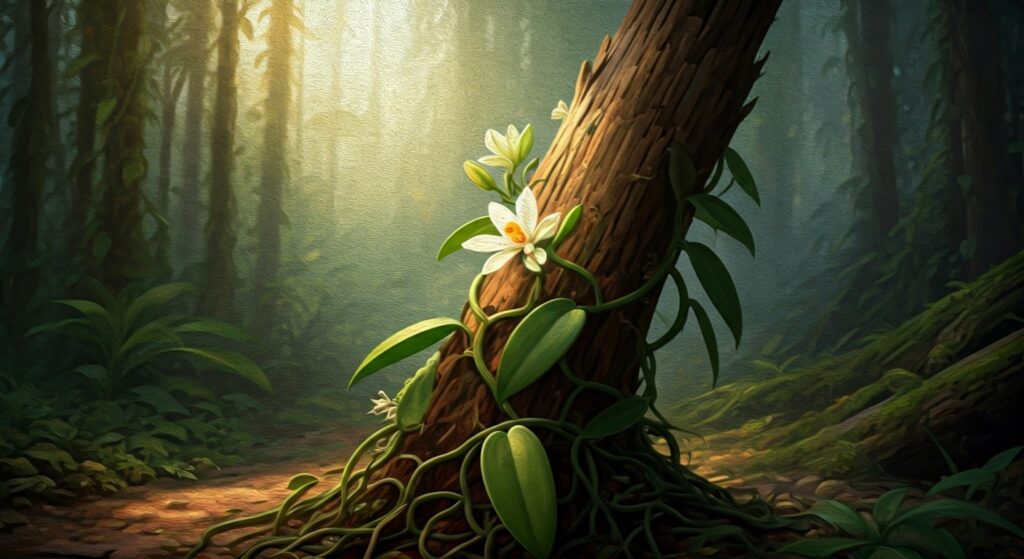
Legend says that on the exact spot where their blood soaked the earth, a robust shrub rapidly grew. Shortly after, a delicate, emerald-green vine sprouted beside it, wrapping its tendrils around the shrub in a tender, eternal embrace. When this vine bloomed and produced dark, slender pods, it released an intoxicatingly sweet aroma. The Totonacs believed the vine was the reincarnated soul of the princess, forever clinging to her lover. From that day on, the plant was declared sacred, and its fragrant pods were offered strictly to their gods.
The Black Flower’s Captors
For centuries, the Totonacs held a strict monopoly on this fragrant treasure. But the aroma of vanilla was too powerful to stay hidden in the forests of Veracruz forever.
In the fifteenth century, the expanding Aztec Empire conquered the Totonacs. The Aztecs quickly became obsessed with the spice. They renamed it tlilxochitl, meaning “black flower,” and demanded vast quantities of it as a tribute. The Aztecs didn’t use vanilla for baking; they famously used it to flavor xocolatl, their legendary, bitter cacao drink.
When Spanish conquistador Hernán Cortés arrived and violently conquered the Aztecs in the early sixteenth century, Emperor Montezuma unknowingly handed over a secret that would change the world. He served Cortés the vanilla-infused chocolate drink. Cortés was captivated. He brought the dark pods back to Europe, where vanilla quickly ignited a sensation across royal courts, becoming a luxury only the ultra-wealthy could afford.
The 300-Year Biological Lock
As global demand for vanilla exploded, colonial powers tried desperately to grow the orchids in their own tropical territories. They planted vines in Asia, Africa, and the Caribbean. The vines grew beautifully, producing lush green leaves and delicate flowers.
But there was a maddening problem: the vines absolutely refused to produce vanilla pods.
For over three hundred years, Mexico retained a total global monopoly on vanilla production. European botanists were baffled. It was a botanical mystery that frustrated the greatest scientific minds of the era.
The secret to Mexico’s monopoly was a highly specialized biological lock. The vanilla orchid could only be pollinated by the Melipona bee, a species native exclusively to Mexico. Without this specific bee to pollinate the flowers, there could be no vanilla pods.
The Boy Who Picked the Lock
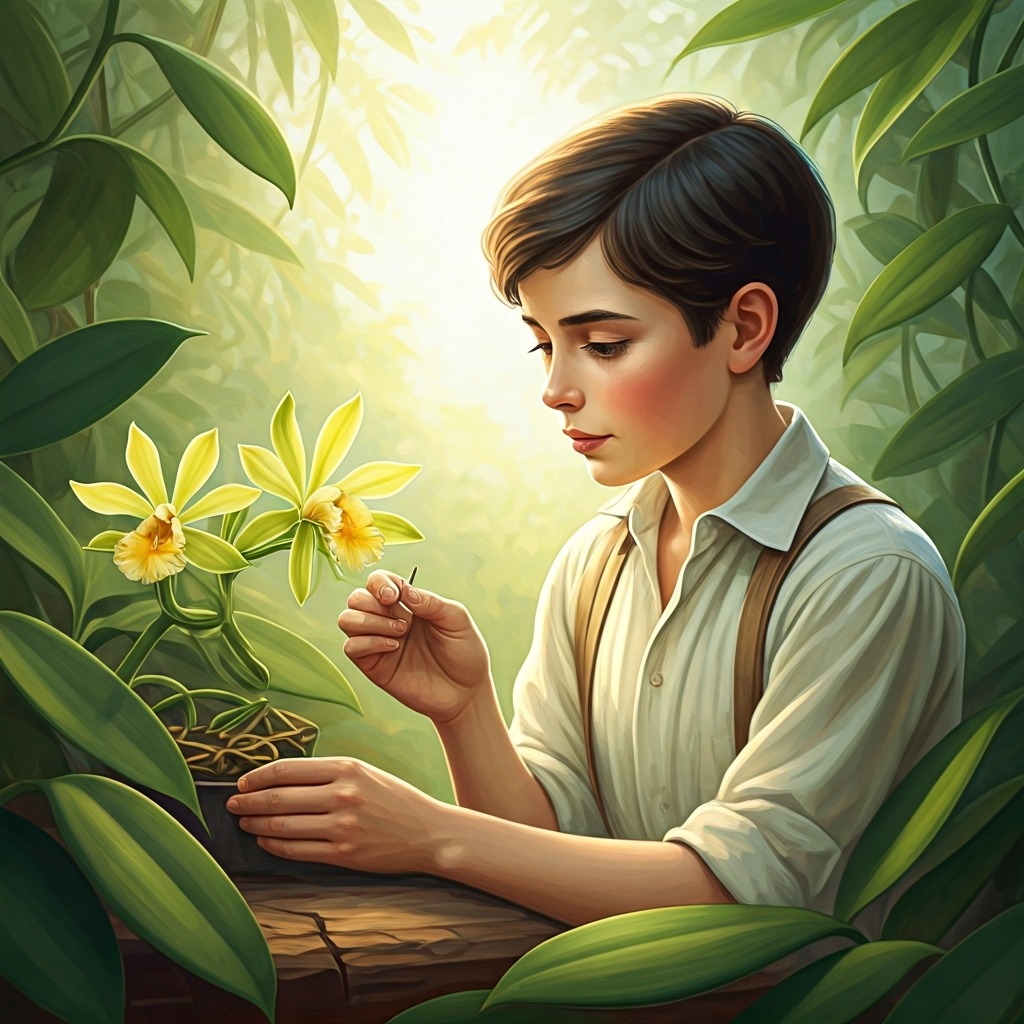
The Mexican monopoly seemed completely unbreakable. But in 1841, the secret was unlocked not by a wealthy European botanist, but by a twelve-year-old enslaved boy named Edmond Albius.
Living on the French island of Réunion in the Indian Ocean, Edmond was a remarkably observant child. While the greatest agricultural minds of Europe were stumped, Edmond discovered a quick and efficient method for hand-pollinating the vanilla flowers using nothing more than a simple stick and a flick of his thumb.
He had successfully hand-pollinated the orchid, entirely bypassing the need for the Mexican bee.
Edmond’s ingenious, devastatingly simple technique broke the 300-year Mexican monopoly overnight. Thanks to him, vanilla could finally be cultivated in tropical climates all around the world, transforming it from a localized Totonac treasure into the ubiquitous global flavor we know today.
So, the next time you scoop a bowl of “plain” vanilla ice cream, take a moment to savor it. You are tasting the legacy of an ancient goddess, a doomed princess, an exclusive Mexican bee, and the brilliant young boy who gave the world its favorite flavor.