The ocean is a terrifying, freezing, endless void. Throughout history, maritime disasters have tested the limits of human endurance, but one story stands apart. It isn’t just a tale of a shipwreck; it is a masterclass in human depravity, political arrogance, and sheer terror.
This is the story of the Méduse.
A Recipe for Ruin
In July 1816, a French frigate called the Méduse was leading a flotilla down the coast of Africa. Its mission was straightforward: sail to Saint-Louis, Senegal, and reclaim the colony from the British following the Bourbon Restoration.
But the French monarchy made a fatal error before the ship even left port. They handed command to Hugues Duroy de Chaumareys.
Chaumareys was a royalist who hadn’t sailed in twenty years. He didn’t get the job because he was a brilliant mariner; he got it purely through political cronyism. Once at sea, his arrogance blinded him. He completely ignored his experienced officers and instead relied on a wildly unqualified passenger to navigate the ship.
On July 2, 1816, the inevitable happened. The Méduse violently ran aground on the Arguin Bank off the coast of Mauritania. The ship was stuck fast. The hull was compromised. And as the crew looked out at the unforgiving Atlantic, a terrifying mathematical reality set in.
There were roughly 400 passengers and crew on board. They only had enough lifeboats for about 250.
The Coward’s Cut
Panic is a highly combustible element, and on the Méduse, it ignited instantly. To solve the lifeboat shortage, the crew hastily lashed together a massive, crude wooden raft measuring roughly 20 by 7 meters.
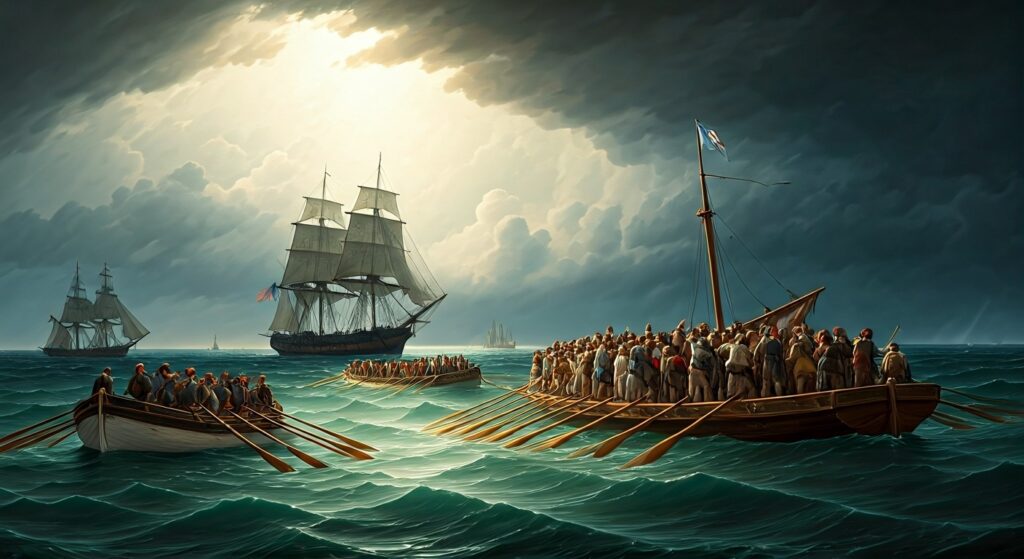
The plan was supposedly simple: the governor, Captain Chaumareys, and the wealthy elites would take the lifeboats, and they would tow the heavily laden raft behind them to the safety of the shore.
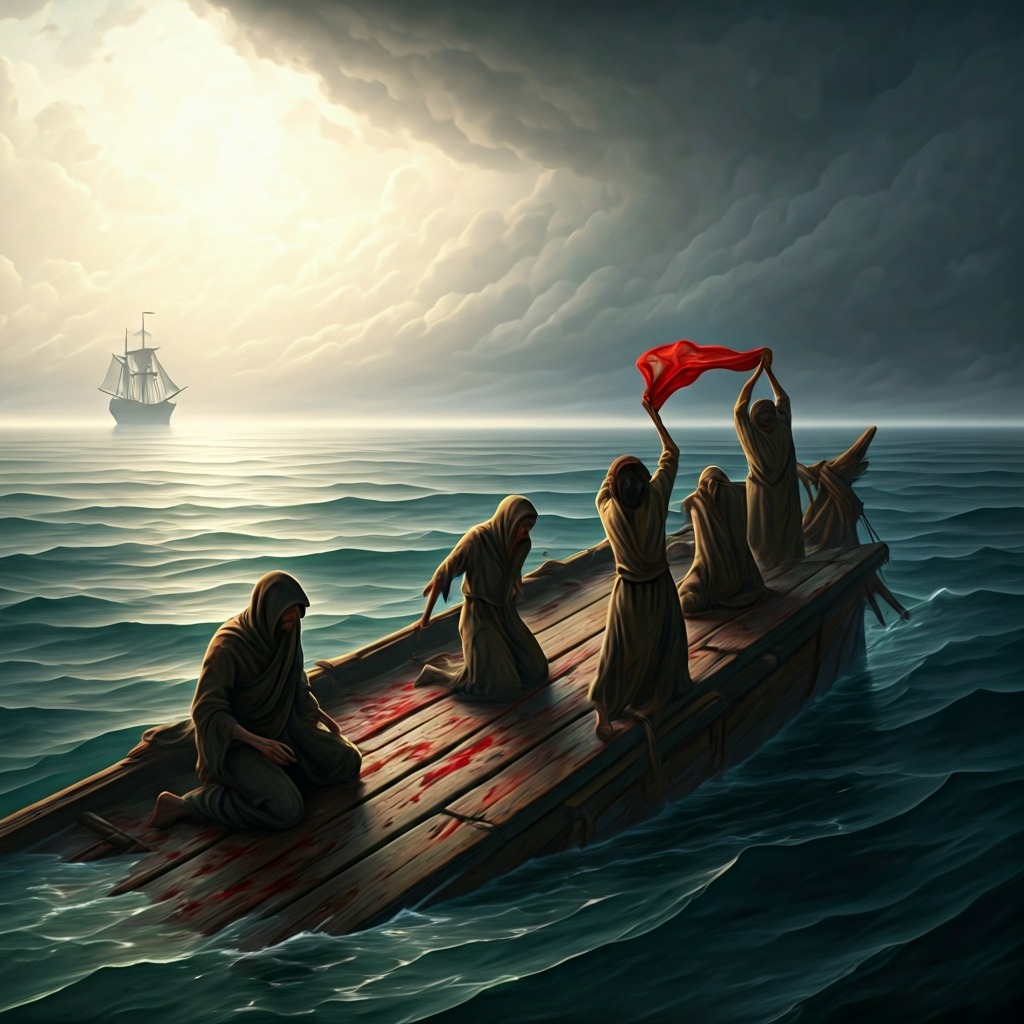
A total of 147 people—mostly soldiers, ordinary sailors, and lower-class passengers—were forced onto the unstable wooden structure. The moment they stepped aboard, the raft sank under their combined weight, leaving them standing in waist-deep ocean water.
For a brief moment, the lifeboats began to row, pulling the heavy raft behind them. But progress was agonizingly slow. The elites in the lifeboats, terrified that the desperate souls on the raft might try to swamp their boats, made a cowardly, unthinkable decision.
They took out their knives. They cut the tow ropes.
Just like that, 147 people were abandoned to the open ocean. Their supplies? A single box of biscuits, two casks of water, and several casks of wine.
Descent into Madness
The descent into madness on the raft didn’t take weeks. It took hours.
By the second night, the combination of terror, exposure, and cheap wine caused the social order to violently disintegrate. Drunken mutinies erupted in the dark. Soldiers and officers engaged in brutal hand-to-hand combat, slipping on the blood-slicked, submerged logs. Dozens were murdered in the pitch black, washed overboard by the waves, or driven to suicide by the sheer hopelessness of their situation.
When the biscuits and water ran out, a grim triage began. The strongest survivors, realizing the wine wouldn’t last, conspired to throw the weak and dying overboard.
And then, the unimaginable happened. To stay alive, the remaining men resorted to cannibalism, consuming the flesh of their fallen crewmates. The raft became a floating slaughterhouse.
Immortalized in Rotting Flesh
On July 17, after 13 days of unimaginable agony, a sister ship named the Argus stumbled upon the drifting raft.
Of the original 147 people, only 15 men were still alive. They were emaciated, traumatized, and barely human. Five of them were so far gone that they died shortly after being rescued.
When the news reached France, the public outrage was explosive. The sheer callousness of the royalist leadership severely damaged the reputation of the restored Bourbon monarchy. Two of the survivors, surgeon Jean-Baptiste Savigny and engineer Alexandre Corréard, refused to let the dead be forgotten. They published a harrowing, unfiltered account of the disaster that shocked the world.
But the story didn’t end in the history books. It was immortalized in paint.
Artist Théodore Géricault became obsessed with the tragedy. He conducted exhaustive research, interviewing survivors and even bringing severed limbs and corpses into his studio to study the accurate pallor of rotting flesh. The result was his monumental 1819 painting, The Raft of the Medusa.
When you look at that painting today, you aren’t just looking at a masterpiece of art. You are looking at a visceral indictment of arrogance, and a terrifying reminder of what happens when humans are stripped of everything but the will to survive.