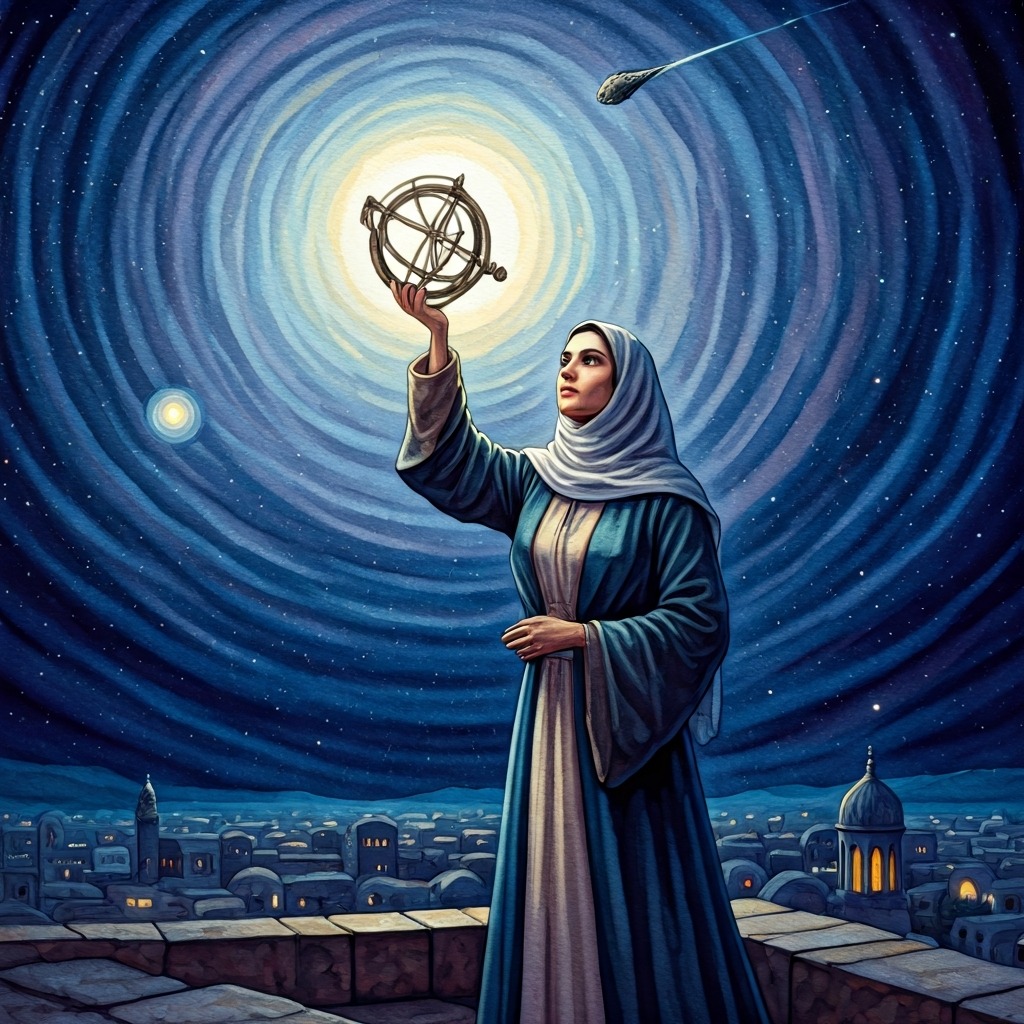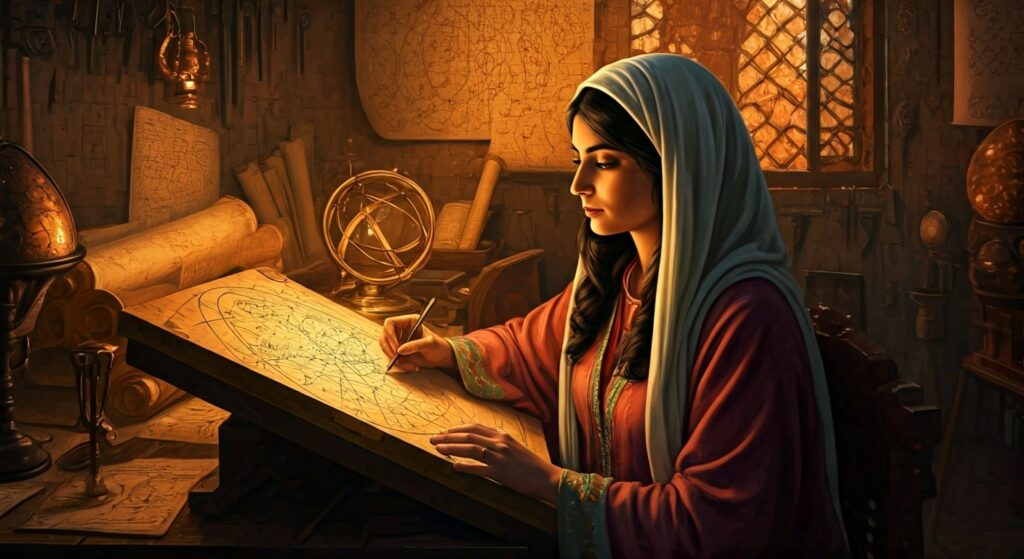
A thousand years ago, a woman built the universe out of brass. She mastered a terrifyingly complex science, caught the eye of a ruthless warlord, and then seemingly vanished into the sands of time.
Her name was Al-‘Ijliya bint al-‘Ijli al-Asturlabi—remembered today simply as Mariam al-Asturlabi. She was a titan of the Islamic Golden Age, an era when the Middle East was the undisputed intellectual engine of the world. But to truly understand the magnitude of her genius, we must first understand the machine she mastered.
The Brass Computer of the Ancients
Imagine trying to navigate the globe, predict the sunrise, and map the stars, all without a battery, a screen, or a satellite. In the 10th century, there was only one tool capable of this magic: the astrolabe.
An astrolabe was essentially an early analog computer and a GPS device combined. By manipulating its moving metal parts—specifically the intricately carved rete and the underlying plates—navigators and astronomers could calculate their exact latitude and predict the positions of celestial bodies.
In the Islamic world, the astrolabe was more than just a scientific curiosity; it was a religious necessity. It was the key to accurately determining the Qibla (the direction of Mecca) and calculating the highly specific, sun-dependent times for the five daily prayers.
Building one of these devices wasn’t just a matter of hammering out some brass. It required a terrifyingly deep understanding of spherical trigonometry and celestial mechanics, paired with the delicate, unforgiving metallurgical skills of a master jeweler. One millimeter of error in the engraving, and your calculations would be thrown wildly off course.
It was a fiercely guarded, male-dominated trade. So how did a young woman in 10th-century Syria become one of its greatest masters?
Whispers from the Aleppo Workshop
Mariam grew up in Aleppo under the Hamdanid dynasty, surrounded by the scent of hot metal and the dizzying scratch of mathematical equations. She learned this intricate trade from her father, who was himself an apprentice to Nastulus—a legendary artisan renowned for creating the oldest surviving astrolabe.
Growing up in the shadow of such titans, Mariam didn’t just learn the applied science of her day; she bent it to her will. She learned to map the heavens onto flat discs of brass, her hands translating the chaotic beauty of the night sky into precise, mathematical scales.
Soon, her reputation eclipsed the very workshop that forged her.
Summoned by the Warlord
In the ancient world, brilliant minds were the ultimate status symbol. Sayf al-Dawla, the powerful Emir of Aleppo who reigned from 944 to 967 CE, was a ruthless warrior, but he was also a legendary patron of the arts and sciences. His court was a glittering assembly of the era’s greatest minds, hosting luminaries like the philosopher Al-Farabi and the poet Al-Mutanabbi.
When whispers of a female astrolabe maker with unparalleled technical expertise reached the Emir, he didn’t dismiss her. He summoned her.
Mariam was brought into the royal court. Working for Sayf al-Dawla meant her astrolabes weren’t just decorative playthings. They were instruments of state power, likely used for state-sponsored astronomical observations, military navigation, and official royal timekeeping. She had reached the absolute pinnacle of her field.
A Ghost in the Archives
Here is where the mystery deepens. If Mariam was so brilliant, where are her astrolabes?
The tragic truth of history is that metal is easily melted down, repurposed, or lost to war and time. Not a single astrolabe bearing Mariam’s signature is known to have survived to the modern day. For centuries, she teetered on the edge of being completely erased from human memory.
But she wasn’t. She survived because of a single, monumental book.
In the late 10th century, a Baghdadi scholar named Ibn al-Nadim set out to compile a comprehensive catalog of all known books and scholars. In his magnum opus, the Al-Fihrist, he dedicated a section to the makers of astronomical instruments. Right there, etched into the historical record, Ibn al-Nadim explicitly names Al-‘Ijliya, noting her prestigious lineage and her employment by Sayf al-Dawla.
That brief, tantalizing mention is the ultimate proof that women were not just passive observers during the Islamic Golden Age. They were active, high-ranking participants in STEM, recognized and elevated for their technical merit.
Reclaiming Her Place in the Sky
Today, Mariam al-Asturlabi is rightfully celebrated as a pioneer who shatters the modern misconception that historical women were entirely locked out of technical fields.
Her legacy continues to ripple through time in the most beautiful ways. She inspired the character of Mariam in Nnedi Okorafor’s brilliant sci-fi novella Binti. And in 1990, the International Astronomical Union looked up at the very stars Mariam once mapped and named the main-belt asteroid 7060 Al-‘Ijliya in her honor.
So, the next time you pull up a GPS app on your phone to find your way, take a second to remember the phantom genius in 10th-century Aleppo who helped lay the groundwork for it all, holding the universe in her brass-stained hands.