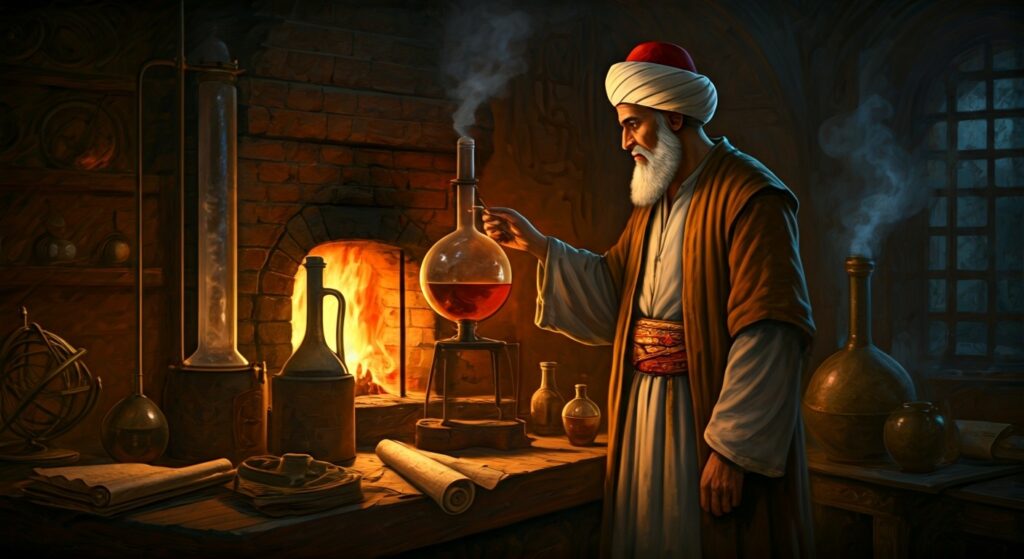
Deep in the glittering heart of the 8th-century Islamic Golden Age, a scholar stood before a roaring furnace, attempting to play God. Abu Musa Jabir ibn Hayyan was not interested in the mundane. He was consumed by a singular, high-stakes obsession: he was trying to manufacture gold.
He would never find it. But what he accidentally pulled from the flames would change the trajectory of human history forever.
The Alchemist’s Obsession
Jabir ibn Hayyan—often Latinized as ‘Geber’ in the West—is widely regarded today as the father of early chemistry. Like many brilliant minds of his era, Jabir was captivated by the alchemical quest to find al-iksir: the elusive philosopher’s stone. The prevailing belief of the age was that all metals were forged from the same fundamental principles. By perfectly rebalancing their natures, an alchemist could theoretically transmute base metals, like lead, into pure, unadulterated gold.
But Jabir was no mere mystic whispering incantations over a boiling cauldron. He was a pioneer of rigorous, empirical experimentation. The meticulous records left behind by his school reveal a man who demanded absolute precision.
To achieve his transmutation, Jabir heavily utilized and refined the al-anbiq (the alembic), a distillation apparatus designed to separate and purify substances through intense heating and condensation. Yet, he faced a massive roadblock. At the time, the strongest solvents available to alchemists were weak organic acids, like vinegar and citrus juices. If you want to break down the fundamental building blocks of the earth, lemon juice simply isn’t going to cut it.
Jabir needed something stronger. He needed a liquid with teeth.
Unleashing the Monster in the Flask
Driven by relentless curiosity, Jabir began dry-distilling various crystalline minerals. He placed vitriols—specifically green vitriol (iron sulfate) and blue vitriol (copper sulfate)—alongside alum into his alembic, stoking his furnace to punishingly high temperatures.
Inside the glass, a violent, invisible reaction was taking place. The intense heat caused the minerals to break down, releasing an acrid, choking vapor: sulfur trioxide gas. As this toxic gas rose through the neck of the alembic, it met with water vapor. The two bound together, condensing into heavy droplets that slid down the glass and pooled in the receiving flask.
When the glass finally cooled, Jabir hadn’t created the philosopher’s stone. Instead, he found a dense, oily, highly corrosive liquid. He called it “oil of vitriol.”
Today, we know it as sulfuric acid.
This accidental discovery was an absolute earthquake in the scientific world. The isolation of mineral acids unlocked entirely new realms of chemical reactions. Suddenly, alchemists could dissolve metals, create new salts, and strip compounds down to their barest elements. It fundamentally shifted human knowledge, dragging the mystical art of alchemy out of the shadows and laying the concrete groundwork for modern chemistry.
The Great 13th-Century Identity Theft
Here is where the story takes a sharp, mysterious turn. If you try to track down the exact moment Jabir first synthesized this acid, you run into a massive historiographical roadblock known by scholars as the “Geber problem.”
The Jabirian corpus is suspiciously vast, with over 3,000 texts attributed to his name. No single human being could have written that much complex scientific literature in one lifetime. Historians now believe that many of these texts were actually penned by later generations of his devoted followers.
The plot thickens centuries later in Europe. In the 13th century, an anonymous European alchemist—likely a man named Paul of Taranto—began writing groundbreaking texts under the name “Pseudo-Geber.” His masterwork, the Summa perfectionis, contains the most explicit early European recipes for mineral acids. By stealing the legendary Jabir’s name, Pseudo-Geber guaranteed his books would be read, respected, and preserved.
Yet, even behind the smokescreen of medieval identity theft, modern historians agree: the foundational techniques for distilling vitriols to produce strong acids originated squarely in the Arabic alchemical tradition pioneered by the historical Jabir. The forged European texts were simply building upon a Middle Eastern foundation.
The Corrosive Blood of the Modern World
Jabir ibn Hayyan never found the recipe for gold. But the irony of history is that his accidental byproduct turned out to be infinitely more valuable.
Today, sulfuric acid is the most widely produced chemical in the entire world, with hundreds of millions of tons manufactured every single year. It is the undisputed, corrosive lifeblood of global industry. In fact, economists frequently use a nation’s sulfuric acid production volume as a reliable indicator of its overall industrial strength.
Without Jabir’s “oil of vitriol,” the modern world would grind to a halt. It is essential for the production of phosphate fertilizers, which literally sustain global agriculture and feed billions. It is required for petroleum refining, wastewater processing, metal extraction, and the manufacturing of everything from synthetic fibers to the lead-acid batteries in our cars.
A medieval scholar, sweating over a blazing furnace in the 8th century, trying to turn lead into a precious metal, ended up giving humanity something far better. He didn’t give us gold. He gave us the key to building the modern world.